Two things separate sports bettors who survive from the ones who don’t: probability and bankroll. Most people learn neither. That’s why most people lose, even some who actually know what they’re picking.
Probability
The breakeven number
At standard -110 juice, where most spreads and totals trade, you need to win 52.4% of your bets to break even. The juice eats the difference. The break-even calculator returns the number for any price. On a prediction market the two sides price to about 100% instead. There’s no juice baked in to beat.
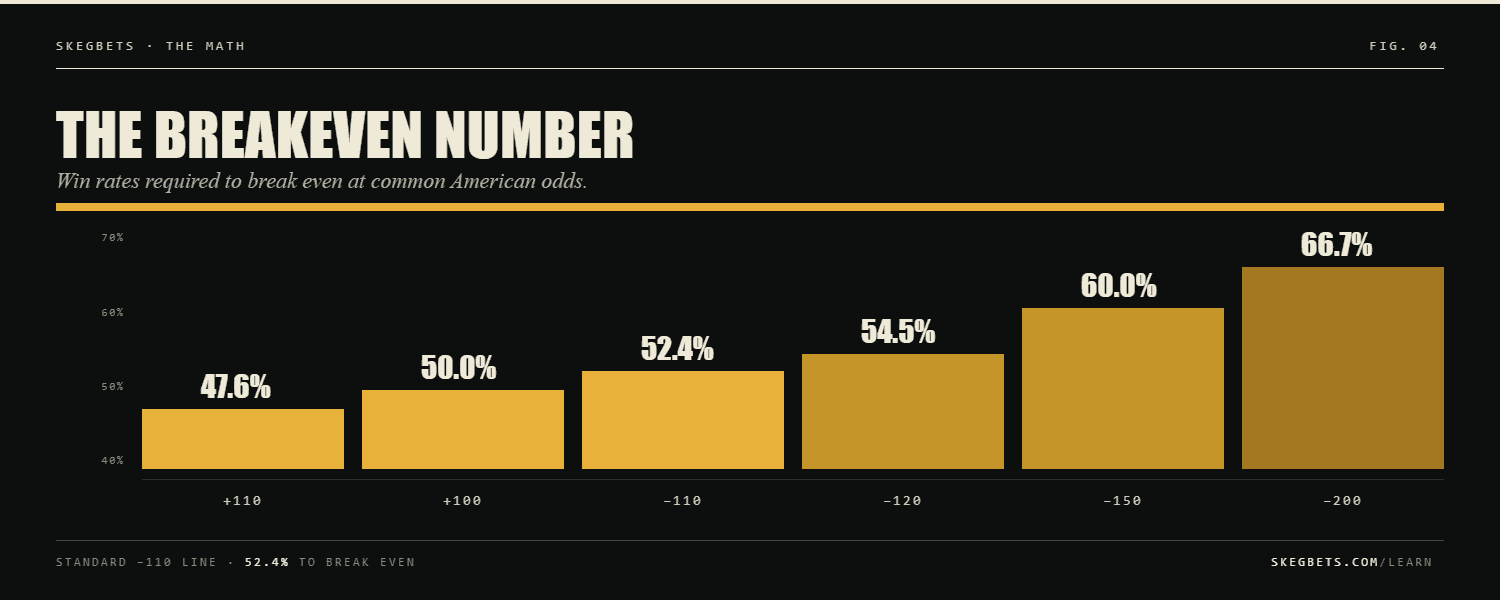
| Price | Breakeven win rate |
|---|---|
| +110 | 47.6% |
| +100 | 50.0% |
| -110 | 52.4% |
| -120 | 54.5% |
| -150 | 60.0% |
| -200 | 66.7% |
This is why someone hitting 65% on heavy favorites can still bleed money over time. A win rate without the price attached tells you almost nothing.
What “sharp” means
Professional sports bettors hit 53% to 55% on standard -110 lines. That sounds barely above coin flip because it is barely above coin flip. The 3% to 6% ROI that turns into real money over years comes from compounding a tiny edge over thousands of bets, not from picking like a genius on any given night.
Anyone claiming sustained 60%+ over thousands of bets is showing you their best stretch or making it up. The math doesn’t allow that number to hold.
Variance
Over short stretches, the edge disappears into noise. Here’s the win-rate distribution for a true 53% bettor at different sample sizes (95% range of observed results):
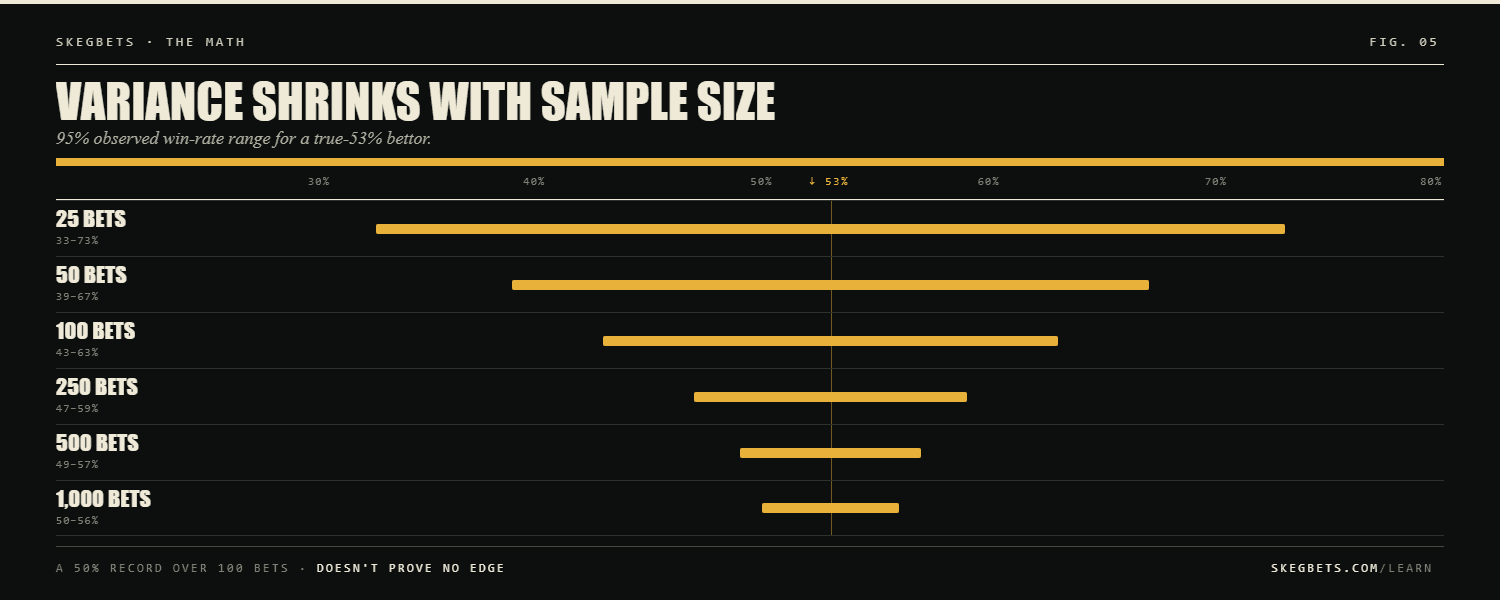
| Sample size | 95% win-rate range |
|---|---|
| 25 bets | 33% to 73% |
| 50 bets | 39% to 67% |
| 100 bets | 43% to 63% |
| 250 bets | 47% to 59% |
| 500 bets | 49% to 57% |
| 1,000 bets | 50% to 56% |
A bettor with professional-level skill can show anywhere from 43% to 63% over 100 bets purely by chance. Identical skill and process, just different luck on which side of the band the sample lands.
That’s the thing most bettors miss. A 50% record over 100 bets doesn’t prove no edge. A 60% record doesn’t prove edge either. Both are possible from a true 53% skill level. Different sample, different luck.
Losing streaks
Inside any 100-bet sample, losing streaks of 5, 6, or 7 are normal. Here’s the probability of a true 53% bettor hitting at least one streak of N consecutive losses over 100 bets:
| Streak length | Probability over 100 bets |
|---|---|
| 4 in a row | 99% |
| 5 in a row | 88% |
| 6 in a row | 61% |
| 7 in a row | 37% |
| 8 in a row | 19% |
A 7-loss streak inside any 100 bets is about a 1-in-3 event. It isn’t rare and it doesn’t mean anything is broken. It just happens. This is the moment where most amateurs panic, and where the second half of the math, bankroll, decides who walks away with anything.
Bankroll
Bankroll is the actual game
Probability tells you what your edge looks like over time. Bankroll tells you whether you survive long enough for “over time” to arrive. Even a true 60% bettor goes broke if they bet 20% of their bankroll per game and hit a 5-loss streak.
The math has no opinion about who deserves to come back. A bankroll that hits zero stays at zero.
Flat betting
Pros bet flat. Every bet is the same size, usually 1% to 2% of bankroll. It sounds boring because it is boring. It’s also what survives variance.
The alternative, sometimes called Martingale, or doubling up to recover, mathematically guarantees ruin given enough bets. Variance always wins that fight.
Drawdown math
Losing streaks compound into bankroll drawdowns. The deeper the hole, the longer the climb out, even with the edge fully intact.
At +1.2% ROI per bet (a typical sharp), recovering from a drawdown takes a brutal amount of action:
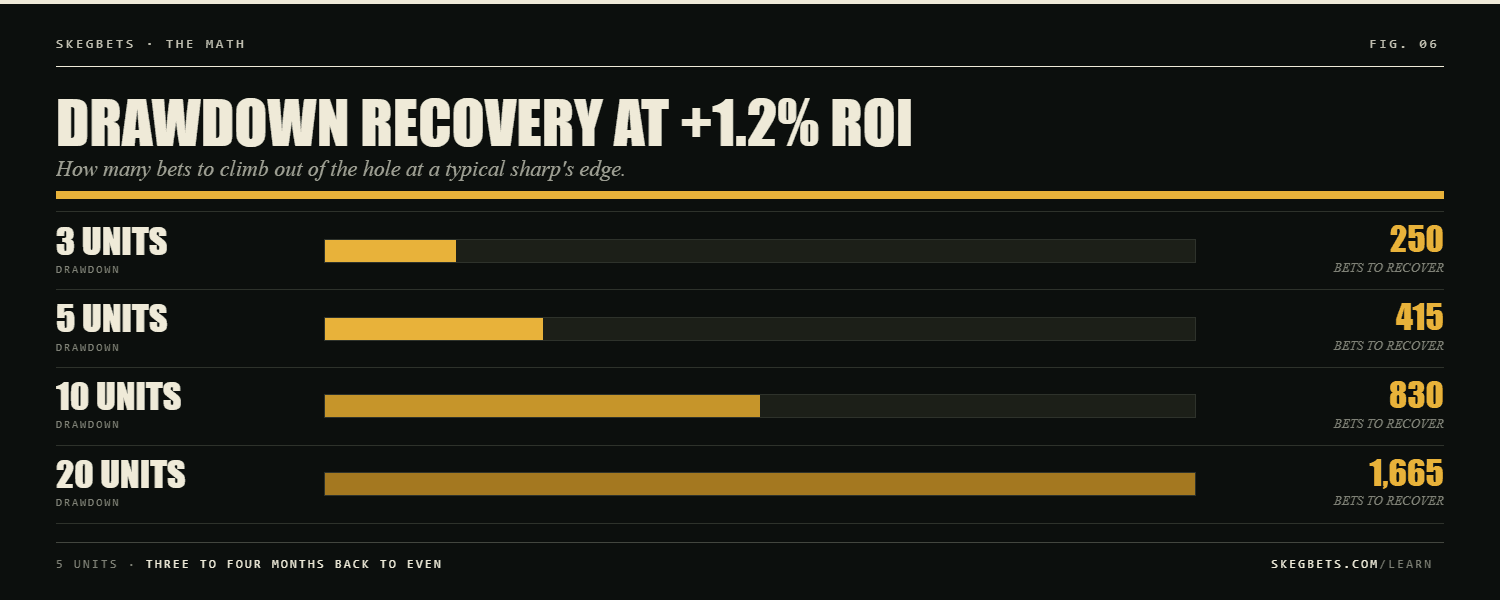
| Drawdown | Bets to recover at +1.2% ROI |
|---|---|
| 3-unit drawdown | 250 bets |
| 5-unit drawdown | 415 bets |
| 10-unit drawdown | 830 bets |
| 20-unit drawdown | 1,665 bets |
That 5-unit drawdown alone is three to four months of typical betting just to climb back to even.
This is why position sizing matters more than picks. A genius handicapper betting too aggressively goes broke. A mediocre handicapper sizing correctly stays in the game long enough to learn.
Unit size
Unit size is the percentage of total bankroll risked on a single bet. Pros stake 1% to 2% per bet, small enough that any realistic losing streak does not threaten survival.
What a 7-loss streak does at different unit sizes:
| Unit size | Bankroll lost on a 7-loss streak |
|---|---|
| 1% per bet | 7% (easy recovery) |
| 2% per bet | 14% (reasonable recovery) |
| 5% per bet | 35% (requires sustained 60%+ for months) |
| 10% per bet | 70% (nearly impossible) |
A 10-loss streak at 5% per bet puts you 50% in the hole. At 10% per bet, you are essentially out.
What the math adds up to
Probability tells you what your true edge is. Bankroll tells you whether you survive variance long enough to realize it. Either one without the other does not work.
A bettor with no edge betting flat 1% units loses slowly. A bettor with real edge betting 5% to 10% units usually loses anyway, because variance bankrupts them before the edge compounds.
Bettors who survive are the ones who get both right. The 53% win rate that turns profitable does so because the bettor stayed flat through losing streaks and bet enough total volume for the edge to compound.
Practical takeaways
What to do with this
Probability tells you what is possible. Bankroll tells you whether you are still around to find out. Most bettors lose because they understand one and ignore the other, usually because the math feels boring next to the picks.
The math is the game. The picks are where the math gets paid out. If you are still finding the basics, start with how to bet on sports and bring the numbers back here.
Frequently asked questions
What win rate do I need to break even on a sports bet?+
At standard -110 odds, you need to win 52.4% of your bets to break even. The juice eats the difference. Plus-money prices need fewer wins (47.6% at +110), +100 is the even-money 50% pivot, and heavier favorites need many more (60.0% at -150, 66.7% at -200).
What's a realistic win rate for a professional sports bettor?+
Sustained 53% to 55% on standard -110 lines is sharp. The 3% to 6% ROI that compounds into real money over years comes from a small edge applied across thousands of bets, not from picking like a genius any single night. Anyone claiming sustained 60%+ over thousands of bets is showing you their best stretch or making it up.
What is bankroll management in sports betting?+
Sizing each bet as a fixed percentage of your total bankroll, typically 1% to 2%, so any normal losing streak doesn't threaten your survival. Flat betting at 1% to 2% is what mathematically works; doubling-up (Martingale) systems guarantee ruin given enough bets.
What unit size should I bet?+
1% to 2% of your bankroll per bet. A 7-loss streak, about a 1-in-3 event over any 100 bets, costs only 7% to 14% of your bankroll at that size. At 5% per bet the same streak costs 35%; at 10% per bet it costs 70% and is essentially unrecoverable.
How long does it take to recover from a betting drawdown?+
At a typical sharp's +1.2% ROI, recovering 5 units takes about 415 bets, three to four months of typical action. A 10-unit hole takes 830 bets; 20 units takes 1,665. This is why position sizing matters more than picks: the same drawdown costs vastly more action when units are large.
Want to apply the math to your own bets? Our Kelly Criterion calculator sizes bets by edge, the break-even calculator shows the win rate each price demands, and our public archive tracks every published pick W/L/P with closing-line value attached. The same vig math is what tells you a sportsbook bonus’s real value, once the rollover is paid.
Free tools