A football record is a noisy thing. A few bounces of an oblong ball, a couple of close games, and a good team can look mediocre or a lucky one elite. The numbers that cut through that noise are the ones a sharp bettor reads before the record ever enters the conversation.
Describe vs predict
Sort the box score by one test and the clutter clears: does this number record a result, or does it forecast one? Records and point totals are receipts. EPA and efficiency are leading indicators. Lines get priced off the receipts, so the edge lives with the indicators.
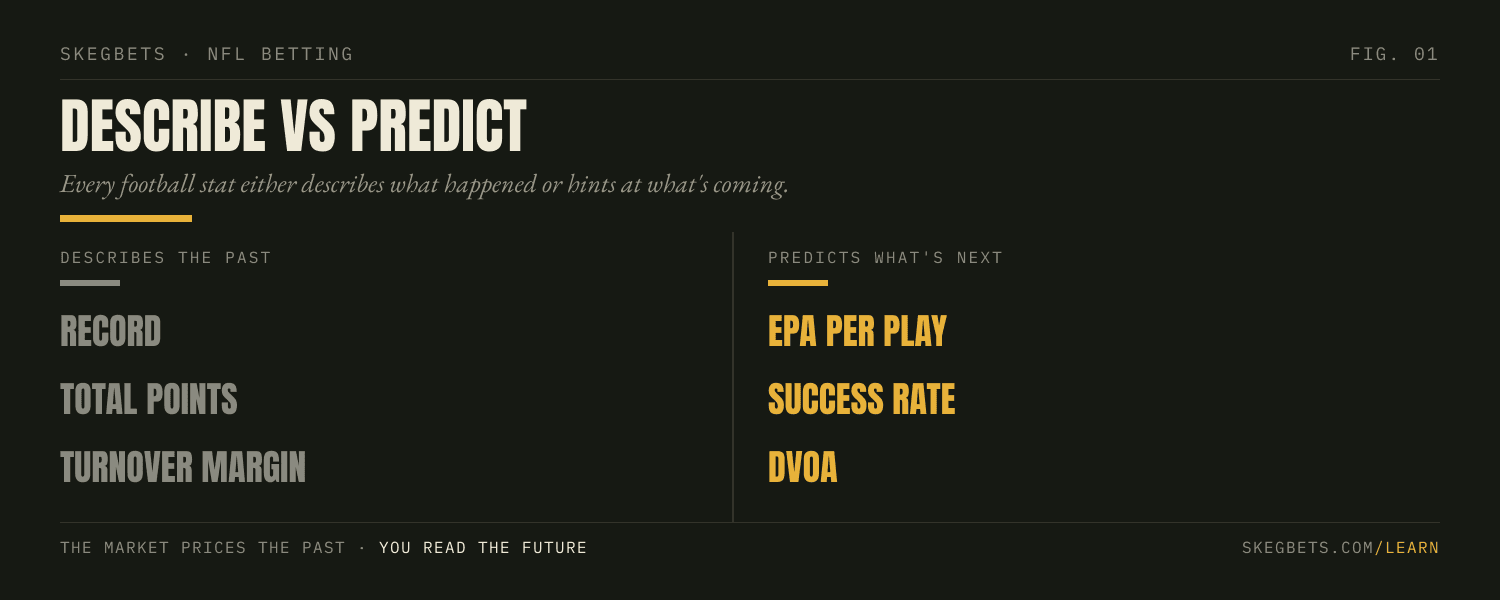
Record, total points, and turnover margin describe. Expected points added, success rate, and DVOA predict. Trade the numbers for a different sport and the test still sorts them, so once it clicks here it carries over to baseball stats, basketball stats, and hockey stats.
EPA and success rate
Two numbers do most of the work of judging a football team, and neither is on a standard box score.
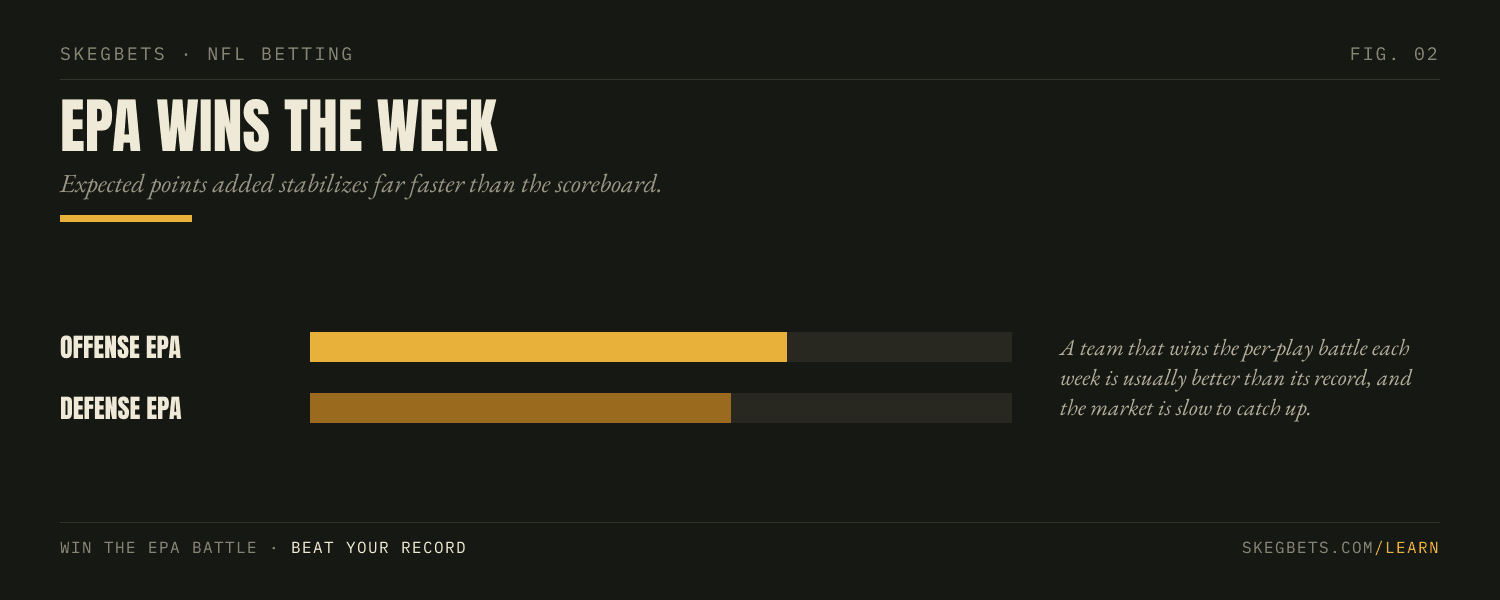
Expected points added per play rewards moving the ball in ways that actually produce points, and it stabilizes far faster than the scoreboard. Success rate measures consistency, the share of plays that stay on schedule, so a high-success offense is more reliable to back than a big-play offense that lives and dies on a few snaps. DVOA wraps both in an opponent-adjusted rating. A team winning these but losing close games is usually better than its record, and the market is slow to catch up. All three sit on our NFL stats pages.
Turnovers and the record
When a team’s record looks far better or worse than how it has played, one stat usually explains it, and warns you it won’t hold.
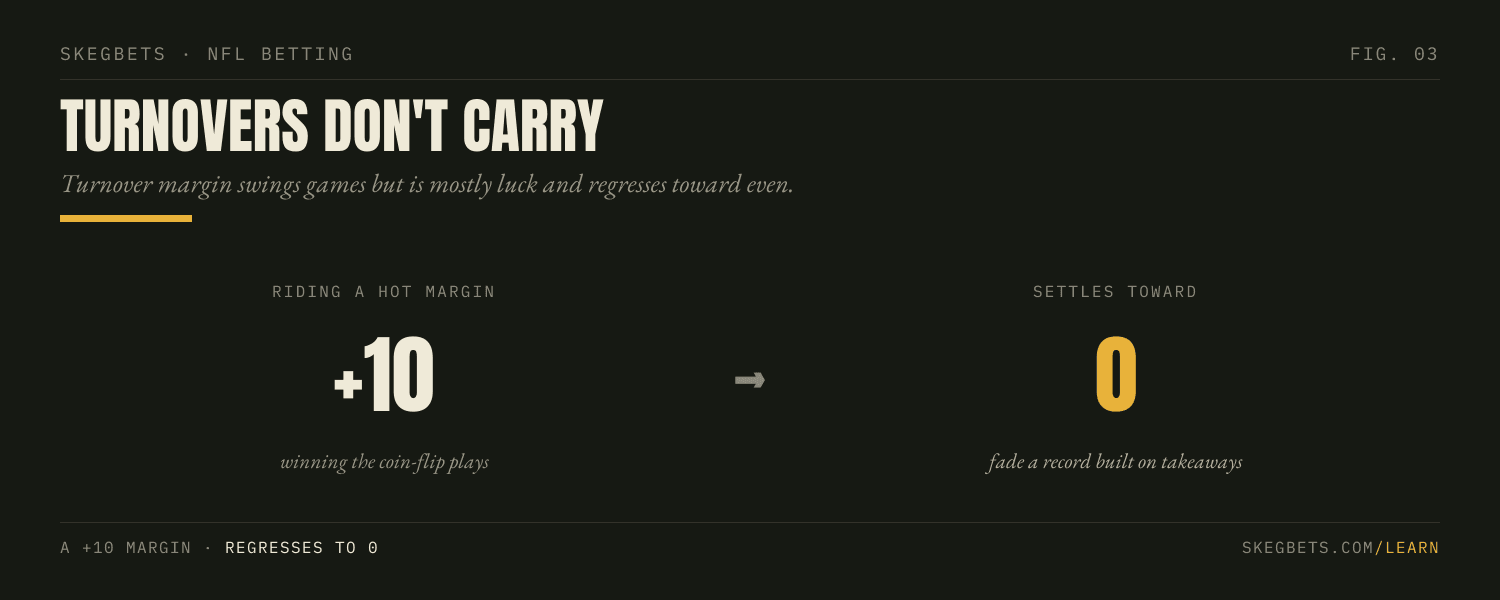
Turnover margin swings outcomes but is mostly luck, especially which team falls on the loose ball, and it does not carry from week to week. A team riding a big positive margin has been winning the coin-flip plays and tends to regress toward even. Fading a record built on takeaways, once the efficiency numbers disagree with it, is one of the steadiest angles in football.
Pricing the number, not the record
Build your read from EPA and success rate, use turnover margin as a check on whether the record is earned or borrowed, and let DVOA settle the close calls on schedule strength. A spread or total is just a number priced off everything the public can see, and the public mostly sees wins and losses. The bettor who has already discounted a lucky 7-2 start is buying at a discount the market has not woken up to yet, which is all expected value really amounts to.
| Stat | What it is | Describes or predicts |
|---|---|---|
| Record / points | What already happened | Describes |
| EPA per play | Points added each snap | Predicts |
| Success rate | Share of on-schedule plays | Predicts |
| DVOA | Opponent-adjusted efficiency | Predicts |
| Turnover margin | Takeaways minus giveaways | Luck gauge |
Frequently asked questions
What is EPA in football?+
Expected points added measures how much each play changes a team's expected points, given the down, distance, and field position. Summed up, EPA per play is the cleanest single measure of how well an offense or defense is actually performing, and it predicts future scoring far better than past points do.
What is DVOA?+
Defense-adjusted Value Over Average, an efficiency rating that compares a team's success on every play to a league baseline and adjusts for the strength of the opponent. It rewards consistent, situation-appropriate play and strips out the schedule, which makes it a strong predictive measure of team quality.
What is success rate?+
The share of plays that gain enough yardage to be a win for the offense, roughly 40% of needed yards on first down, 60% on second, and a conversion on third or fourth. It captures consistency rather than big plays, and consistent teams are more reliable to bet than boom-or-bust ones.
Does turnover margin predict future games?+
Barely. Turnover margin swings games but is largely luck and does not carry from week to week, especially fumble recoveries. A team riding a big positive turnover margin is usually due to regress, so fading an inflated record built on takeaways is a classic edge.
For the full picture, start with how to bet on football, apply it to player props, and read every metric on our NFL stats pages.
Free tools