A baseball box score is a wall of three-digit numbers, and most of them are lying to you a little. Batting average and ERA describe what happened; a bettor needs to know what’s likely to happen next. The good news is that the stats which actually predict are not hard to read once you know which ones to trust.
Hitting: past the batting average
Batting average is the first stat anyone learns and the least useful one for betting. It counts hits per at-bat and nothing else, treating a single and a grand slam as equals and ignoring walks completely. Every stat that came after it exists to fix one of those blind spots.
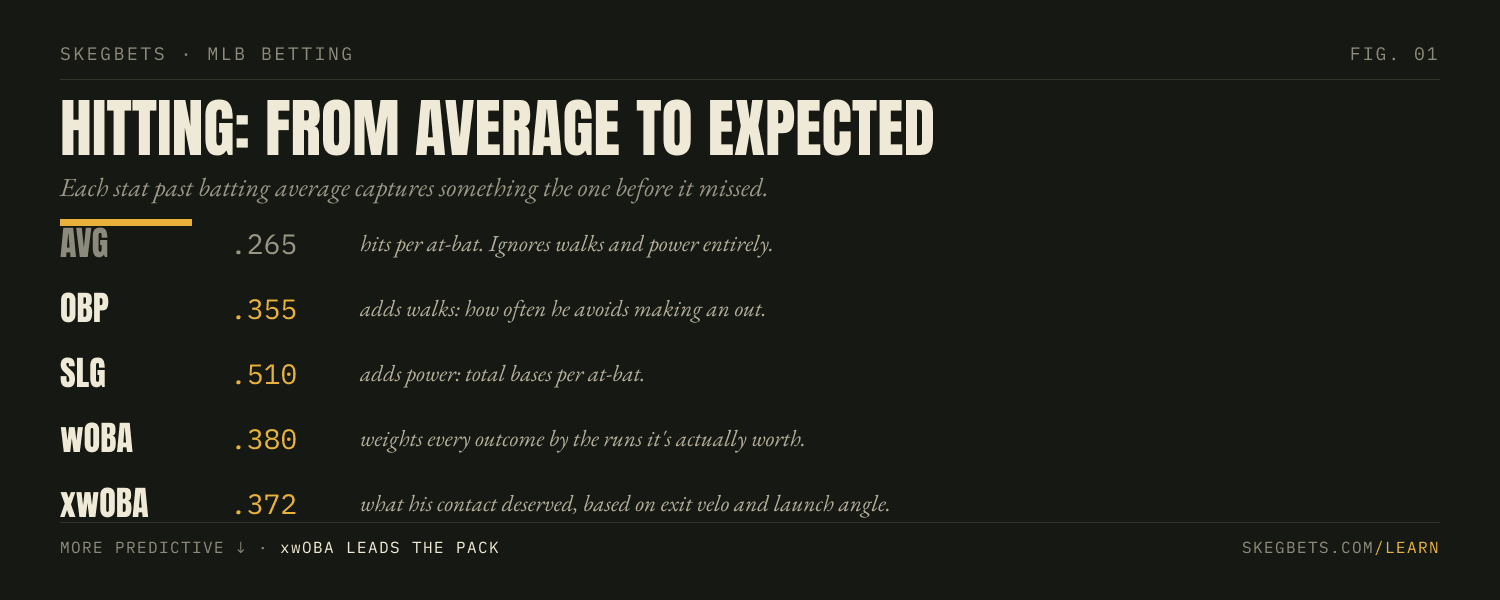
On-base percentage (OBP) adds walks: how often a hitter avoids an out at all. Slugging (SLG) adds power: total bases per at-bat. Add the two and you get OPS, a quick catch-all. But the number sharp bettors actually lean on is weighted on-base average (wOBA), which puts every outcome on one scale weighted by the runs it’s really worth, and its expected cousin xwOBA, which grades the quality of contact rather than whether the ball happened to find a glove. When a hitter’s wOBA and xwOBA disagree, the expected number is usually the better bet on where he’s headed.
Pitching: past the ERA
On the mound, the trap is ERA. It’s the runs a pitcher gave up, but a huge share of that depends on his defense, his ballpark, and plain luck on where balls land. A shiny ERA can hide a pitcher who’s about to come back to earth.

FIP (fielding independent pitching) grades only what a pitcher controls: strikeouts, walks, and home runs, on the same scale as ERA so you can compare them directly. xERA goes further and uses contact quality. When a pitcher’s ERA sits well below his FIP, he’s usually been lucky and is due to regress, and the total or moneyline priced off that low ERA is the one to fade. Underneath, the rate stats that drive everything are his strikeout rate (K%) and walk rate (BB%): missing bats and not giving away free bases is the whole job.
Statcast: what the ball does
The deepest layer is Statcast, the tracking that measures the ball itself rather than the result. It’s where the most predictive signal lives, because how hard and how squarely a hitter strikes the ball stabilizes long before his batting line does.
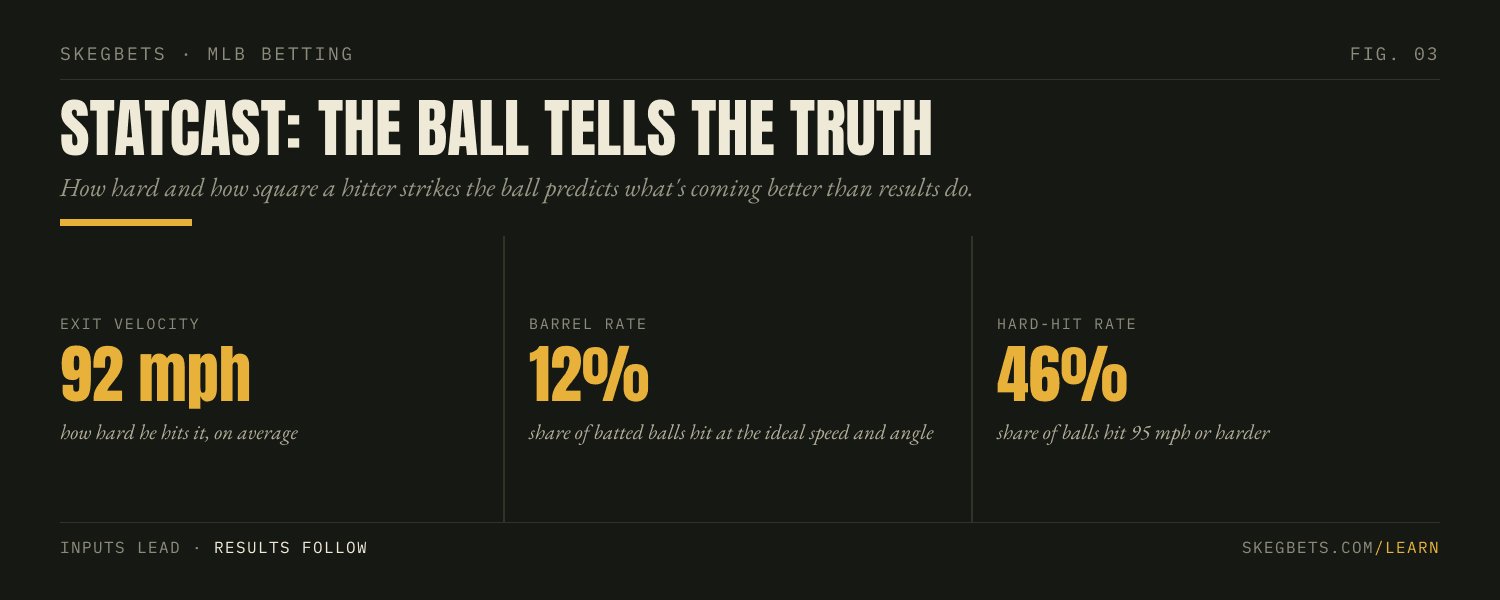
Exit velocity is how hard a hitter hits the ball on average. Barrel rate is the share of batted balls hit at the speed-and-angle combination that produces the most damage. Hard-hit rate is the share struck at 95 mph or more. These inputs lead; the results follow. A hitter barreling everything with a quiet batting average is a buy, not a fade. On the pitching side, the same tracking gives you whiff rates and a pitcher’s full arsenal, the velocity and movement on each pitch he throws.
Which stats actually predict
Here’s the rule that ties it all together: the stats built from inputs (xwOBA, FIP, barrel rate) forecast the future far better than the stats built from results (AVG, ERA, win-loss). Results carry luck and defense and small samples; inputs carry skill. A bettor who prices a game off a pitcher’s glossy ERA is reading the past, while the bettor reading his FIP and whiff rate is reading what’s coming. That gap is exactly the kind of mispricing expected value is built on, and it’s most exploitable in totals and player props, where one player’s real form moves the number. The same describe-versus-predict split runs through football stats, basketball stats, and hockey stats.
| Stat | What it measures | Read it as |
|---|---|---|
| wOBA / xwOBA | Hitter value, by run worth + contact quality | Trust over AVG |
| FIP / xERA | Pitcher skill, minus defense and luck | Fade a low ERA above it |
| K% / BB% | Strikeouts and walks per plate appearance | The engine of pitching |
| Barrel / EV | How hard and how squarely the ball is hit | Leading indicator |
See every number live
Reading a stat and seeing it are different things. Every number above is on our MLB stats pages: each hitter’s slash line, contact-quality bars, and spray; each pitcher’s form, arsenal, and per-pitch velocity and spin, all built from the same Statcast data the pros use. The prop research tool turns the same data into how often a player has actually cleared each prop line. Learn the stat here, then go read it on a real player and put it to work.
Frequently asked questions
What baseball stats matter most for betting?+
The predictive ones. For hitters, weighted on-base average (wOBA) and its expected version (xwOBA) capture value far better than batting average. For pitchers, FIP and xERA reflect skill better than ERA. Statcast inputs like exit velocity and barrel rate lead before the results catch up.
What is wOBA and why is it better than batting average?+
Weighted on-base average puts every outcome (walk, single, double, homer) on one scale, weighted by the runs it is actually worth. Batting average treats a single and a home run the same and ignores walks entirely, so wOBA is a much truer read on how much a hitter helps his team score.
What is the difference between ERA and FIP?+
ERA is the runs a pitcher allowed, which depends heavily on his defense and luck. FIP (fielding independent pitching) strips that out and grades only what a pitcher controls: strikeouts, walks, and home runs. A big gap between a low ERA and a higher FIP usually means the ERA is due to rise.
What is xwOBA and Statcast?+
Statcast is the tracking system that measures how the ball is hit: exit velocity, launch angle, and more. xwOBA (expected wOBA) uses that batted-ball quality to estimate what a hitter deserved, independent of whether the ball found a glove. It is one of the most stable, predictive hitting stats available.
New to baseball betting? Start with how to bet on baseball, then put these stats to work on totals and player props. Look up any player in the prop research tool.
Free tools