Player props are where a lot of sharp money quietly lives, for one reason: a book can only price so many things carefully. It pours its attention into the game line and spreads what’s left across hundreds of props. That gap is the opportunity.
What a player prop is
A player prop is a bet on a single player’s stat instead of the game result. You’re betting whether one number lands over or under a line.

Every prop has three parts: the player, the stat and its line, and the price. “Aaron Judge over 1.5 total bases at −120” is a bet that Judge records two or more total bases, and it pays out no matter what the Yankees do. If you’re new to over/unders and pricing, the bet types guide and reading odds cover the groundwork.
Why props can be softer
A sportsbook’s main game line is a hard target. Sharp money pounds it into shape long before kickoff. Props don’t get the same treatment, because there are simply too many of them.
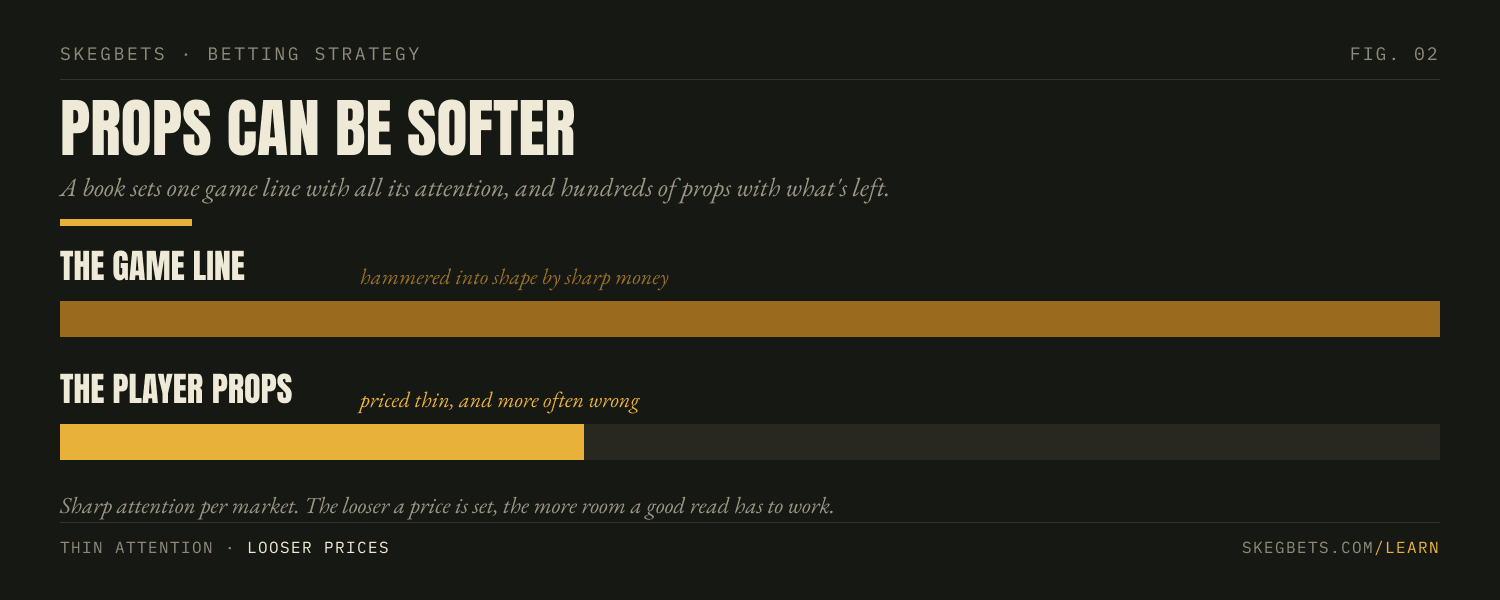
One game might carry a moneyline, a spread, and a total, but it also carries dozens of player props across both teams. The book can’t price every one of them as tightly as the main number, so prop lines are looser and move slower. That’s the same softness that makes prediction markets beatable, showing up inside a regular sportsbook: a less-watched market is a more-mispriced one.
Read the hit rate, not the story
The trap in props is the narrative. A great hitter in a marquee spotfeels like an over, and the book counts on that feeling. The number tells you something better: how often the player has actually cleared the line.
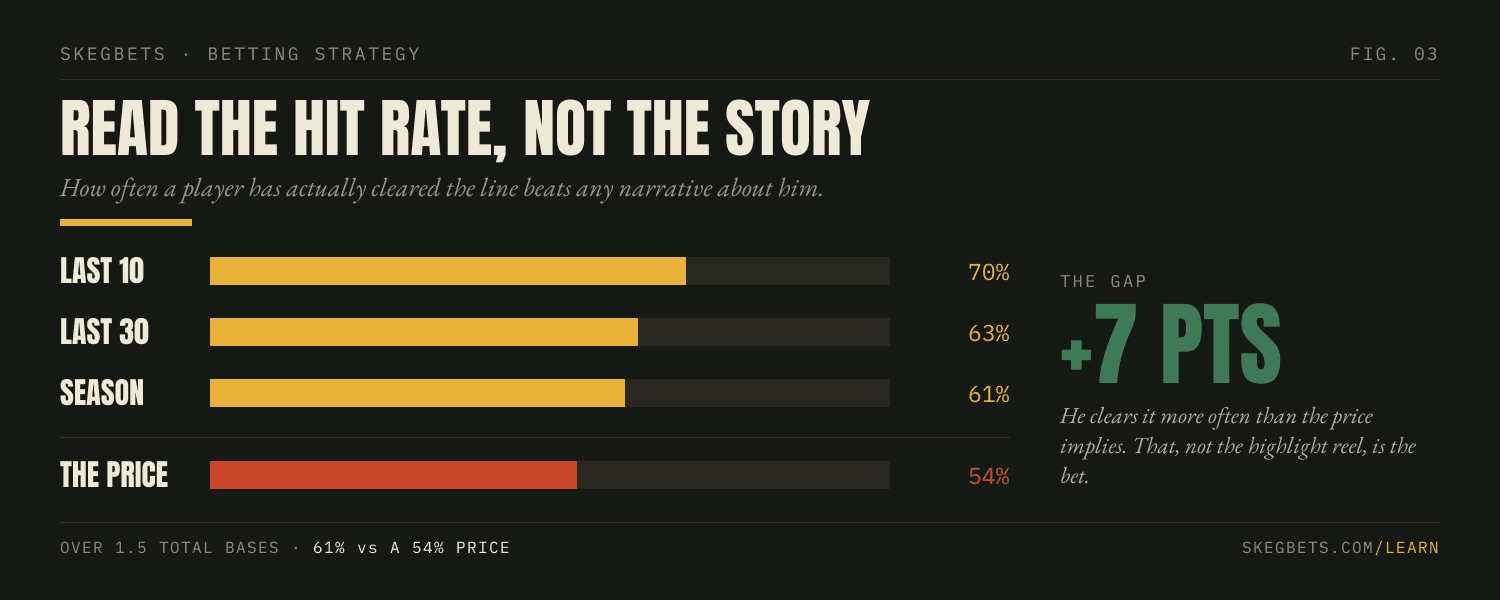
If a hitter has gone over 1.5 total bases in 61% of his games this season but the price only implies 54%, the over is paying you for something more likely than it’s priced. That 7-point gap is the bet, and no amount of highlight-reel narrative changes it. This is exactly what the prop research tool is built for: it shows any hitter or pitcher’s over rate by line across the last 10 games, the last 30, and the season, and the same boards live on every player page. Turn the price into a percentage with the implied probability calculator, compare, and only bet the gap, the heart of expected value.
| Window | Over rate | Vs the 54% price |
|---|---|---|
| Last 10 | 70% | +16 pts |
| Last 30 | 63% | +9 pts |
| Season | 61% | +7 pts |
| The price | 54% | the bar to clear |
Where props go wrong
The softness is real, but so are the traps. Popular props, a star to go over his points line, often carry steep juice, because the book knows which way the public leans. Correlated parlays of props (a quarterback over his yards and his team over the total) feel clever but are usually priced against you. And one big game can fool you into chasing a line that’s already moved. Lean on the sample, respect the price, and size small, because books limit winning prop bettors faster than almost anyone.
Frequently asked questions
What is a player prop bet?+
A player prop is a bet on one player's statistic rather than the game result. You bet whether a player goes over or under a posted line, like over 1.5 total bases, over 6.5 strikeouts, or over 24.5 points. Who wins the game doesn't matter.
Are player props easier to beat than game lines?+
Often, yes. A sportsbook prices one game line with its full attention, but it posts hundreds of props with whatever is left over. That thinner attention means prop lines are more frequently a little bit wrong, which is exactly where a careful read finds value.
How do you find value in player props?+
Compare how often a player has actually cleared the line to the probability the price implies. If a hitter has gone over 1.5 total bases in 61% of his games but the price only implies 54%, the over is underpriced. The hit rate, not the storyline, is the bet.
What are the biggest mistakes in prop betting?+
Betting the narrative instead of the number, ignoring the steep juice books attach to popular props, parlaying correlated props at a poor price, and overreacting to one or two recent games. Books also limit prop bettors quickly, so disciplined sizing matters.
Put it into practice: look up any player’s hit rates in the prop research tool, learn the value math in expected value betting, the baseball-specific markets in MLB player props, and see the props we’re on in the live feed.
Free tools