It’s the question under all the others: can you actually make money on prediction markets? Yes, but not the way the breathless posts promise. The edge is real. So is the catch that keeps it small.
The straight answer
Making money in any market comes down to one thing: buying something for less than it’s worth. Prediction markets are no different. A contract that should be priced at 50¢ but trades at 45¢ is a 5-cent edge, the same kind of mispricing a sharp bettor hunts for at a sportsbook, just on a different venue. The skill is identical: price the outcome better than the market does.
What changes is where the mispricings show up and how big they are. To see why prediction markets offer them at all, start with what a price even is, covered in prediction markets explained, and then look at who’s setting it.
Where the edge comes from
A major sportsbook’s line is a hard target. By the time a game starts, syndicates and professional bettors have pushed it to within a whisker of fair value. That’s why beating the closing line consistently is the gold standard, and why closing line value is the cleanest proof of a real edge.
Prediction markets are set by a different crowd: younger, thinner, more retail-heavy, and it doesn’t price as tightly. That looseness is exactly where an edge lives. A read sharp enough to beat a razor-honed sportsbook line will find even more room against a softer price.

The catch: liquidity, fees, and the spread
A market is soft partly because it’s thin, and thin cuts both ways. The value can be entirely real and still small, because the liquidity to bet it at size may not be there. You spot a 5-cent edge, go to take it, and the good price is gone after a small stake.
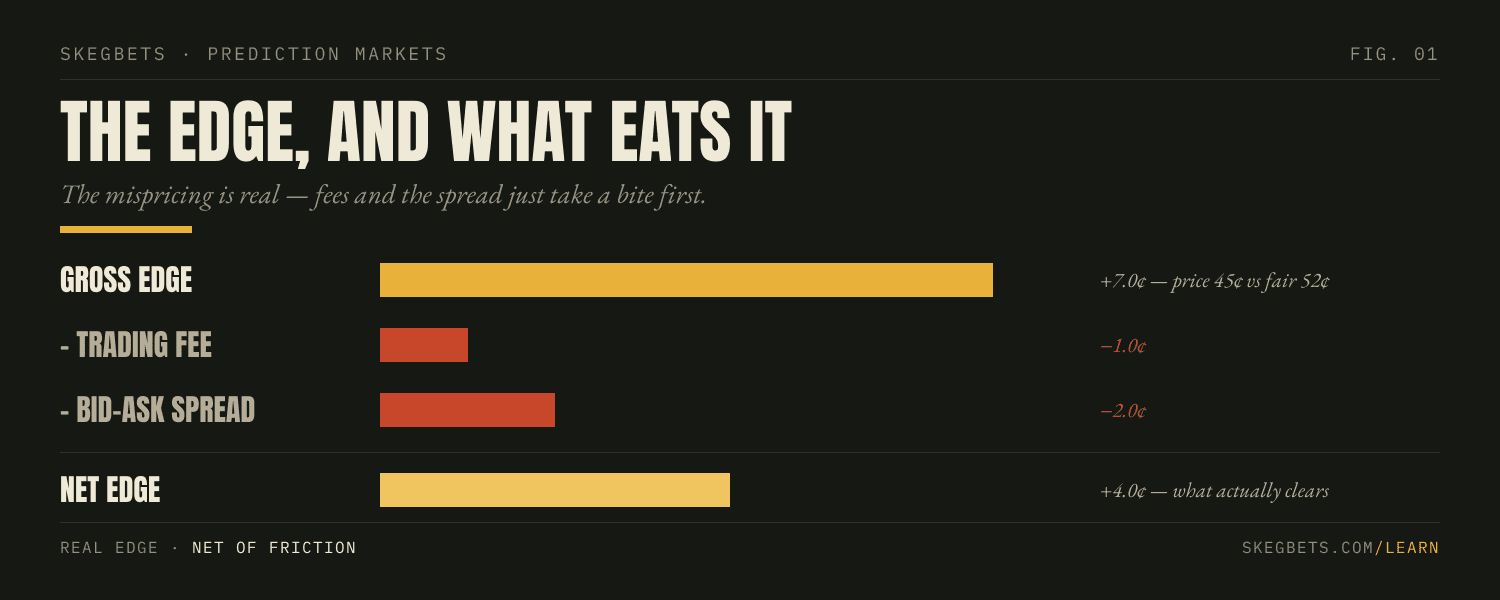
Two more frictions quietly shave the edge: the trading fee the venue charges per contract, and the bid-ask spread. You buy at the ask and sell at the bid, so a wide spread is a real cost. A great-looking number you can only get at a wide ask isn’t as good as it looks. Reading those frictions is half the game; the mechanics are in how to read Kalshi odds.
| Force | What it does to your edge |
|---|---|
| Less-efficient crowd | creates the mispricing (good) |
| Thin liquidity | caps how much you can bet at the price |
| Trading fee | small flat cost per contract |
| Bid-ask spread | the price of getting in and out |
How to actually find value
Value isn’t a feeling; it’s a number. You need your own estimate of how likely an outcome is, a fair probability, and then you compare it to the price. A prediction-market price already is a probability, so the comparison is direct: if your fair value says 52% and the contract is trading at 45¢, that 7-point gap is your edge. No gap, no bet.
That’s the whole discipline, and it’s the same one in the math of sports betting: you don’t need every price to be wrong, you need this one to be, by enough to clear the fees and spread. The comparison is easy. The hard part is producing a fair probability good enough to trust.
What’s realistic
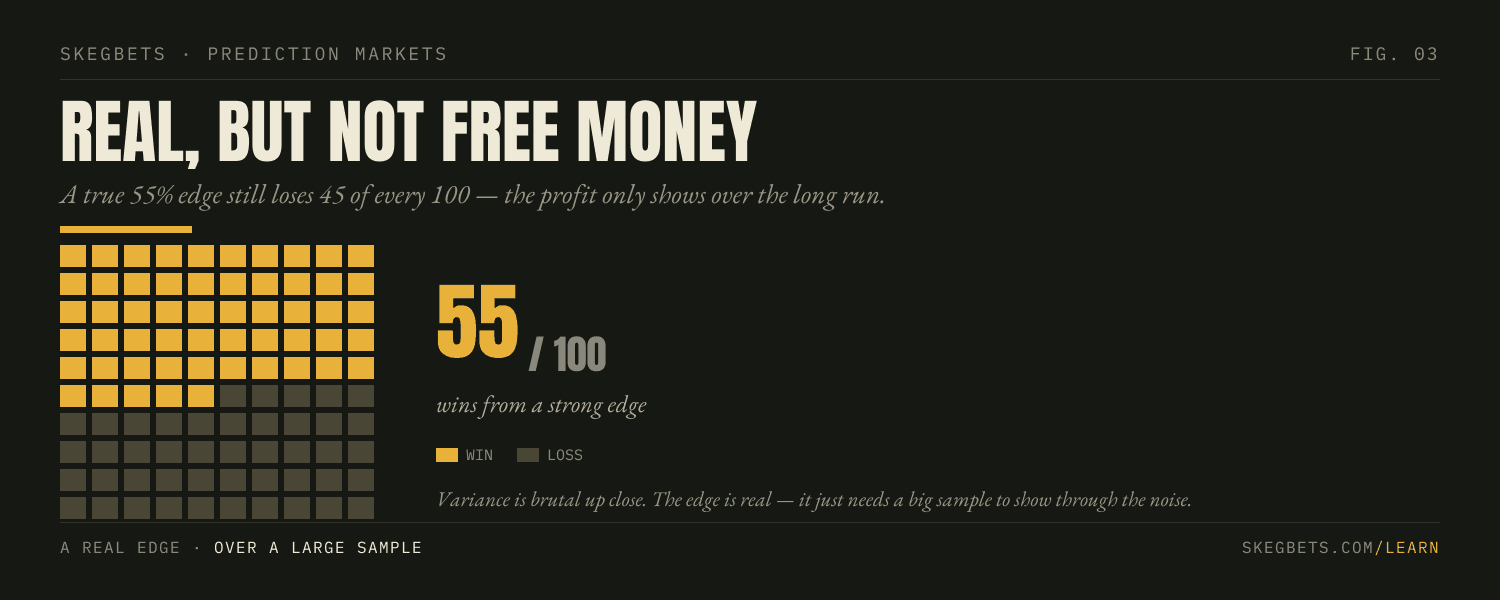
Calibrate your expectations. A real edge in these markets looks like a modest percentage return compounded over many bets, not a windfall on any single one. Variance is exactly as brutal here as it is at a sportsbook. A true 55% bet still loses plenty of the time, and it takes a large sample for the edge to show through the noise. Anyone promising fast, guaranteed prediction-market profits is selling something.
Put plainly: prediction markets are a second place to look for a wrong price, often with more room than the book, bounded by thinner liquidity. It’s a real edge, just a small one.
How we do it
We don’t treat a prediction market as a separate game. Our model produces a fair probability for an outcome; a prediction-market price is already a probability, so we line the two up. When the price is meaningfully below our fair value, by enough to clear the fee and the spread, that’s the read, and we track how those positions close the same way we track closing line value against the book. Same model, same discipline, a second venue to apply it to.
Putting it together
Are prediction markets profitable? Yes, conditionally. The edge is real and comes from a less-efficient crowd; the catch is that thin liquidity, fees, and the spread all shrink it. Finding value means comparing your own fair probability to the price and only acting when the gap is big enough to matter. Do that with discipline and the math works, slowly, in your favor, over a lot of bets.
It’s the same game it’s always been, on a newer board: price the outcome better than the market, buy what’s wrong, and respect the variance. For the foundation under all of it, start with prediction markets explained.