A prediction market looks exotic until you notice the trick: the price is just a probability wearing a dollar sign. A contract trading at 60¢ is the market saying “about 60% likely.” Once you see that, Kalshi and Polymarket stop being crypto curiosities and start being what they actually are: another place to find a mispriced outcome.
What a prediction market is
Strip away the framing and a prediction market is an order book, the same machinery the stock market runs on. Instead of shares in a company, the thing being traded is a yes/no claim about the future: will this team win, will the total go over, will this happen by Friday. Buyers and sellers meet at a price, and that price moves as new money and new information arrive.
The contract is binary. It resolves to one dollar if the answer turns out to be yes, and to nothing if it’s no. That single design choice is what makes the price so readable. There’s no payout table to decode, no spread to convert. The number on the screen is the odds.
The price is a probability
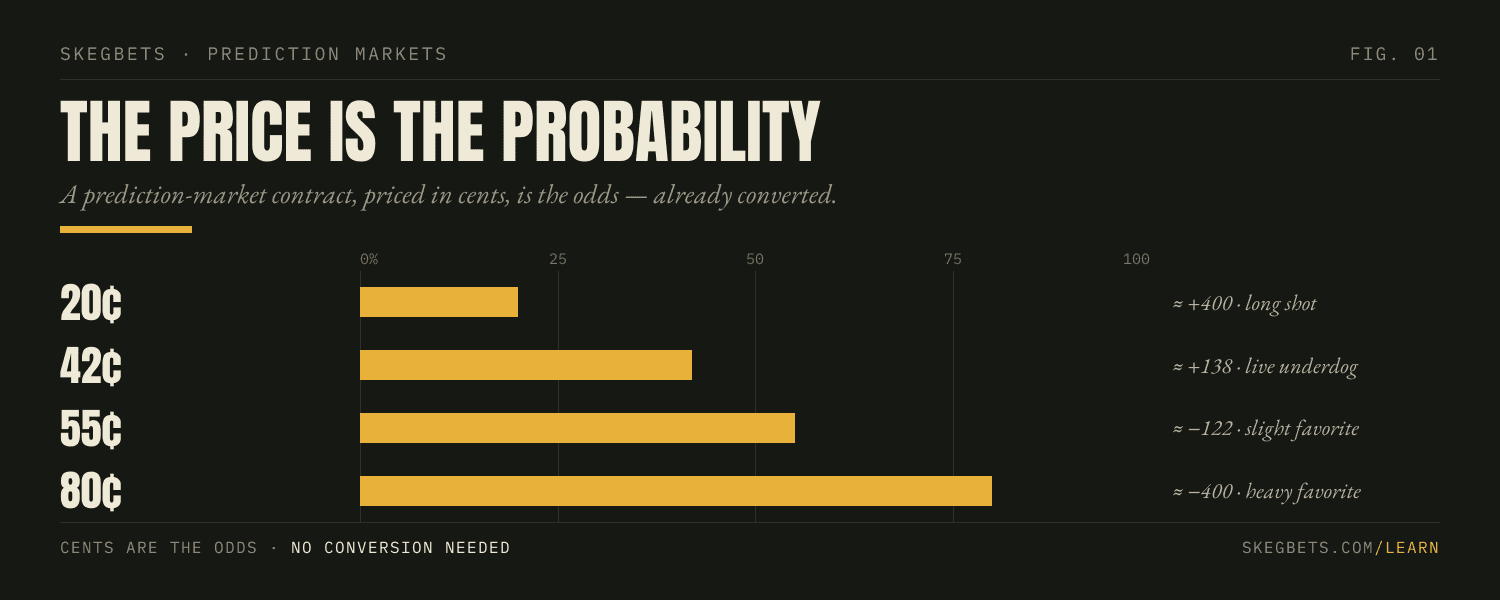
Because a winning contract is worth exactly $1, its fair price is just the probability of winning times that dollar. A 25% shot is worth 25¢. A coin flip is worth 50¢. A heavy favorite trades in the 80s. You never have to translate a moneyline in your head. The market has done it for you and printed it in cents.
That makes the bridge to sportsbook odds short. A price in cents is an implied probability; convert it the same way you’d convert a no-vig line. If you already think in closing line value, this will feel familiar: it’s the same probability math, just shown to you up front instead of buried in juice.
| Contract price | What it means |
|---|---|
| 20¢ | 20% · ≈ +400 |
| 42¢ | 42% · ≈ +138 |
| 55¢ | 55% · ≈ −122 |
| 80¢ | 80% · ≈ −400 |
Kalshi vs Polymarket
The two venues share the mechanics and differ in plumbing. Kalshi is a US exchange regulated by the CFTC, the same agency that oversees commodity futures. Its contracts are settled in dollars, it’s available nationwide, and it has leaned hard into sports and event markets. For most US users it’s the front door: a regulated account, cash in, cash out. New to its prices? Start with how to read Kalshi odds.
Polymarket grew up on the crypto side, settling in stablecoins on a public order book rather than through a brokerage. Its sports and event coverage is deep and its prices are often quoted to the cent, but its US access has run through a more winding regulatory path. Think of Kalshi as the regulated brokerage and Polymarket as the open exchange, same idea on different rails. For a full head-to-head, see Kalshi vs Polymarket.
How they differ from a sportsbook
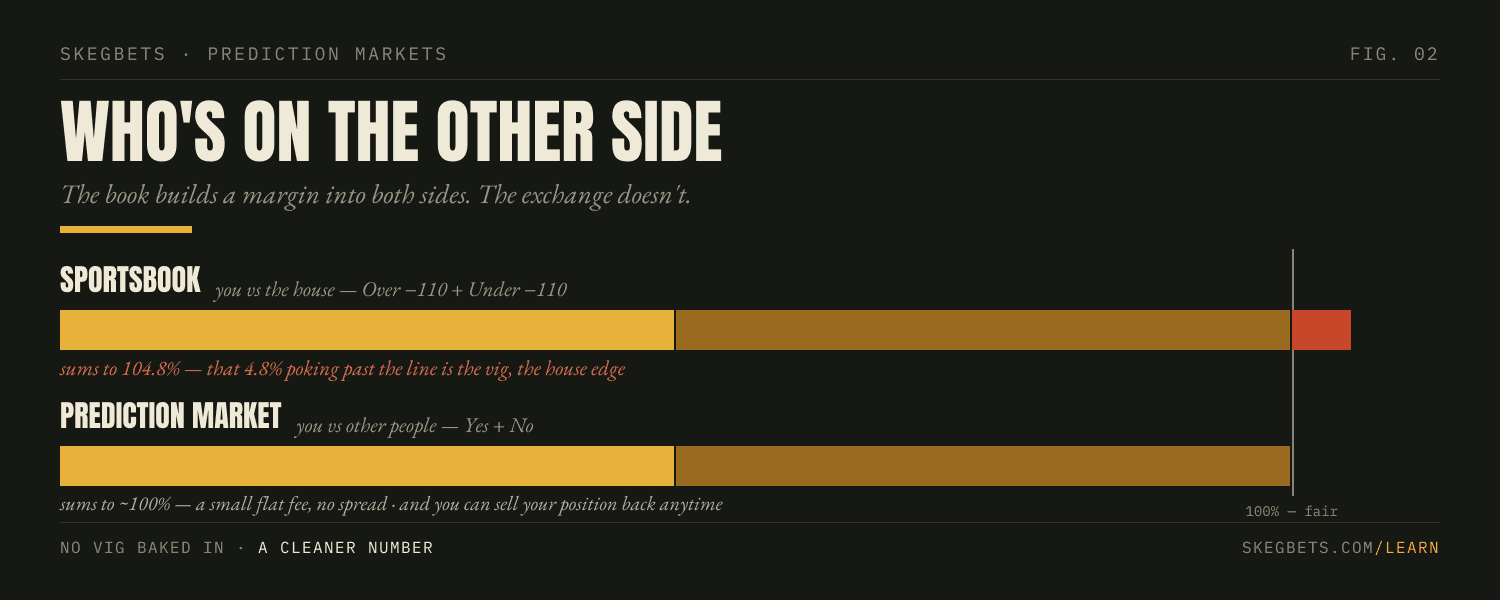
What changes isn’t the interface. It’s who’s on the other side of your trade. At a sportsbook, that’s the house. The book sets the line, and it builds a margin into both sides: a standard −110 / −110 total is really about a 52.4% break-even on each side, so the book collects the gap no matter who wins. That gap is the vig, and it’s the price of admission on every bet.
On a prediction market the other side is another person, not the house. The exchange isn’t trying to price in a margin against you. It takes a small flat fee and lets the order book find the number. So the price sits much closer to a clean probability, the two sides add up close to 100¢ instead of 105, and you can do something a bookmaker won’t let you: sell your position back before the event ends, the way you’d close a stock trade.
| Trait | Sportsbook | Prediction market |
|---|---|---|
| Who you trade against | The house | Other people |
| Built-in margin | Vig on both sides | Small flat fee |
| Price reads as | Moneyline / spread | Probability in cents |
| Exit before the event | No | Yes, sell back |
| Regulated as | State gambling | CFTC event contracts |
Are prediction markets legal?
Kalshi operates as a CFTC-regulated exchange, which puts its contracts under federal financial regulation rather than state gambling law. The practical upshot is reach: its event contracts are available in all 50 states, including the ones where you still can’t legally open a sportsbook account. That framing, “event contracts” rather than “bets,” is why the category exists where sportsbooks can’t go.
It isn’t settled water, though. Several states have pushed back specifically on sports event contracts, and the legal picture is still moving. Treat the venue’s availability as something to check rather than assume. The marketplace itself is a regulated financial product, not an offshore book; on whether it’s trustworthy to fund, see is Kalshi legit?
Why the prices can be softer
This is the part that matters for value. A major sportsbook’s line has been hammered into shape by syndicates and sharp money for hours before kickoff, so it’s a hard target. Prediction markets are younger, thinner, and more retail-heavy, and that crowd prices less tightly.
That doesn’t make prediction-market prices wrong. Often they’re excellent. But “less efficient” is exactly where an edge can live. A read that’s good enough to beat a razor-sharp sportsbook closing line is, almost by definition, good enough to find even more room against a softer price. The catch is the flip side of thin: the liquidity may not be there to bet it at size. The value can be real and still small. More on that in are prediction markets profitable?

How we use them
We don’t treat a prediction market as a separate game. The same model that produces a fair probability for a sportsbook pick produces a fair probability, full stop. And a prediction-market price is already a probability, so the comparison is direct. When our number and the market’s number disagree, that gap is the read, whether it shows up against a book line or a Kalshi contract.
Practically, that means our analysis looks at where a price sits across the major books and the prediction markets, and flags the spots where the same opinion is worth more in one place than another. Our prediction-market boardlays out where the markets and the books disagree across tonight’s games. The discipline is identical to everything in the math of sports betting: find the price that’s wrong, ignore the one that isn’t.
Putting it together
A prediction market is an order book for yes/no questions, and its price is a probability you don’t have to decode. Kalshi is the regulated US front door; Polymarket is the open exchange. The structural break from a sportsbook is what pushes the price toward a clean number and, sometimes, leaves more room for a sharp read than the book does: you trade against people instead of the house, no vig is baked into the line, and you can sell back.
None of that repeals variance or the work of being right. It just adds a second place to look for a wrong price. If you already think in probabilities and closing line value, the jump is short: a prediction market is the same math, quoted more honestly.