Kalshi and Polymarket get lumped together, and for good reason: both let you trade contracts that pay a dollar if an event happens and nothing if it doesn’t, priced in cents that read as probability. The mechanic is identical. What separates them is everything around the trade: who regulates it, how you fund it, and what it’s built on.

Same engine, different plumbing
Start with what they share, because it’s most of the story. Both are order-book markets for yes/no questions. Both price contracts from 1¢ to 99¢, where the price is the implied probability. Both let you buy either side and sell out before the event resolves. If you understand one, you understand the other. The reading skill carries over directly, and how to read Kalshi odds applies to both.
The differences are structural, not conceptual. They come down to four things: who regulates the venue, how money gets in and out, what each covers best, and what it costs. Take them one at a time.
At a glance
| Dimension | Kalshi | Polymarket |
|---|---|---|
| Regulation | CFTC-regulated US exchange | Crypto-native, US access via a licensed route |
| Settles in | US dollars | USDC stablecoin |
| Fund with | Linked bank account | Crypto wallet |
| Built on | Regulated brokerage rails | Public blockchain |
| Coverage edge | Economics, events, sports | Politics, world events, crypto |
| Best for | US users who want dollars | Crypto-comfortable event traders |
Regulation and legal footing
This is the biggest split. Kalshi operates as a CFTC-regulated exchange, which puts it under federal financial oversight and makes its contracts available across the US. If regulatory standing is what you care about (whether your funds sit on a footing you can verify), that’s Kalshi’s strongest card. We cover it in depth in is Kalshi legit?
Polymarket took the crypto path. It ran as a decentralized, blockchain-settled market and restricted US access for years, and it has been returning to the US through a CFTC-licensed route rather than as a domestic exchange from day one. The result is deep global liquidity on some markets paired with a more winding regulatory history. Neither is disqualifying; they’re just different postures.
How you fund and settle
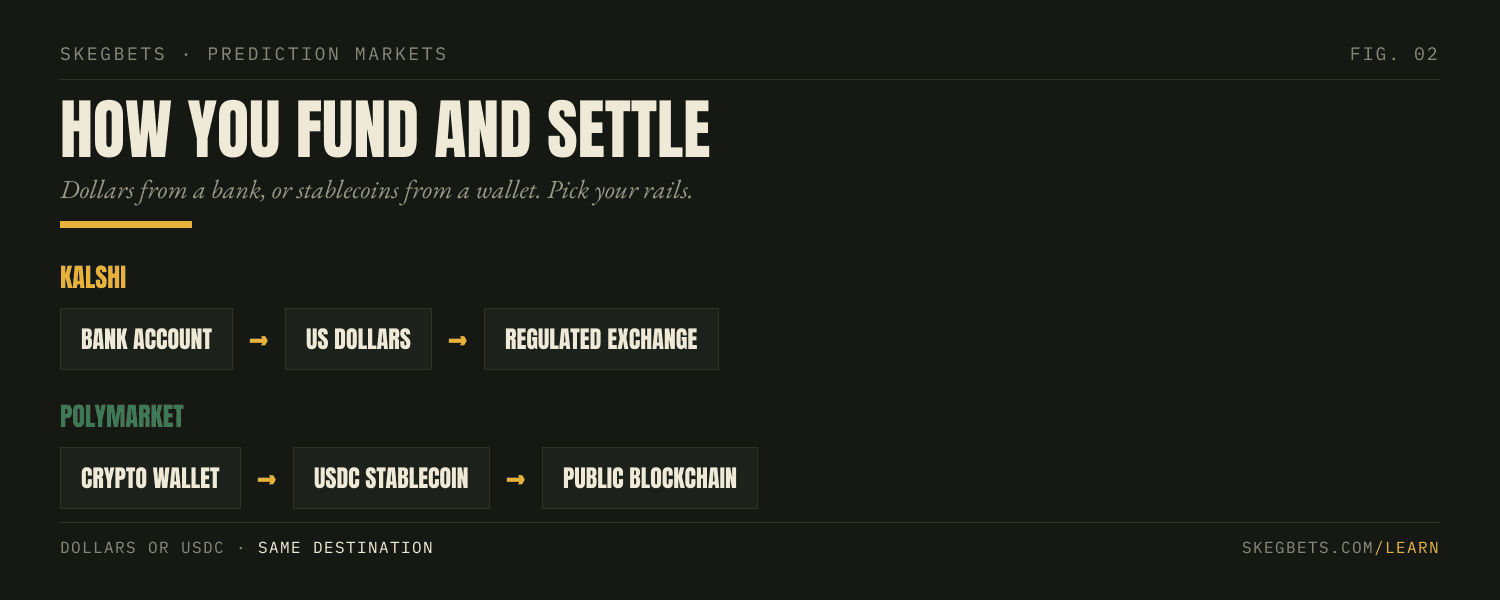
The funding method is the part most people feel first. On Kalshi you link a bank account, deposit dollars, and withdraw dollars, with no crypto anywhere in the loop. If you’ve used a brokerage, it’s the same motion.
Polymarket runs on USDC, a dollar-pegged stablecoin, in a crypto wallet. That suits people already holding stablecoins and adds a step for people who aren’t. It also means your balance lives on a public blockchain rather than in a brokerage account. For some traders that’s a feature; for a newcomer who just wants to deposit fifty dollars, it’s friction.
Coverage and liquidity
Coverage is where the two genuinely diverge in usefulness. Polymarket built its name on politics, elections, and world events, and it has often carried the deepest liquidity on those markets. Kalshi spans economics, weather, company and culture events, and a growing sports slate, with the advantage of regulated US access on all of it.
Liquidity matters as much as the topic list. A market only helps you if there’s size to trade at a fair price. A thin market with a wide spread isn’t much use no matter which venue hosts it. Check the order book on the specific contract you want, not the platform’s reputation in general.

Fees and pricing
Costs show up in two places: explicit fees and the spread. Kalshi charges a small trading fee per contract, heaviest near 50¢ and lighter toward the extremes. Polymarket has historically leaned on very low explicit fees, with cost living mostly in the bid-ask spread and minor on-chain gas.
On any one trade, the spread usually outweighs the fee, so don’t pick a venue on the fee schedule alone. A two-cent spread on a thin market costs you more than a fee ever will. The mechanics of reading that cost are in how to read Kalshi odds.
Which one should you use?
For most US users getting started, Kalshi is the simpler answer: a regulated account, dollars in and out, no wallet to set up, and broad US availability. It’s the front door.
Polymarket makes more sense if you’re already comfortable with crypto and you want the depth it carries on politics and world events. And there’s a third answer: use both, and compare. The same outcome can be priced a few cents apart across the two, and that gap is exactly the kind of mispricing worth acting on, as we cover in are prediction markets profitable?
Putting it together
Kalshi and Polymarket run the same engine and differ in the plumbing. Kalshi is the regulated, dollar-settled US front door. Polymarket is the crypto-native venue with deep event coverage. Pick by how you want to fund an account and what you want to trade, and remember that the prices themselves can disagree across the two.
If you’re still getting your bearings on what these markets even are, start with prediction markets explained and work back here.