A Kalshi ticket reads like a stock quote, and that’s the good news: there’s no moneyline to decode. The price is in cents, the cents are the probability, and the payout falls straight out of them. Learn to read one contract and you can read the whole board.
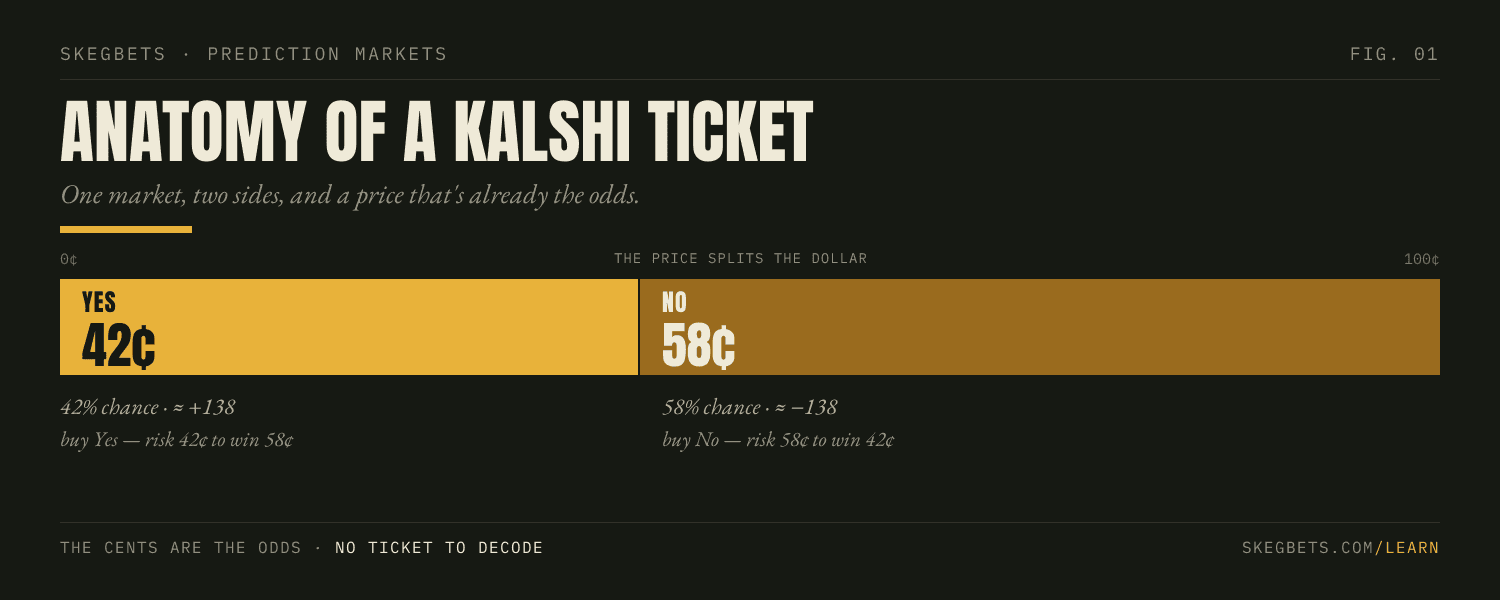
The cents are the probability
Every Kalshi contract pays out exactly one dollar if its question resolves the way you bought, and nothing if it doesn’t. That one rule is what makes the price so easy to read: a thing worth $1 when it hits is worth its probability right now. A 25% shot is worth about 25¢. A coin flip is worth 50¢. A heavy favorite trades up in the 80s and 90s.
So the number on the screen is doing double duty: it’s both the market’s estimate of how likely the event is and the price you pay for one contract. If this feels familiar, it’s the same idea behind every prediction market; the broader version lives in prediction markets explained.
Yes and No are two sides of one price
Every market has a Yes and a No, and their prices add up to about 100¢. If Yes is trading at 42¢, No is trading near 58¢, because one of them is going to happen, and the two probabilities have to sum to one. Buying Yes profits if the event occurs; buying No profits if it doesn’t.
Choosing a side isn’t complicated: you’re just deciding which outcome the market has underpriced. If you think a 42¢ Yes should really be 50¢, you buy Yes. If you think it should be 30¢, you buy No at 58¢. Same market, opposite reads.
What you risk and what you win
Because every contract settles at a dollar, the math is fixed before you click. Buy a Yes at 42¢ and you risk 42¢ to win 58¢, the rest of the dollar. Buy a favorite Yes at 80¢ and you risk 80¢ to win 20¢. The cheaper the contract, the more it pays relative to the stake, which is exactly how plus-money underdogs work at a sportsbook.
| Buy Yes at | You risk → you win (per contract) |
|---|---|
| 20¢ | risk 20¢ → win 80¢ |
| 42¢ | risk 42¢ → win 58¢ |
| 50¢ | risk 50¢ → win 50¢ |
| 80¢ | risk 80¢ → win 20¢ |

One caveat the price doesn’t show: Kalshi charges a small trading fee per contract, largest on coin-flip prices and smaller toward the extremes. It’s minor, but it’s real, so a 50¢ contract needs to win slightly more than half the time to break even, the same way −110 juice nudges a sportsbook break-even above 50%.
Converting a Kalshi price to American odds
If you think in American odds, the bridge is short, because a Kalshi price is already an implied probability. Below 50¢ you’ve got a plus-money underdog; at 50¢ it’s even; above 50¢ it’s a minus-money favorite.
| Kalshi price | Probability · American odds |
|---|---|
| 10¢ | 10% · +900 |
| 25¢ | 25% · +300 |
| 42¢ | 42% · +138 |
| 50¢ | 50% · +100 |
| 60¢ | 60% · −150 |
| 80¢ | 80% · −400 |
The formula, if you want it: for a price under 50%, American odds = 100 × (1 − p) ÷ p; at or above 50%, −100 × p ÷ (1 − p), where p is the price as a decimal. But you rarely need it. The cents already tell you the story.
The bid, the ask, and the spread
A market isn’t one number; it’s two. The bid is the highest price someone will pay for a contract right now; the ask is the lowest price someone will sell one for. You buy at the ask and sell at the bid, and the gap between them is the spread.
That spread is a real cost. It’s the prediction-market cousin of the vig, just usually much smaller. A liquid market might be one cent wide (Yes 42 bid / 43 ask); a thin one can be several cents, which quietly eats into a thin edge. When you read a price, read the spread too: a great-looking number you can only get at a wide ask isn’t as good as it looks.

Reading a market end to end
Put it together on one line. Say a team’s Yes shows 43¢ bid / 45¢ ask. That tells you: the market thinks they’re about a 44% chance (roughly +127), you can buy in at 45¢ (risking 45¢ to win 55¢), the No side sits near 55¢, and the two-cent spread is your cost of getting in and out. If your own read says they should be 52%, that 45¢ ask is a buy.
How we use Kalshi prices
We don’t read a Kalshi market any differently than a sportsbook line. We compare its number to ours. Our model produces a fair probability, the Kalshi price is a probability, so the comparison is direct: when the ask is meaningfully cheaper than our fair value, that’s the edge. The discipline is the same one in the math of sports betting and closing line value: buy the price that’s wrong, ignore the one that isn’t.
Putting it together
Reading Kalshi comes down to four things: the cents are the probability, Yes and No split the dollar between them, your payout is whatever’s left of that dollar, and the spread is what it costs to get in. Convert to American odds if it helps, though the price already says everything a moneyline would.
Once the ticket reads easily, the only question left is whether the price is wrong. For the bigger picture on where those wrong prices come from, start with prediction markets explained.