Most people ask this question with a finger over the “deposit” button. The plain answer: Kalshi is a real, US-regulated exchange, not an offshore book. That settles whether it’s legitimate. Whether you’ll make money on it is a separate question, and the two get confused all the time.

The short answer
Kalshi is legitimate. It runs as a CFTC-regulated exchange, its contracts have defined payouts, and money moves in and out in US dollars through a linked bank account. None of that is true of the offshore sites people rightly worry about. If your question is “will this company take my deposit and vanish,” the answer is no.
If your question is “will I win,” that depends entirely on whether you buy contracts for less than they’re worth, which is its own skill. We cover that in are prediction markets profitable? Keep the two questions apart. A platform can be perfectly legitimate and still a place where most casual traders lose.
What CFTC regulation actually means
The CFTC, the Commodity Futures Trading Commission, is the federal regulator for futures, options, and event contracts. Kalshi operates under its oversight rather than under state gambling law, which is why its contracts are framed as financial instruments and why they’re available across all 50 states.
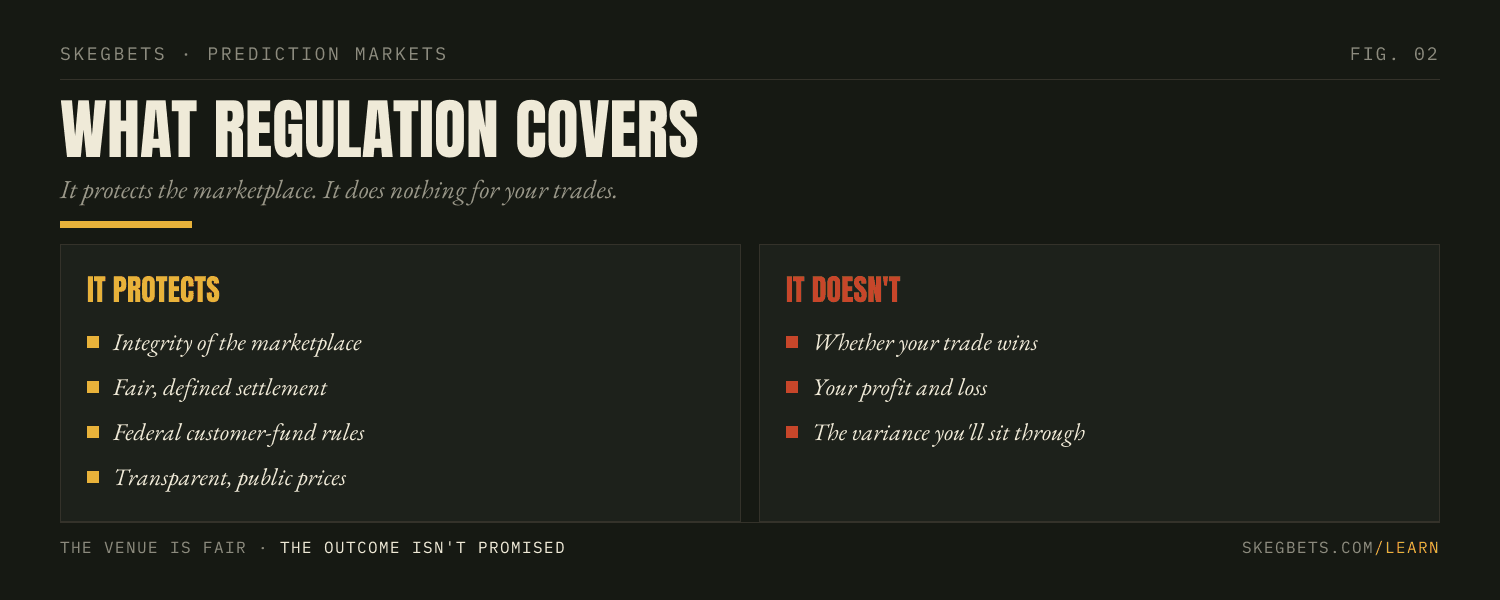
In practice, that oversight means a few concrete things: the exchange has to run a fair and transparent market, follow federal rules for handling customer money, report to a regulator, and settle contracts by defined terms instead of house discretion. An offshore book answers to none of that. The gap between “a federal agency can audit them” and “they’re registered in a country you can’t name” is the entire point.
Is your money safe?
Two different things hide inside that question, so separate them.
Your account balance sits at a regulated US exchange under federal rules for customer funds, which is a far stronger position than money parked at an offshore site. One honest caveat: Kalshi is an exchange, not a bank, so your balance is not FDIC-insured the way a checking account is. That isn’t a knock on its legitimacy; it’s just what an exchange is.
The value of a contract you hold is a completely different matter. A contract can go to zero if the event resolves against you. That’s not the platform failing. That’s the bet losing, exactly as designed. People who blur these two end up blaming the venue for a result that was always part of the deal.
Regulated is not the same as risk-free
This is the line that matters most. Regulation makes the marketplace trustworthy. It does nothing for the quality of your trades. A CFTC-regulated exchange will faithfully take the other side of a bad bet and faithfully pay out a good one. The fairness is in the mechanics, not in the outcome.
Treat Kalshi the way you’d treat a brokerage. The institution is sound; what you do inside it is on you. If you want the actual mechanics of pricing and payouts before you fund an account, read how to read Kalshi odds.

The part that’s genuinely contested
One area is still being fought over, and it’s worth knowing. Some state regulators have challenged whether Kalshi’s sports-related event contracts belong under federal commodity rules or under state gambling law, and that question is moving through the courts. It’s a dispute about jurisdiction over one category of contract, not about whether the company is real or your funds exist.
The practical takeaway: the exchange itself is a regulated financial platform, but the availability of specific sports markets in specific states can change. Check what’s offered where you are rather than assuming, and don’t read the legal back-and-forth as a sign the platform is shady. It isn’t.
How to tell a legit market from a sketchy one
The same test works for any platform asking for your money. Kalshi passes it; most offshore sites fail it.
| Question to ask | Kalshi |
|---|---|
| Regulated by a named agency? | Yes, the CFTC |
| Registered US entity? | Yes |
| Federal rules on customer funds? | Yes |
| Settles in real dollars you can withdraw? | Yes |
| Public, transparent pricing? | Yes, a public order book |
If a platform can’t answer those cleanly, that’s your signal. A regulator you can look up, a US registration, real settlement, and transparent prices are the difference between an exchange and a trap.
Putting it together
Is Kalshi legit? Yes. It’s a CFTC-regulated US exchange that settles in dollars and runs a transparent market, which is the opposite of the offshore operations the question usually has in mind. Your funds sit on a regulated footing, though the platform is an exchange rather than a bank, and any individual contract can still lose.
Hold the two questions apart and you’ll judge it correctly: the company is sound, and winning is up to you. For the foundation under the whole category, start with prediction markets explained.