Sportsbooks list hundreds of markets, but the spine of all of it is three bets: the moneyline, the spread, and the total. Get these three cold and you can walk up to any board, in any sport, and know exactly what you’re looking at.
Moneyline: pick the winner
The moneyline is the simplest bet there is: pick who wins, at any margin. A one-run squeaker and a ten-run blowout pay the same. The only thing the price reflects is how likely each side is to win outright.
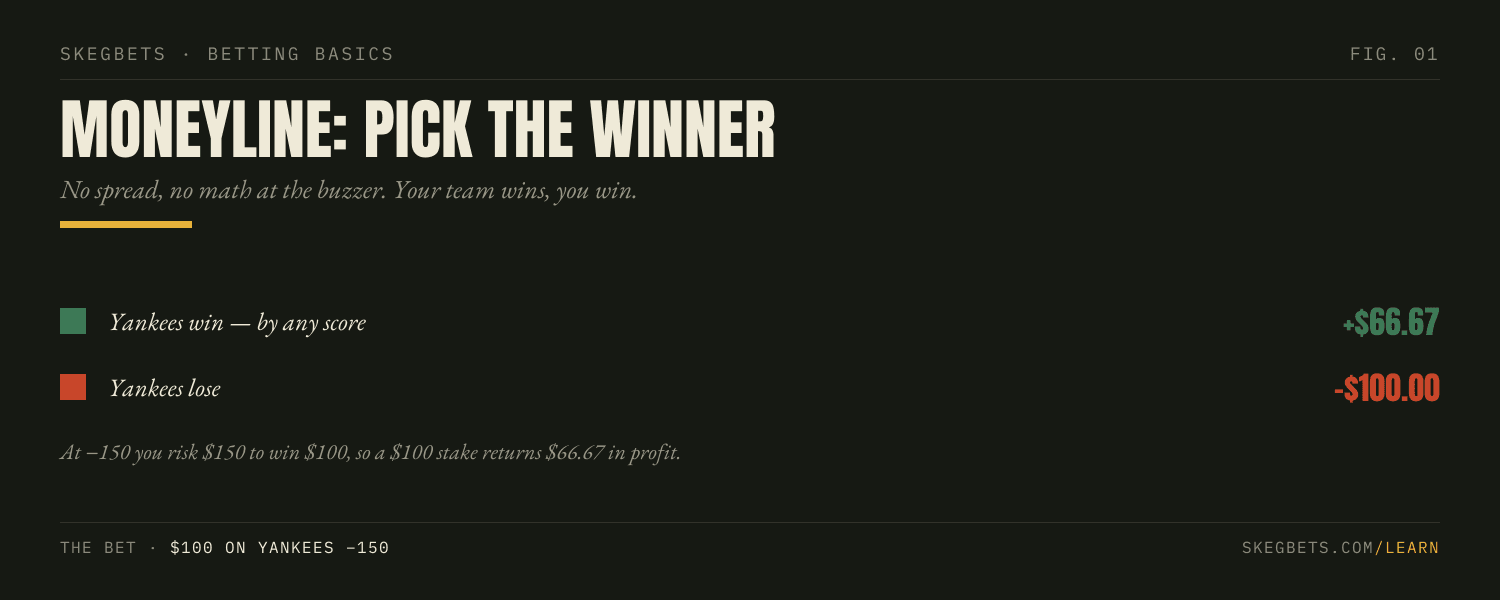
Back the Yankees at −150 for $100 and you win $66.67 if they take the game by any score, and lose your $100 if they don’t. Because you’re only judging a winner, the moneyline is the cleanest place to learn how a price moves before adding the wrinkles below.
Spread: cover the number
The spread evens out a lopsided game by handing the underdog a head start. The favorite is laid a number it has to beat; the underdog is given that same number as a cushion. In baseball and hockey the spread is a fixed 1.5 (the run line and puck line); in the NFL and NBA it moves with the matchup.
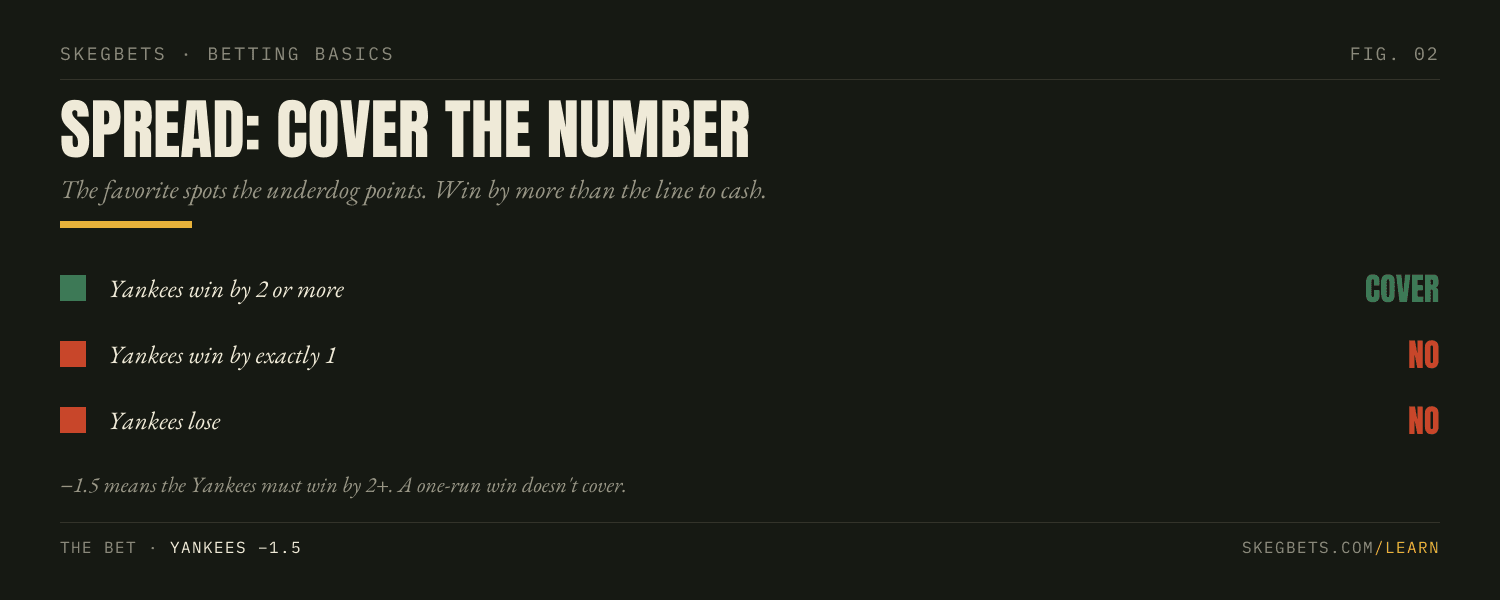
Lay the Yankees at −1.5 and a one-run win isn’t enough, they have to take it by two or more to cover. Bet the other side at +1.5 and you cash if the underdog wins outright or loses by exactly one. When a whole-number spread lands on the exact margin (a team favored by 7 winning by 7), the bet is a push and your stake comes back, which is why so many spreads carry a half-point to rule out the tie.
Total: over or under
The total ignores who wins entirely. The book posts a number for the two teams’ combined score, and you bet whether the game lands over or under it. A blowout and a one-run nail-biter can both go over; a defensive slog goes under no matter who takes it.

Bet over 8.5 and you need the two teams to combine for 9 or more. The half-run means there’s no tie to worry about. Totals are where context does the most work: a starting pitcher, the wind at a ballpark, the pace of an NBA matchup. That’s also where the sharpest edges in baseball tend to hide, which is its own subject for a later guide.
| Bet type | What you're betting | Example |
|---|---|---|
| Moneyline | Who wins, at any margin | Yankees −150 |
| Spread | A side after a points handicap | Yankees −1.5 (+115) |
| Total | Combined score, over or under | Over 8.5 (−110) |
Which one should you start with
Start on the moneyline in a sport you actually watch. One bet type, one sport, until the prices stop looking like noise. Add the spread once you want closer-priced action on lopsided games, and the total when you’d rather bet the flow of a game than its winner. From there, every exotic market is built on these same three: stack them into a parlay, move the number with a teaser, or bet a single player’s line as a prop.
Frequently asked questions
What is the difference between the moneyline and the spread?+
The moneyline is a straight bet on who wins, at any margin. The spread adds a handicap: the favorite has to win by more than the line, and the underdog can lose by less than it. The spread tightens the payouts on lopsided games by making the favorite do more.
What does over/under mean in betting?+
A total (the over/under) is a bet on the two teams' combined score, not on who wins. The book posts a number, and you bet whether the final total lands over or under it. Most totals use a half-point so there's no tie.
What is a run line or puck line?+
They are the spread for baseball (run line) and hockey (puck line), almost always set at 1.5. Because those sports are low-scoring, the spread is a fixed 1.5 runs or goals rather than a number that moves like an NFL or NBA spread.
Which bet type is best for a beginner?+
The moneyline. You are only picking a winner, with no number to cover, so it is the cleanest way to learn how prices work and move. Add the spread and total once the moneyline feels routine.
For the bigger picture, start with how to bet on sports, learn to read the prices in how to read betting odds, then see the exact lines we take on our live picks.
Free tools