A hockey total looks like a single number, but it’s really a stack of a few. Get the goalies, the pace, and the special teams right, and you can see the over/under before the market settles on it. Then a handful of scoring rules decide which goals actually count.
Three levers on a total
An NHL over/under is mostly set by three things, and so is the value in it.

The goalies set the floor and ceiling for goals against. The pace, how many shots and high-danger chances a matchup generates, sets the run environment the way a ballpark does in baseball. And special teams, a power play that clicks into a penalty kill that leaks, add goals at the margins. All three live on our NHL stats pages.
The goalies set the floor
No single input moves a hockey total like the men in the crease. Confirm both starters before you touch the over/under.
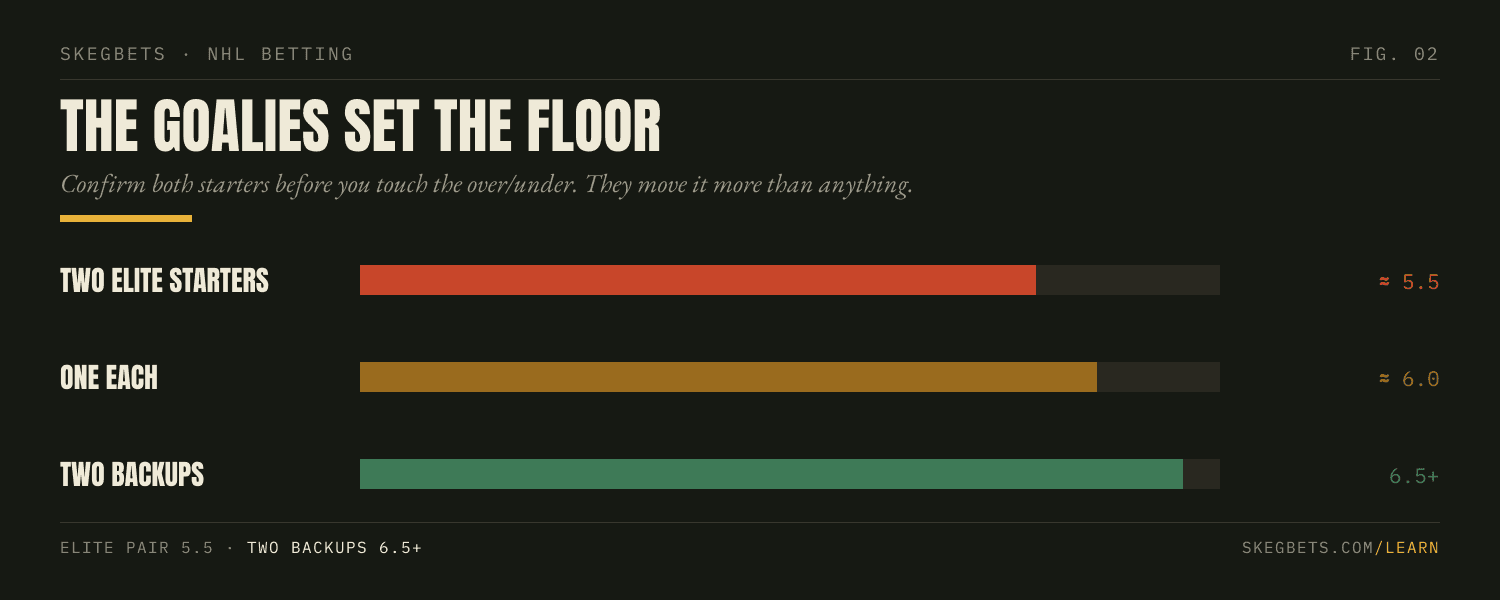
Two starters in form can hold a total to 5.5; a pair of backups can lift the same matchup to 6.5. A late goalie scratch is one of the few times the total moves a half goal in a single update, which is exactly why the starting goalie is the first thing a hockey bettor checks. Read both, not just the favorite’s.
Overtime, shootouts, and the empty net
Hockey’s last few minutes have their own arithmetic, and it cuts both ways on a total.
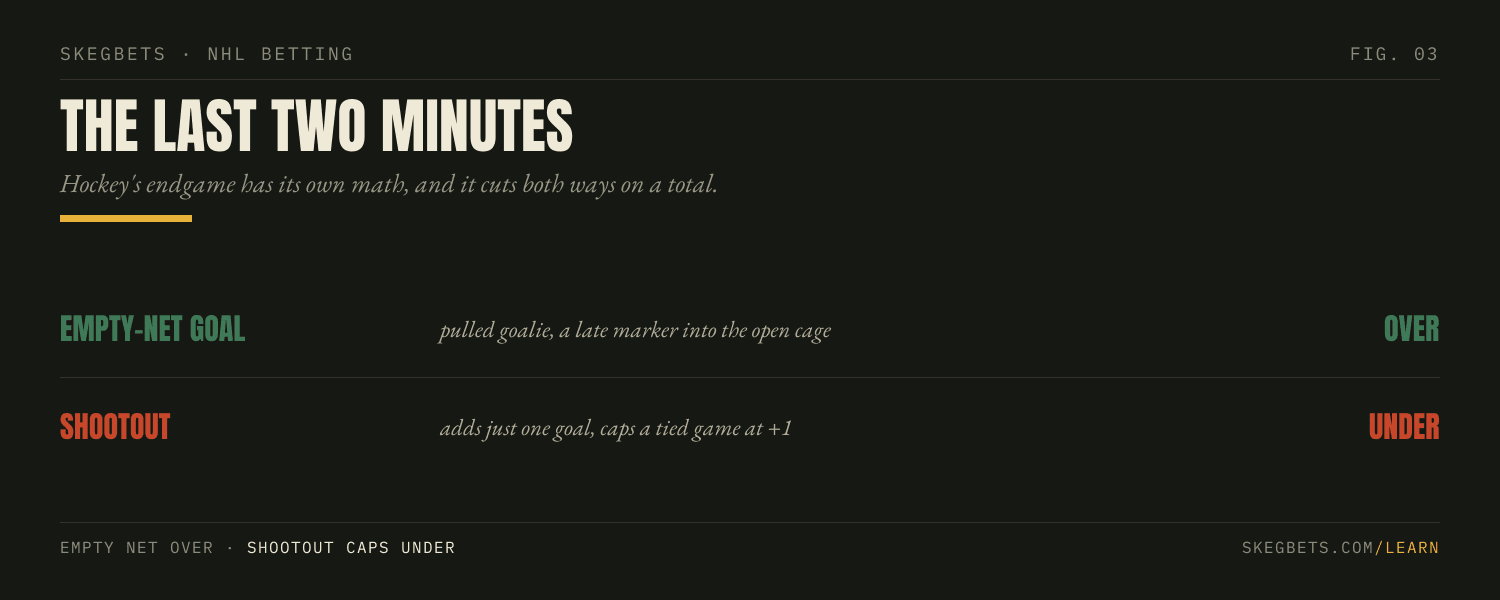
The empty net adds goals: a trailing team pulls its goalie, and the late marker into the open cage pushes a live game toward the over. The shootout does the opposite, capping the damage: a tie after overtime adds just one goal to the winner’s total, so a 2-2 game settles 3-2 no matter how many rounds the shootout runs. Tight, well-goaltended games live under the number; one-goal games with a pulled goalie sneak over it.
Reading a total
Start with the two goalies, then ask whether the matchup plays fast or slow and which special teams have the edge. Compare that read to the posted number, convert the over and under prices with the odds converter, and bet the side with the gap. That is expected value, and the numbers behind it are the ones in how to read hockey stats.
| Lever | What it does | Pushes the total |
|---|---|---|
| Goaltending | Both starters' form | Elite under, backup over |
| Pace | Shots + chances per game | Fast over, slow under |
| Special teams | Power play vs penalty kill | Mismatch leans over |
| Empty net | Pulled goalie, late goal | Over |
| Shootout | Adds one goal, caps the game | Under |
Frequently asked questions
What is a typical NHL total?+
Most NHL totals sit at 5.5 or 6.5 goals, with the occasional 6 as a flat number. Two elite goalies pull it toward 5.5; two backups or two high-event offenses push it to 6.5 or higher. The goalies and the pace of the matchup do most of the work.
Do overtime and shootout goals count toward the total?+
Yes, with one quirk. Overtime goals count normally. A shootout, however, adds exactly one goal to the final score for betting purposes: the winner is credited a single goal no matter how the shootout actually went. So a 2-2 game decided in a shootout settles as 3-2, which caps how high a tight game can climb.
What moves an NHL total the most?+
Goaltending, first and most. A confirmed starter versus a backup can move a total half a goal on its own. After that, pace (how many shots and chances the matchup generates) and special teams (a hot power play against a leaky penalty kill) round it out.
Should I lean over or under in hockey?+
Neither by default. Empty-net goals nudge live one-goal games toward the over, while the shootout cap and elite goaltending pull the other way. Read the specific goalies, pace, and special-teams matchup, and let the number tell you which side has value.
For the full picture, start with how to bet on hockey, read the goalie’s outsized role in goalies and betting, and see the totals we take in our live feed.
Free tools