Hockey doesn’t move its spread the way football does. The puck line is almost always parked at 1.5 goals, and the books move the price instead. That fixed number sits right on the most common margin in a low-scoring sport, which is what makes it one of the sharper bets on the board.
The favorite’s puck line
Lay the favorite at −1.5 and you’re asking it to win by two or more. In exchange for that tougher condition, the price jumps from a pricey moneyline to plus money.
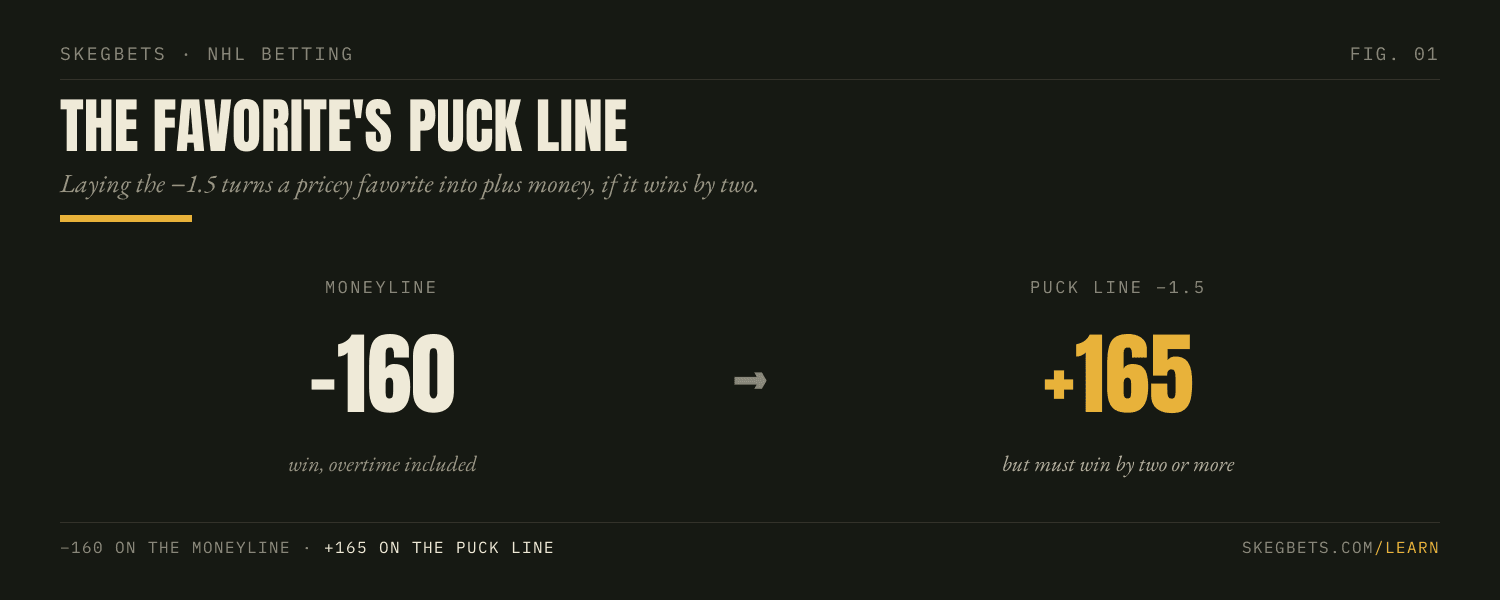
A team you’d have to lay −160 for on the moneyline might be +165 on the −1.5 puck line. That’s the trade: instead of risking $160 to win $100, you risk $100 to win $165, but a one-goal win no longer pays. If you think a good team is going to win comfortably rather than hang on, the puck line is the better-priced way to back it. For the general idea of a spread, see bet types explained.
The +1.5 underdog
Flip the bet and the math flips with it. Take the dog at +1.5 and you’ve banked a goal of cushion: it can lose by one and you still win.

The +1.5 dog cashes if it wins the game or loses by exactly one, which is a much higher hit rate than its moneyline. The payoff is smaller to match, usually a favorite-style minus price. It’s the play when you like an underdog to keep the game close but aren’t sure it wins. One warning lives in the last two minutes, and it has a name.
The empty-net wrinkle
Hockey has a quirk no other puck-line sport shares. Trailing by one in the final minutes, a team pulls its goalie for a sixth skater, and the leader often buries the puck into the empty net.

That empty-net goal turns a one-goal game into a two-goal final. It quietly tips the puck line: it pushes −1.5 favorites over the line they’d otherwise miss, and it sinks +1.5 underdogs that were a goal away from cashing. It’s the single biggest reason raw one-goal-game rates understate how often the favorite covers, and why a +1.5 dog is rarely the easy money it looks like.
When to take it
Use the favorite’s puck line when you expect a comfortable win against a backup-goalie or tired opponent, and the moneyline price is steep. Use the underdog’s +1.5 when you expect a tight game you’re not sure the dog wins, knowing the empty net is working against you. The decision is a value question: convert both prices to a percentage with the odds converter, compare them to your own read on a one-goal game, and take the bigger edge. That comparison is the whole of expected value.
| Bet | Cashes when | Trade-off |
|---|---|---|
| Favorite −1.5 | Wins by 2 or more | Plus money, empty net helps |
| Underdog +1.5 | Wins, or loses by 1 | Higher hit rate, empty net hurts |
| Moneyline | Wins, overtime included | The straight, no-spread version |
Frequently asked questions
What is the puck line in hockey betting?+
The puck line is hockey's version of the point spread, and it is almost always fixed at 1.5 goals. The favorite is laid at −1.5 (it must win by two or more) and the underdog is given +1.5 (it can lose by one and still cash). The prices move instead of the number.
Should I bet the puck line or the moneyline?+
It depends on the price and your read. Laying −1.5 on a favorite turns a costly moneyline into plus money, but the team has to win by two. Taking +1.5 on a dog raises your hit rate for a smaller payout. Compare both prices to your estimate of a one-goal game, and watch for empty-net goals.
Why do empty-net goals matter on the puck line?+
Late in a one-goal game the trailing team pulls its goalie for an extra skater, and the leader often scores into the empty net. That turns a one-goal game into a two-goal final. It quietly helps −1.5 favorites cash and burns +1.5 underdogs, so it belongs in every puck-line read.
Why is the puck line always 1.5?+
Because hockey is low-scoring and one-goal games are everywhere. About a quarter of games are still tied after regulation, and once you add regulation one-goal games, well over a third of the schedule is decided by a single goal. A 1.5 line sits right on top of that margin.
For the full picture, start with how to bet on hockey, see how the same one-goal math drives NHL totals, and find the puck lines we take in our live feed.
Free tools