Every other idea in sharp betting points at this one. Closing line value, no-vig prices, line shopping: they are all ways of chasing the same thing, a bet whose expected value is positive. Get EV and you have the only target that matters.
What expected value is
Expected value is what a bet makes on average if you could place it forever. It folds the upside, the downside, and how likely each one is into a single number. Positive EV means the bet makes money over the long run; negative EV means it bleeds.
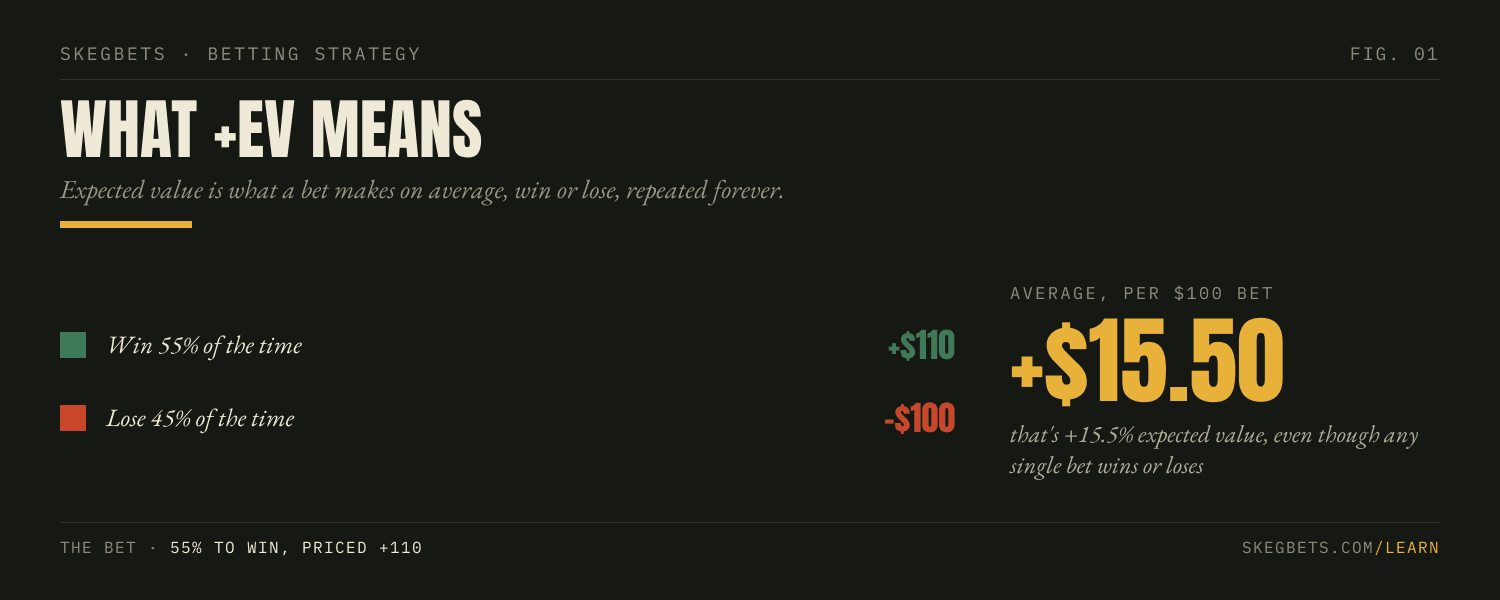
The math is one line. EV per dollar is your win probability times the decimal profit, minus your loss probability times the stake. A bet you think wins 55% of the time, priced at +110, works out to 0.55 times 1.10 minus 0.45, which is +0.155. That is +15.5% expected value: on average, every $100 on that bet returns $15.50 in profit, even though any single one either wins $110 or loses $100. The hard part isn’t the arithmetic, it’s producing a win probability you can trust, which is what implied probability is for.
Take it, or pass
Once you can estimate a fair probability, every bet becomes a yes-or-no question. Convert the price to a percentage, compare it to your honest read, and act only when your number is higher.
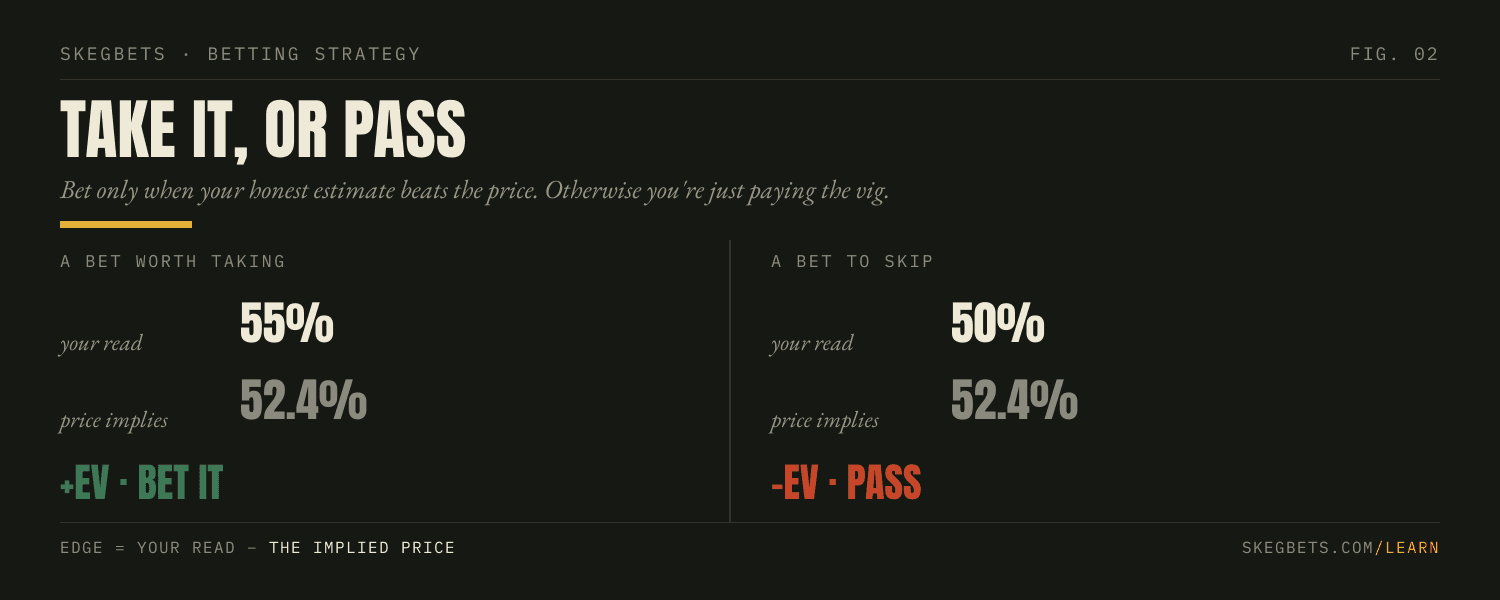
At a price implying 52.4%, a read of 55% is +EV: bet it. The same price against a read of 50% is −EV: pass, because you’d be paying the vig for the privilege of a coin flip. Most prices are close to right, so a disciplined bettor passes far more often than they bet. The skill isn’t having an opinion on every game, it’s knowing which opinions clear the price.
A small edge compounds
Real edges are small. A +15% bet is rare; most live in the 1 to 5% range. That sounds like nothing until you remember how many bets a season holds.

Over 1,000 bets of $100, a 2% edge is +$2,000 and a 5% edge is +$5,000. That’s the entire business model of a winning bettor: a thin edge, repeated thousands of times, sized so variance can’t end the run before the average shows up. For how big each bet should be, see bankroll management, and to size by the edge directly, the Kelly calculator does the math.
EV and closing line value
EV and closing line value are two views of one edge. EV is your estimate at bet time, from your own probability. CLV is the after-the-fact check: if you keep beating the closing line, the market kept moving toward your prices, which means your EV estimates were real and not wishful. EV is the target you aim at; CLV is the scoreboard that tells you whether you hit it. The cleanest way to find a fair probability to start from is to strip the vig out of a sharp book’s price and compare your read to that.
| Your fair % | Price | Expected value |
|---|---|---|
| 55% | +110 (52.4%) | +$15.50 |
| 53% | −110 (52.4%) | +$1.20 |
| 50% | −110 (52.4%) | −$4.50 |
| 45% | +120 (45.5%) | −$1.00 |
Frequently asked questions
What is expected value in sports betting?+
Expected value (EV) is the average result of a bet if you could place it over and over. A positive EV bet makes money on average; a negative EV bet loses. It is computed from your estimate of the true probability and the payout the odds offer.
How do you calculate the EV of a bet?+
EV per $1 staked is (your win probability times the decimal profit) minus (your loss probability times 1). A 55% chance at +110 (decimal profit 1.10) is 0.55 times 1.10 minus 0.45, which is +0.155, or +15.5% expected value.
Is a +EV bet guaranteed to win?+
No. EV is a long-run average, not a promise about any single bet. A strong +EV play still loses plenty of the time. The edge only shows through over a large sample, which is why disciplined sizing matters as much as finding the value.
What's the difference between EV and closing line value?+
EV is the edge you estimate at the moment you bet, from your own probability. Closing line value measures the same edge after the fact, by comparing your price to where the market closed. EV is the goal; CLV is the scoreboard that tells you whether your estimates were right.
New to the math? Start with implied probability and the math of sports betting. Prove your edge over time by tracking closing line value, and hunt for it where prices are softest, in player props and mid-game in live betting. When two books disagree far enough, you can even lock a guaranteed result with arbitrage and hedging.
Free tools