Every price on a betting board is a probability wearing a costume. Strip the +/− off and −110 is just “52.4% to break even.” Once you can read odds as percentages, you can do the only comparison that matters: what the market thinks against what you think.
A price is a percentage
Implied probability is the chance an outcome happens according to the odds. The conversion is a one-line formula in each direction, but the shape is easy to feel: the heavier the favorite, the higher the percentage.
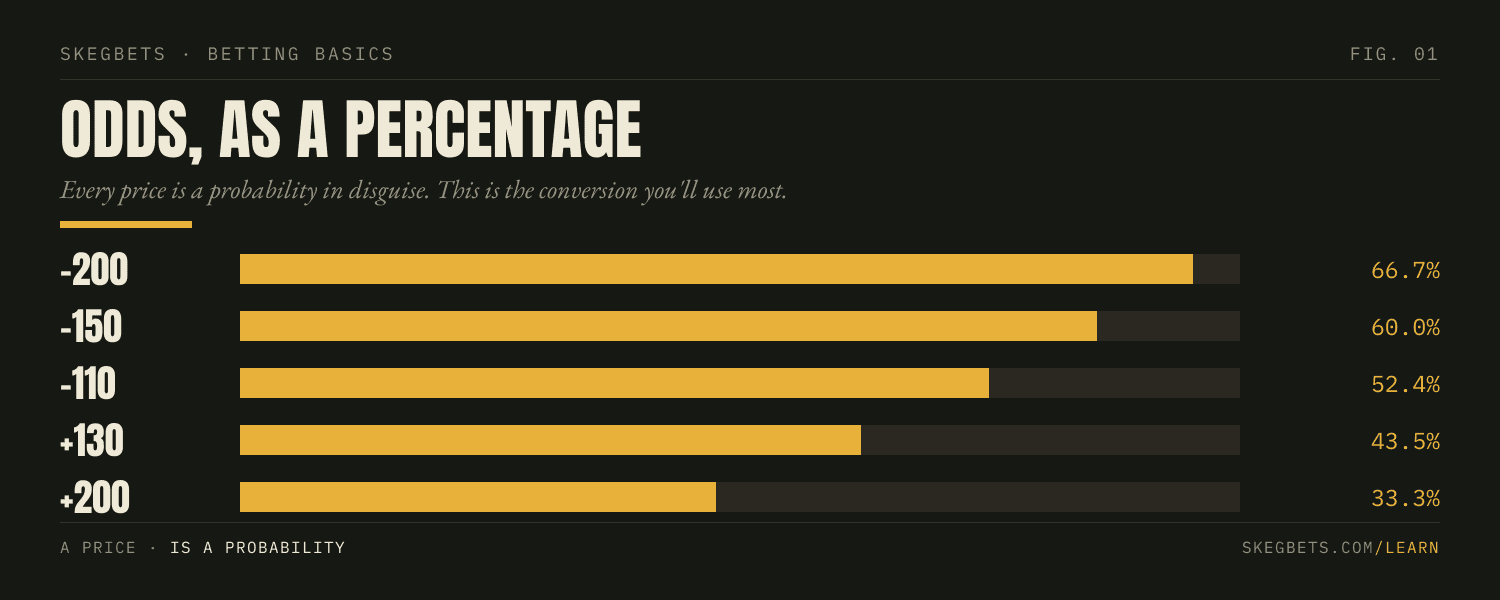
For a minus price, divide the number by itself plus 100: −150 is 150 / 250 = 60%. For a plus price, divide 100 by the number plus 100: +130 is 100 / 230 = 43.5%. You rarely need to do this by hand, the implied probability calculator turns any price into its percentage, but knowing the shape keeps you honest at the board.
Why it never adds up to 100%
Here is the catch. Add up the implied probability of both sides of a game and you’ll get more than 100%. Two sides at −110 imply 52.4% each, which is 104.8% together. The world only happens 100% of the time, so that extra 4.8% isn’t real probability, it’s the book’s margin: the vig, baked straight into the prices.
That overround is exactly why you can’t just bet coin flips and break even. It is the same 4.8% that pushes the break-even win rate at −110 up to 52.4%, the number the math of sports betting is built around.
Value: your number against theirs
Once a price is a percentage, finding value is a subtraction. Form your own honest estimate of how likely an outcome is, then compare it to what the price implies. When your number is higher than theirs, the difference is your edge.

A +130 underdog implies 43.5%. If your read says the real chance is closer to 52%, the price is paying you for an outcome more likely than it’s priced, and that 8.5-point gap is the bet. The discipline is the second half: when there’s no gap, there’s no bet. Most prices are roughly right, and forcing action on them just feeds the vig.
The book’s true number
There’s one more move worth knowing. Because both sides carry the vig, neither implied probability is the book’s honest estimate. To get that, you scale both sides back down so they sum to 100%, which is called removing the vig, or devigging.

Two −110 sides go from 52.4% / 52.4% as priced to a fair 50% / 50% once the juice is stripped out. That fair number is the cleanest read on what the market actually believes, and it’s the benchmark a sharp bettor measures their own estimate against. The no-vig calculator does the scaling for any two prices, and the odds converter handles the odds-to-percentage step. That same vig compounds on every leg of a parlay, which is why the payout is smaller than it first looks.
| Odds | Implied probability | Win rate to break even |
|---|---|---|
| −200 | 66.7% | 66.7% |
| −110 | 52.4% | 52.4% |
| +100 | 50.0% | 50.0% |
| +150 | 40.0% | 40.0% |
| +250 | 28.6% | 28.6% |
Frequently asked questions
What is implied probability in betting?+
It is the chance an outcome happens, according to the odds. Convert a price to a percentage and you get the market's estimate. −110 implies 52.4%, +130 implies 43.5%. It lets you compare what the book thinks to what you think.
How do you calculate implied probability from American odds?+
For a minus price, it is the number divided by (the number plus 100): −150 gives 150 / 250 = 60%. For a plus price, it is 100 divided by (the number plus 100): +130 gives 100 / 230 = 43.5%. Our implied probability calculator does it instantly.
Why do both sides of a bet add up to more than 100%?+
Because the book builds its margin (the vig) into both prices. Two −110 sides imply 52.4% each, or 104.8% together. That extra 4.8% is the house edge. Scaling both back to 100% gives you the fair, no-vig probability.
How does implied probability help you find value?+
Convert the price to a percentage, then compare it to your own honest estimate of the chance. If you think a team wins 52% of the time but the price only implies 43.5%, the gap is your edge. No gap, no bet.
First time with odds at all? Read how to read betting odds first. For the variance and bankroll math behind the break-even line, see the math of sports betting, and convert any price with the implied probability calculator.
Free tools