From the outside, sports betting looks like a wall of numbers and plus-minus signs. Underneath, almost all of it is three bets, one number that sets the price, and one rule that keeps you solvent. Learn those and you can read any line on any book.
Start with the odds
Every bet starts with a price, and US sportsbooks quote that price in American odds: a number with a plus or minus in front. The sign tells you which side is favored; the number tells you what the bet pays.
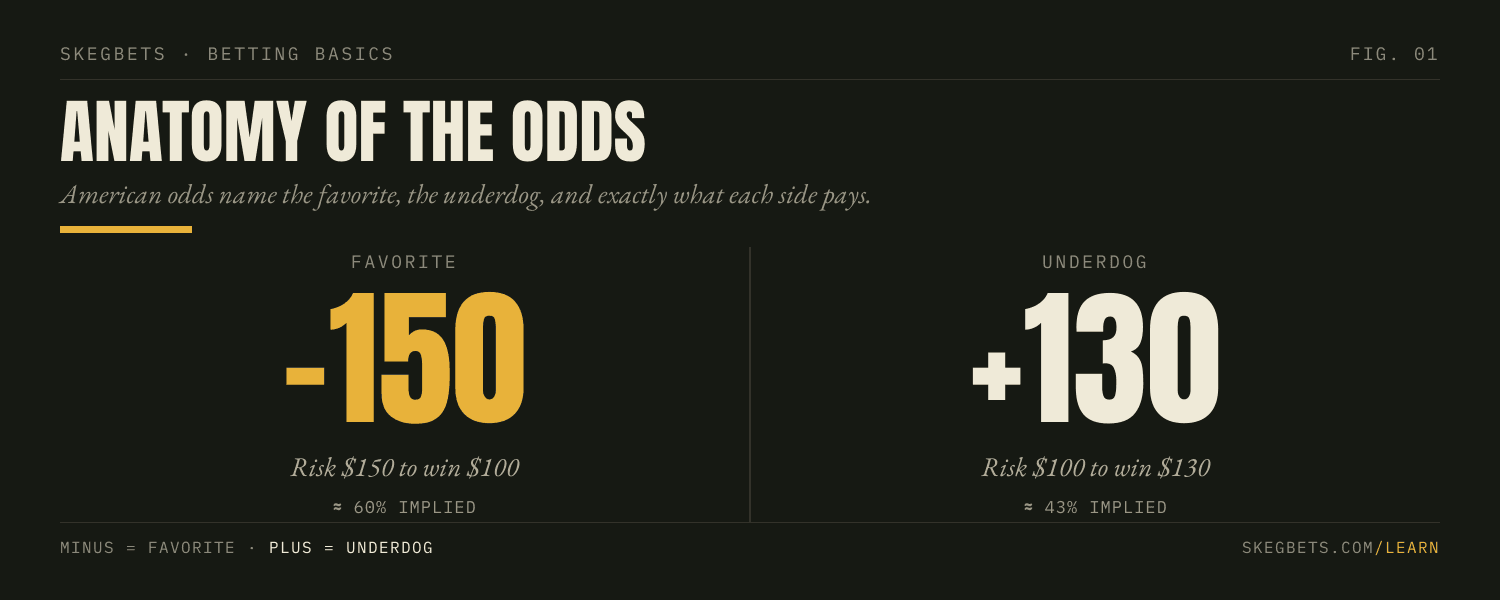
A minus number is the favorite, and it shows what you risk to win $100. At −150, you put up $150 to win $100. A plus number is the underdog, and it shows what $100 wins. At +130, you risk $100 to win $130. The further a number sits from even, the bigger the gap the book sees between the two teams.
Those odds also carry a probability. A price of −150 implies roughly a 60% chance; +130 implies about 43%. Turning a price into a percentage is the single most useful habit in betting, because it lets you compare what the book thinks to what you think. The odds converter does the arithmetic instantly, and the implied probability calculator turns any price into its percentage.
The three bets you’ll actually make
There are dozens of exotic bet types, but you can go a long way with three. Everything else is a variation on them.
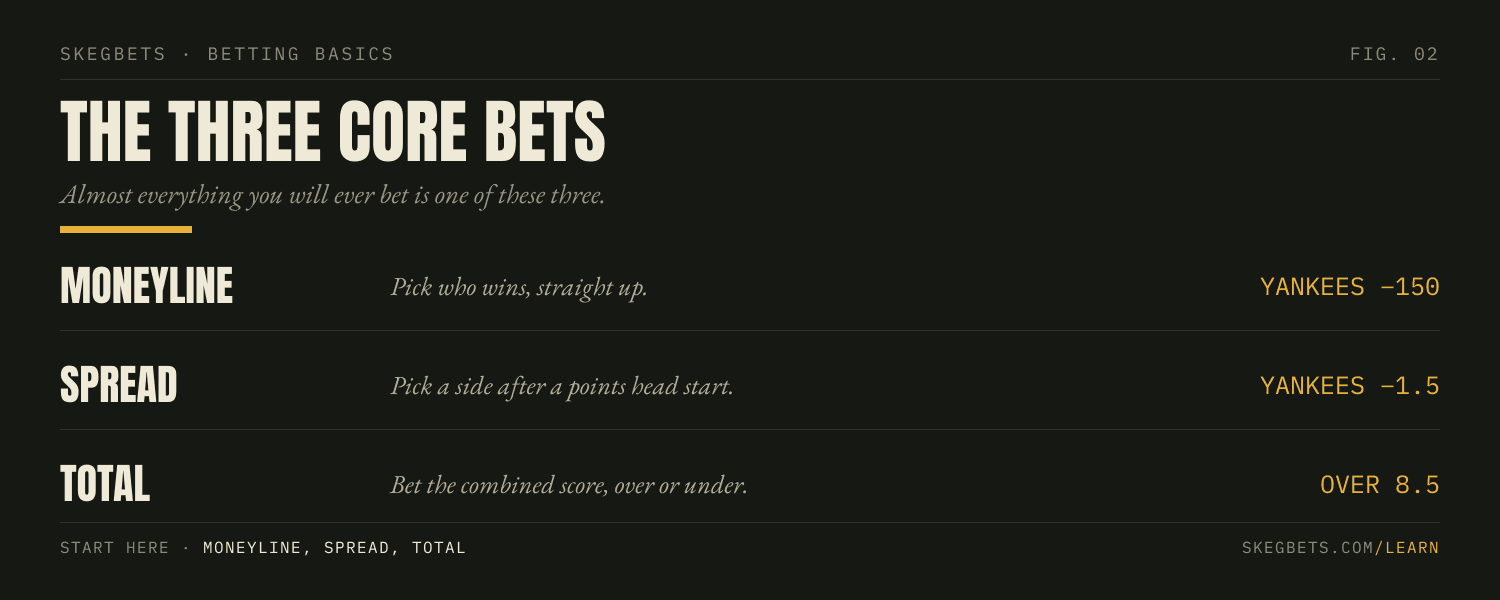
| Bet type | What you're picking | Example |
|---|---|---|
| Moneyline | Who wins, straight up | Yankees −150 |
| Spread | A side after a points handicap | Yankees −1.5 |
| Total | The combined score, over or under a line | Over 8.5 (−110) |
The moneyline is the simplest: pick the winner. The spread (the run line in baseball, the puck line in hockey) hands the underdog a head start, so a favorite has to win by more than the number to cash. The total ignores who wins entirely; you are betting whether the two teams combine to score over or under a posted line. Start on the moneyline, get comfortable watching a price move, then add the other two.
The vig: why winning half isn’t enough
Here is the part that trips up new bettors. A coin-flip game should pay even money, but you will almost never see it. Instead, both sides are priced around −110: risk $110 to win $100. That extra $10 is the vig (also called the juice or the hold), and it is how the book makes money no matter who wins.
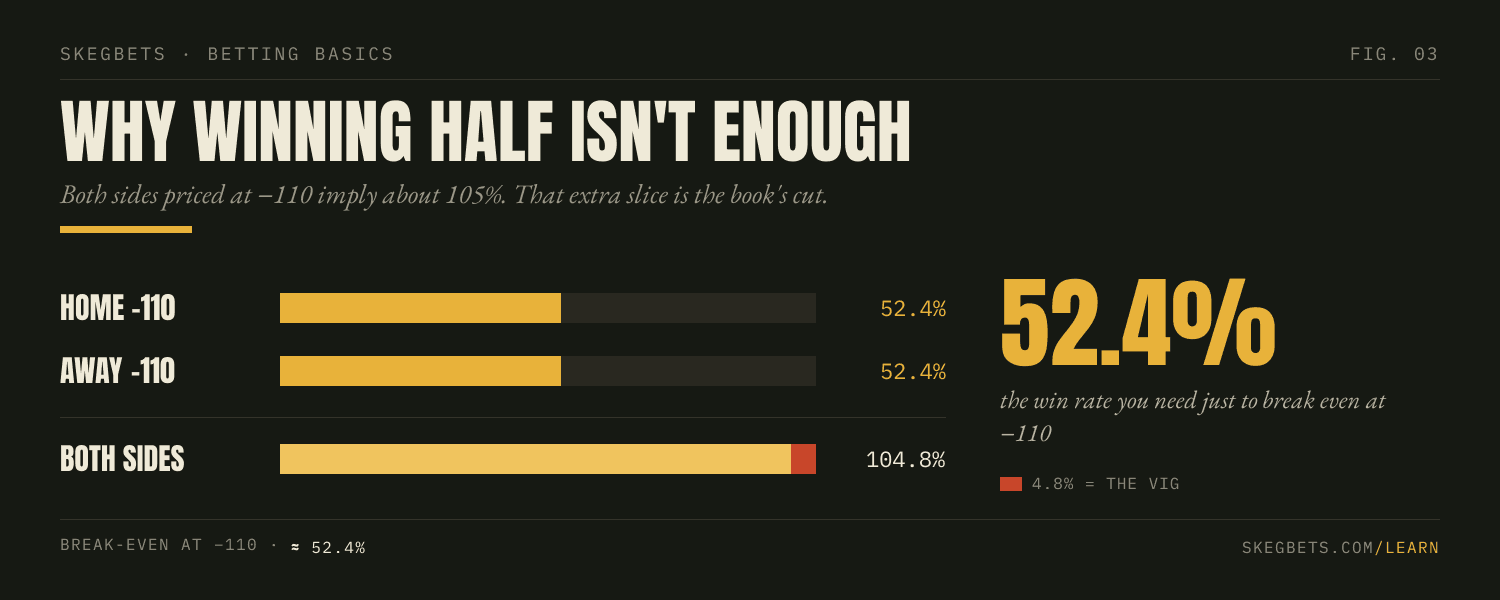
Price both sides of a game at −110 and the implied probabilities add up to about 104.8%, not 100%. That extra 4.8% is the book’s margin baked into the line. In practice it means you have to win about 52.4% of your −110 bets just to break even, not 50%. That 2.4-point gap is the whole game: clear it and you win, fall short and the vig grinds you down. The no-vig calculator strips the juice out of any price to show the book’s true estimate, and the math of sports betting walks through the break-even and the variance behind it.
Bankroll: the rule that keeps you in the game
The most common way to lose is not bad picks, it is bad sizing. Decide on a bankroll, an amount you can afford to lose, and bet a small, fixed slice of it per game, usually 1 to 2%. That slice is your unit. Flat-betting one unit at a time is boring on purpose: it means a normal cold streak dents you instead of wiping you out.
The two habits that ruin bankrolls are chasing (raising your bet to win back a loss) and betting your whole roll on a “lock.” There is no lock. Even a strong 55% bet loses 45 times out of 100, so the only way an edge ever shows up is over a large sample, at a steady size. The Kelly criterion calculator gives a mathematically optimal stake once you can estimate your edge, but a flat 1 to 2% is a perfectly good place to start. For the full approach, see bankroll management and unit sizing, and keep the whole activity inside healthy limits with responsible gambling.
Where the edge actually comes from
If the vig means you need 52.4% just to tread water, where does a winning bettor find the extra? Not from picking more winners, exactly, but from getting better prices than the final market. A bet placed at +3 that the market moves to +1.5 by game time beat the closing number by a point and a half, and beating the close is the cleanest proof there is that you found value before everyone else.
That is the thread connecting every advanced piece on this site: closing line value is how you measure it, timing your bets is how you capture it, and the underlying math is why a small, repeatable edge compounds. None of it requires a model on day one. It requires reading a price, knowing the break-even, and betting a size you can survive.
A simple way to start
Frequently asked questions
How do sports betting odds work?+
American odds use a plus or minus sign. A minus number is the favorite and shows what you risk to win $100 (−150 means risk $150 to win $100). A plus number is the underdog and shows what $100 wins (+130 means risk $100 to win $130). The bigger the number, the bigger the gap between the two sides.
What is the easiest bet for a beginner?+
The moneyline. You are only picking who wins, with no point spread to cover. It is the simplest bet to understand, and it is a clean way to learn how prices move before you take on spreads, totals, or props.
How much should I bet on each game?+
A small, fixed fraction of a bankroll you can afford to lose, usually 1 to 2 percent per bet. Betting in consistent units is what survives a normal losing streak. Chasing losses with bigger bets is the fastest way to go broke, even with a real edge.
Can you actually make money betting on sports?+
Yes, but it is hard. Because the book builds a cut (the vig) into every price, you need to win about 52.4 percent of even-money bets just to break even. Long-term winners get there by finding prices that are a little bit wrong before the market corrects them, then betting them at a disciplined size.
Ready to put it to work? Our live picks show the exact price we took on every play, the free tools handle the odds math for you, and the stats pages carry the numbers behind the bets. When you’re ready to go deeper, the math of sports betting is the natural next read. From there, go to your sport: football, basketball, baseball, hockey, or tennis.
Free tools