Odds look like a foreign language until you notice it’s the same sentence in three accents. American, decimal, and fractional are three ways of writing one price. Learn to read all three and no betting board, anywhere, can confuse you.
The same bet, three ways
A sportsbook in New Jersey, an exchange in London, and a betting app in Sydney will quote the exact same game in three different notations. None of them is a different wager, only a different way of writing the price.
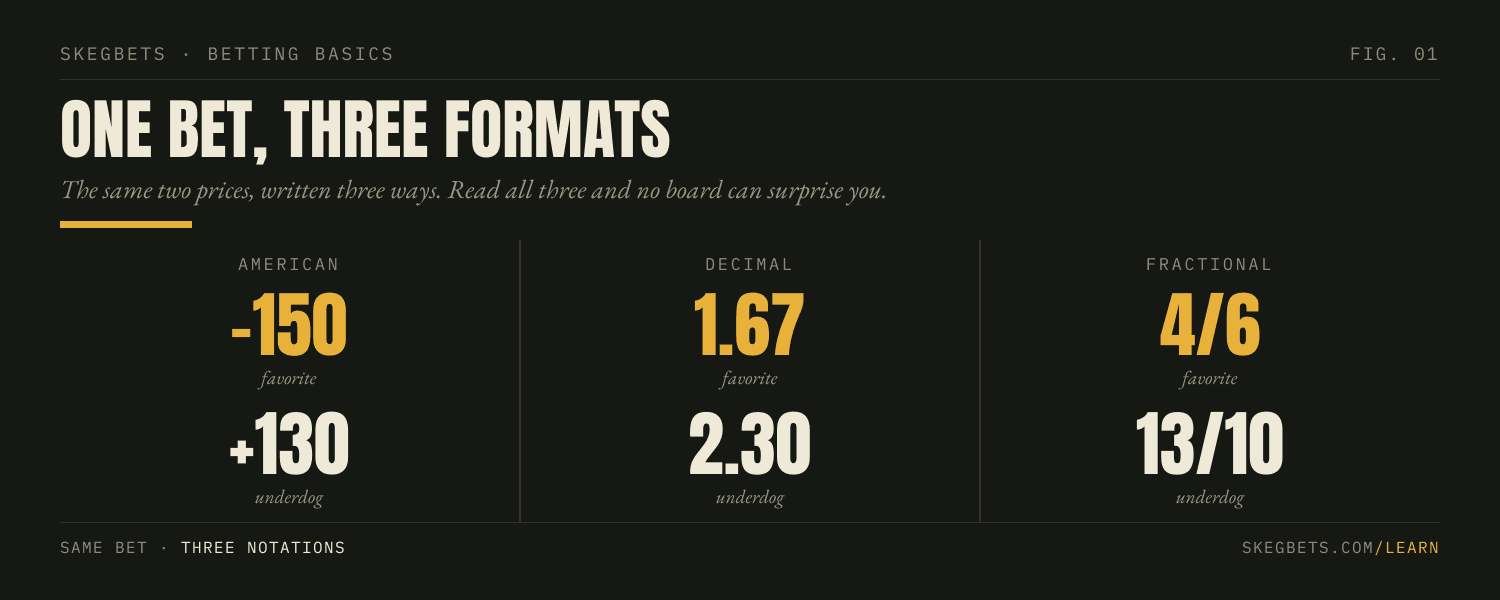
American books lead with the +/− format, so that is the one to learn first. Decimal shows up on exchanges and most of the world’s books, and fractional is the old racing notation you’ll still see in the UK. They convert cleanly between each other, as the table at the bottom of this page shows.
American odds: the sign is the story
The plus or minus does the heavy lifting. A minus price is the favorite and tells you what to risk to win $100: −150 means stake $150 to win $100. A plus price is the underdog and tells you what $100 wins: +130 means stake $100 to win $130.

The further a number sits from even, the more lopsided the book thinks the matchup is. −300 is a heavy favorite that pays little; +300 is a long shot that pays well. A game priced near +100 on both sides is close to a coin flip. The sign alone tells you who’s favored before you do any arithmetic.
Decimal odds: one number, one multiply
Decimal odds are the easiest to do math with, which is why exchanges and sharp bettors prefer them. The number already includes your stake, so you just multiply.

Stake times the decimal price is your total return. A $100 bet at 2.30 returns $230: your $100 back plus $130 of profit. Anything above 2.00 is an underdog (you more than double up), anything below 2.00 is a favorite, and 2.00 itself is an even-money coin flip.
Fractional odds: profit over stake
Fractional odds read as profit-to-stake. A price of 13/10 means you win $13 for every $10 risked, the same as +130 or 2.30. A favorite like 4/6 means you win $4 for every $6 staked, which matches −150 and 1.67. The format is older and clunkier for math, but you’ll still meet it on UK books and horse racing, so it’s worth recognizing.
Which one should you use
Read whatever your book shows, but think in the format that fits the job. American tells you the favorite at a glance. Decimal is fastest for figuring out a payout. And to judge whether a price is any good, the move is to convert it to a percentage, which is the whole subject of implied probability. The odds converter flips between all three formats plus the implied percentage, so you never have to do it by hand.
| American | Decimal | Fractional · implied |
|---|---|---|
| −200 | 1.50 | 1/2 · 66.7% |
| −150 | 1.67 | 4/6 · 60.0% |
| −110 | 1.91 | 10/11 · 52.4% |
| +130 | 2.30 | 13/10 · 43.5% |
| +200 | 3.00 | 2/1 · 33.3% |
Frequently asked questions
What does a minus sign mean in betting odds?+
A minus sign marks the favorite, and the number is what you risk to win $100. At −150 you put up $150 to win $100. The bigger the minus number, the heavier the favorite and the smaller the payout.
What does a plus sign mean in betting odds?+
A plus sign marks the underdog, and the number is what $100 wins. At +130 you risk $100 to win $130. The bigger the plus number, the longer the underdog and the larger the payout.
Are decimal and American odds different bets?+
No. They are the same price in different notation. −150 American, 1.67 decimal, and 4/6 fractional all describe the identical bet. Decimal is just the cleanest for math: stake times the decimal equals your total return.
How do I convert between odds formats?+
By hand it is a small formula for each direction, but the fastest way is a converter. Our odds converter turns American, decimal, and implied probability into each other instantly, so you can read any book's board.
New to all of this? Start with how to bet on sports. Ready to judge whether a price is worth taking? That’s implied probability, and the odds converter handles the conversions for you.
Free tools