The fastest way to lose at sports betting isn’t bad picks. It’s good picks bet at the wrong size. Bankroll management is the unglamorous half of winning, and it’s the half that decides whether you’re still here in six months.
What a unit is
Start with a bankroll: money set aside for betting that you can afford to lose, separate from rent and groceries. Then bet a small, fixed slice of it on each play. That slice is your unit.

On a $1,000 bankroll, a 2% unit is $20. You bet roughly that on every play, win or lose, hot or cold. Thinking in units rather than dollars does two things: it keeps your risk proportional as the bankroll grows or shrinks, and it lets you compare results honestly. “Up 12 units” means the same thing whether you started with $500 or $5,000.
Flat staking beats chasing
The single most expensive habit in betting is chasing: raising your stake to win back a loss. It feels like taking control. It is the opposite. Chasing puts your biggest bets down at the worst possible moment, right in the middle of a cold streak.
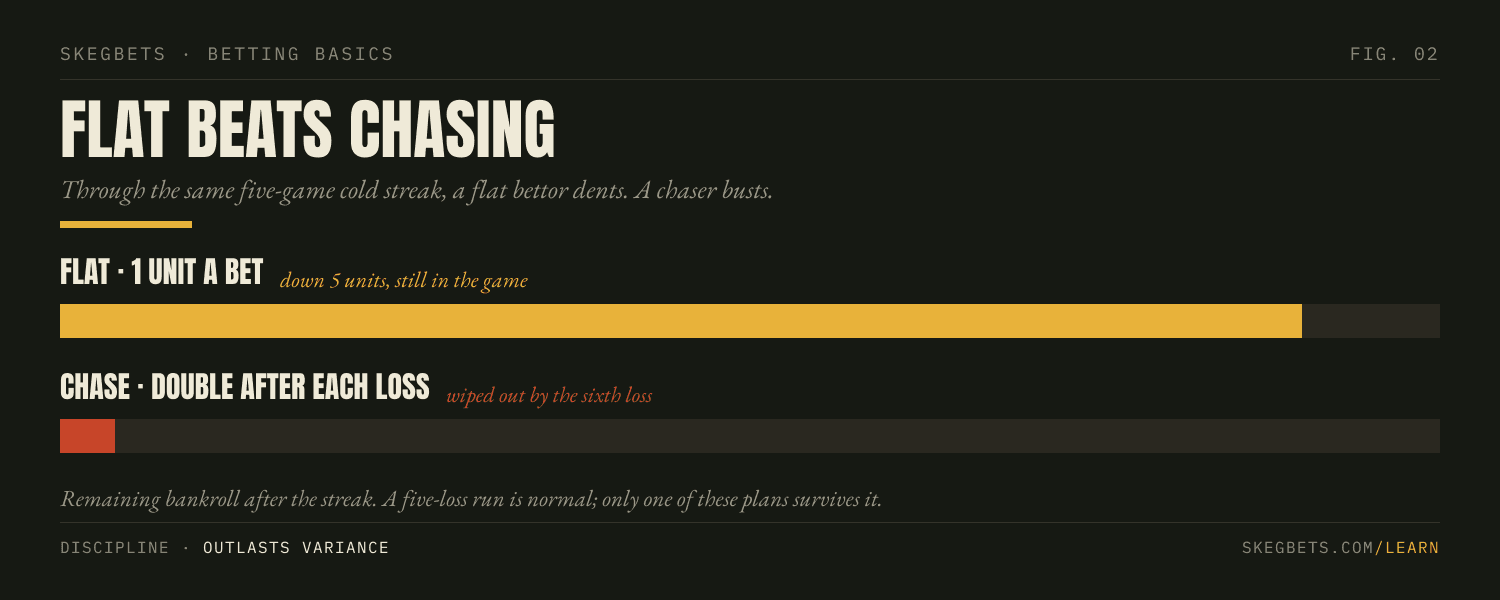
A five-game losing streak is not bad luck, it’s a normal Tuesday; even a 55% bettor hits one regularly. Flat-staking one unit, that streak costs you five units and you’re still standing. Doubling after each loss, the same five-game run runs out of bankroll before it’s over. Same picks, same streak, opposite endings. The difference is entirely in the sizing.
How big should a unit be?
For almost everyone, the answer is 1 to 2% per play. Small enough to absorb a bad run, large enough that a real edge compounds.

At 1% you’ll almost never go broke, but you grow slowly. At 2% you’ve got the common, sane default. Push to 3% and the swings get real; at 5% and up, an ordinary cold streak can end your bankroll outright, no matter how good your picks are. When in doubt, bet smaller. You can always size up once you have a long, honest record to point to.
| Bankroll | 1% unit | 2% unit |
|---|---|---|
| $500 | $5 | $10 |
| $1,000 | $10 | $20 |
| $2,500 | $25 | $50 |
| $5,000 | $50 | $100 |
Sizing by your edge
Flat staking is the right call until you can actually estimate how big your edge is on a given bet. Once you can, the Kelly criterion sets the stake that grows a bankroll fastest, scaling your bet up when the edge is large and down when it’s thin. Full Kelly is volatile, so most bettors use a half or a quarter of it. The Kelly criterion calculator does the math from your edge and the odds, and the math of sports betting explains the variance that makes disciplined sizing matter in the first place.
Frequently asked questions
What is a unit in sports betting?+
A unit is your standard bet size, set as a small fixed slice of your bankroll, usually 1 to 2 percent. On a $1,000 bankroll, a 2 percent unit is $20. Betting in units instead of dollars keeps your risk consistent as the bankroll moves.
How much of my bankroll should I bet per game?+
For most bettors, 1 to 2 percent per play. That is small enough to survive a normal losing streak and steady enough that your edge, if you have one, shows up over time. Sizes above 3 percent leave you exposed to ordinary variance.
Why is chasing losses such a bad idea?+
Because it raises your stake exactly when your bankroll can least afford it. A doubling-up plan only needs one ordinary cold streak to wipe you out. Flat staking takes the same streak as a dent instead of a knockout.
What is the Kelly criterion?+
Kelly is a formula that sets the mathematically optimal bet size from your estimated edge and the odds. It grows a bankroll fastest in theory, but full Kelly is volatile, so many bettors use a half or quarter of it. A flat 1 to 2 percent is a fine starting point until you can estimate an edge.
New here? Start with how to bet on sports. To size by your edge, the Kelly calculator does the work, and closing line value is how you prove the edge is real before you trust your sizing to it. To keep the whole activity inside healthy limits, see responsible gambling.
Free tools