Most of betting is about probabilities. Arbitrage and hedging are the two plays where you can take the probability out entirely: one guarantees a profit, the other guarantees a result. Both are useful to understand, and both are easy to overrate.
Arbitrage: a locked profit
Arbitrage exists because books set their own numbers and sometimes disagree. When two books price the two sides of a game generously enough, you can back both and come out ahead no matter what happens.

If one book has Team A at +105 and another has Team B at +105, both prices imply 48.8%, which sums to 97.6%. Anything under 100% is an arb. Because the two prices are equal, you split the $1,000 evenly, $500 a side, and collect about $1,025 whichever team wins: a guaranteed 2.5%. The arbitrage calculator finds the exact stakes for any pair of prices. The catch is in the execution, not the math: lines move, stakes have to be exact, and books move quickly to limit accounts that arb at size.
Hedging: bank a sure thing
Hedging is the cousin of arbitrage you reach for when you already have a bet live. Instead of riding an all-or-nothing outcome, you bet the other side to lock in a guaranteed result.
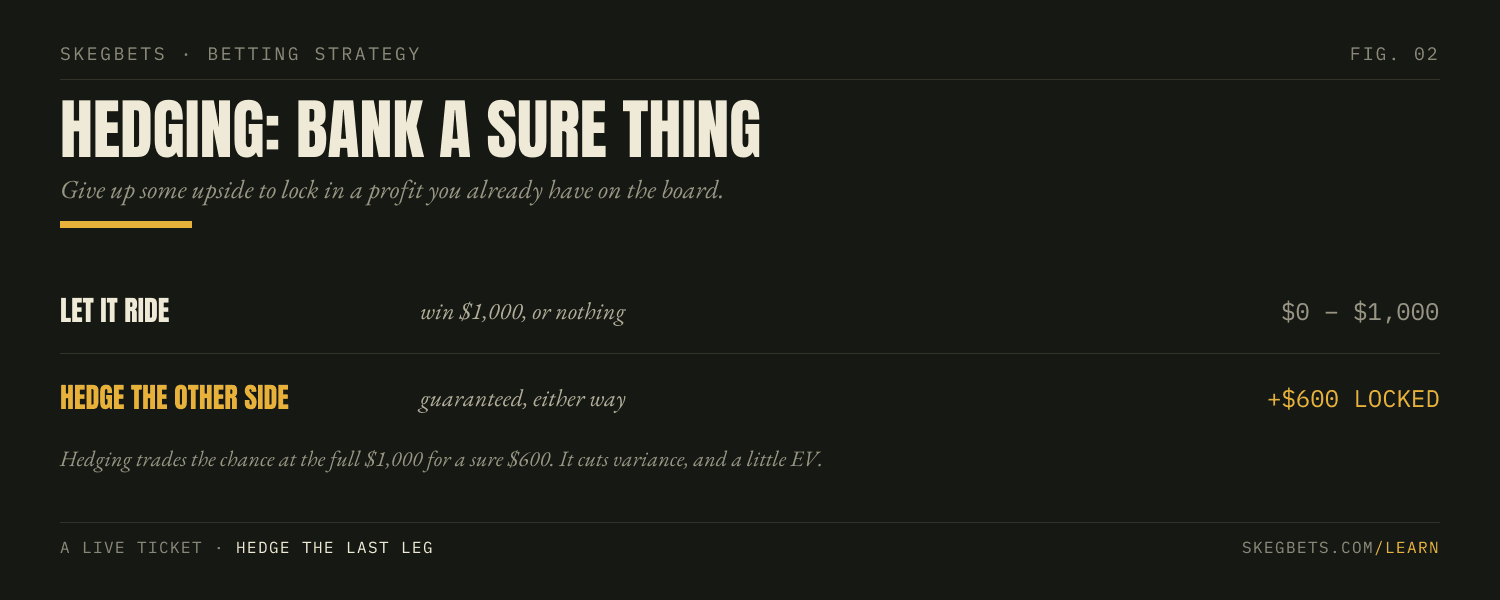
Say a futures ticket is one leg from paying $1,000, but that last leg is a coin flip. Let it ride and you win $1,000 or nothing. Bet a measured amount on the other side and you can lock in a guaranteed profit, perhaps $600, no matter how the leg lands. Hedging trades the shot at the full amount for a sure thing. It doesn’t add expected value, it removes variance, and the right call depends entirely on how much the swing matters to your bankroll.
Arb, hedge, or value?
It’s worth being clear about what each tool actually does, because only one of them grows a bankroll over time.
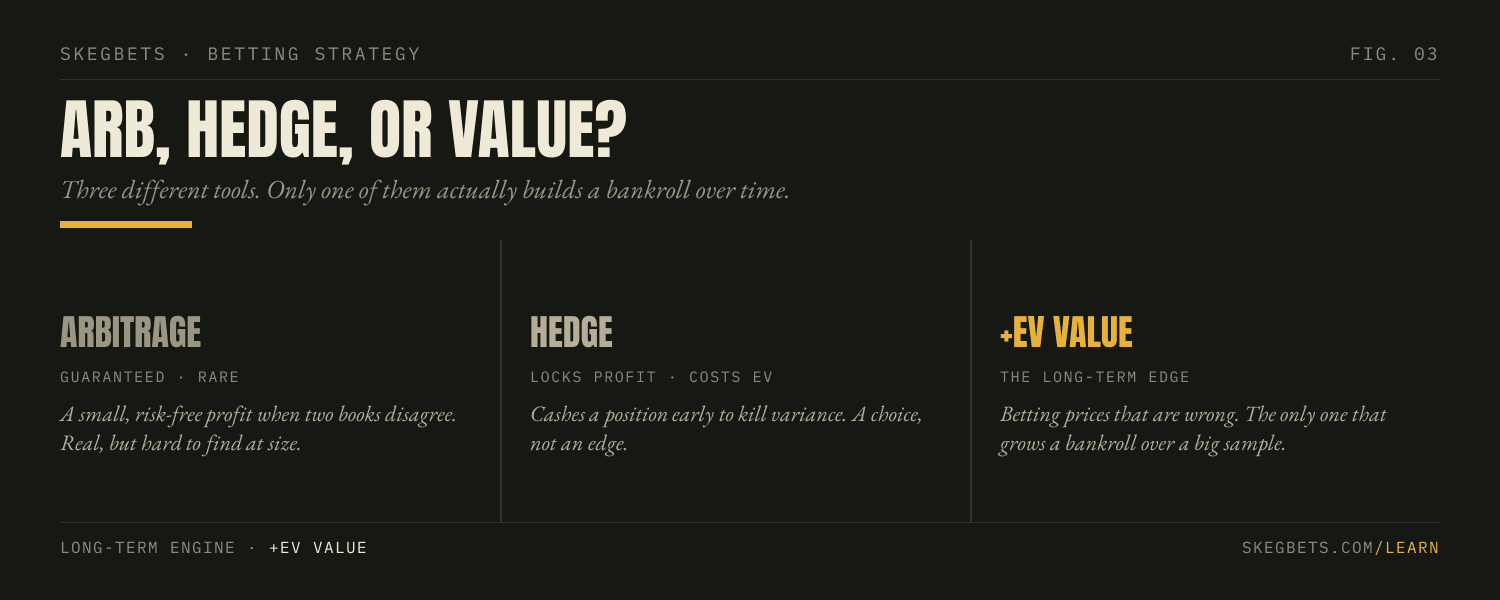
Arbitrage is a guaranteed, tiny, hard-to-find profit. Hedging is a way to cash a position early and kill variance, at the cost of some expected value. Neither is an edge in the way that matters: the thing that actually compounds a bankroll is positive expected value, betting prices that are wrong, over and over. Arb and hedge are situational tools layered on top of that, not substitutes for it.
Should you do either?
Understand both; lean on neither. Pure arbitrage is real but the margins are thin, the windows are short, and books limit the accounts that pursue it, so it’s a grind for small, fragile returns. Hedging has a clear place, mostly on big futures or long parlays where a guaranteed payout is worth more to you than the extra expected value of letting it ride. For everyone else, the time is better spent finding +EV bets and shopping for the best number, the two habits that actually build an edge.
| Play | What it gives you | The cost |
|---|---|---|
| Arbitrage | A guaranteed small profit | Rare; books limit it |
| Hedge | A locked-in result | Gives up expected value |
| +EV value | Long-term growth | Variance along the way |
Frequently asked questions
What is arbitrage betting?+
Arbitrage means betting both sides of a game at different sportsbooks whose prices, taken together, guarantee a profit no matter who wins. It exists when two books disagree enough that the combined implied probability of both sides is under 100%.
Is arbitrage betting legal and risk-free?+
It is legal, and the profit on a correctly placed arb is locked in. The practical risks are execution, not the math: a line moving before you place the second leg, a bet getting voided, account limits, or a stake error. The edges are small and books limit accounts that do it heavily.
What does hedging a bet mean?+
Hedging is betting the other side of a wager you already have live, to guarantee a profit or cap a loss. The classic case is a futures or parlay one leg from cashing: betting against your own ticket locks in a sure return instead of an all-or-nothing finish.
Should I hedge or let it ride?+
It depends on the bankroll and the stakes, not on a rule. Hedging trades expected value for certainty, so it lowers your average return but removes the variance. If losing the full amount would genuinely hurt, hedging is reasonable. If you can absorb the swing, letting a +EV position ride is worth more over time.
The real edge is expected value plus line shopping. Run the numbers on a specific arb with the arbitrage calculator.
Free tools