A football total looks like one number and is really a small stack of them. Read the offenses, the pace, and the forecast, and you can often see the over/under before the market settles. Then the way the game actually unfolds, the script, decides the last few points.
Three levers on a total
Pull an NFL number apart and the same three inputs fall out every time: how good the offenses are, how often they get the ball back, and what the sky is doing to the passing game. Price those better than the book and the edge is yours.
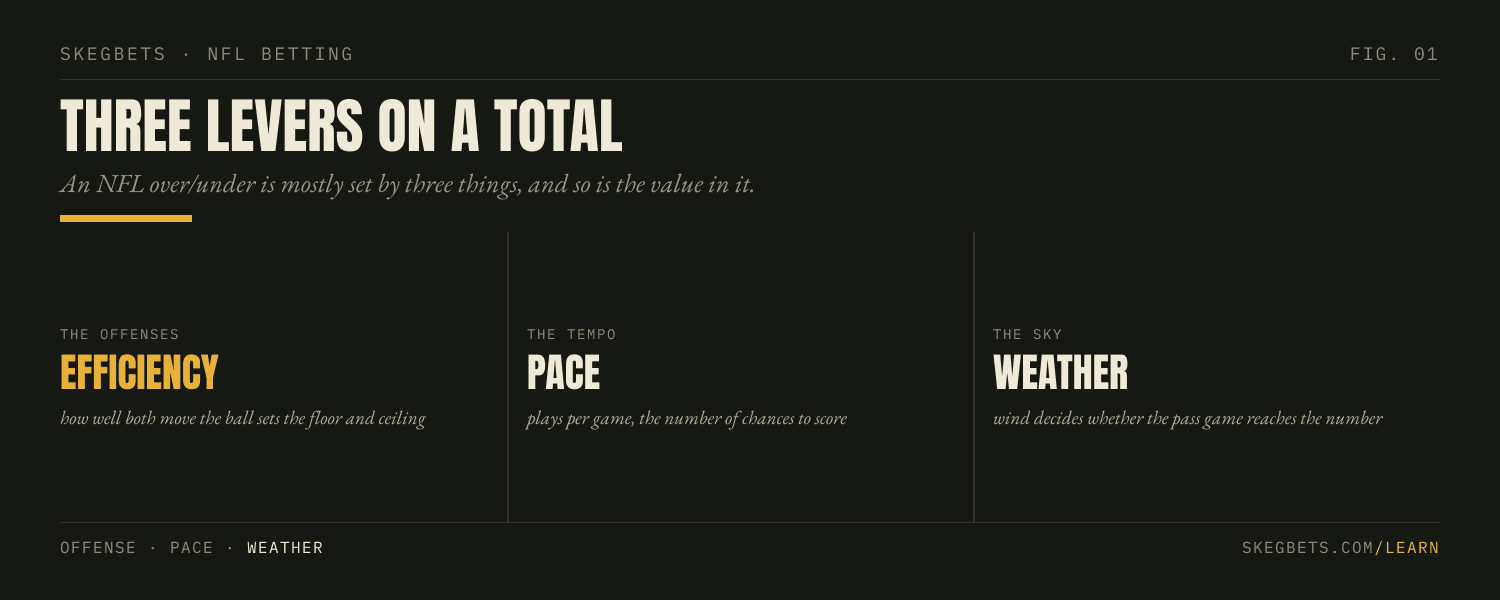
Offensive efficiency on both sides sets the scoring floor and ceiling. Pace, how many plays the matchup runs, sets the number of chances to score. And the weather, wind above all, decides whether the passing game can reach the number. The efficiency and pace figures live on our NFL stats pages.
Wind is the big one
Of everything the forecast throws at a game, one element actually moves a total, and it is not the one most people check.
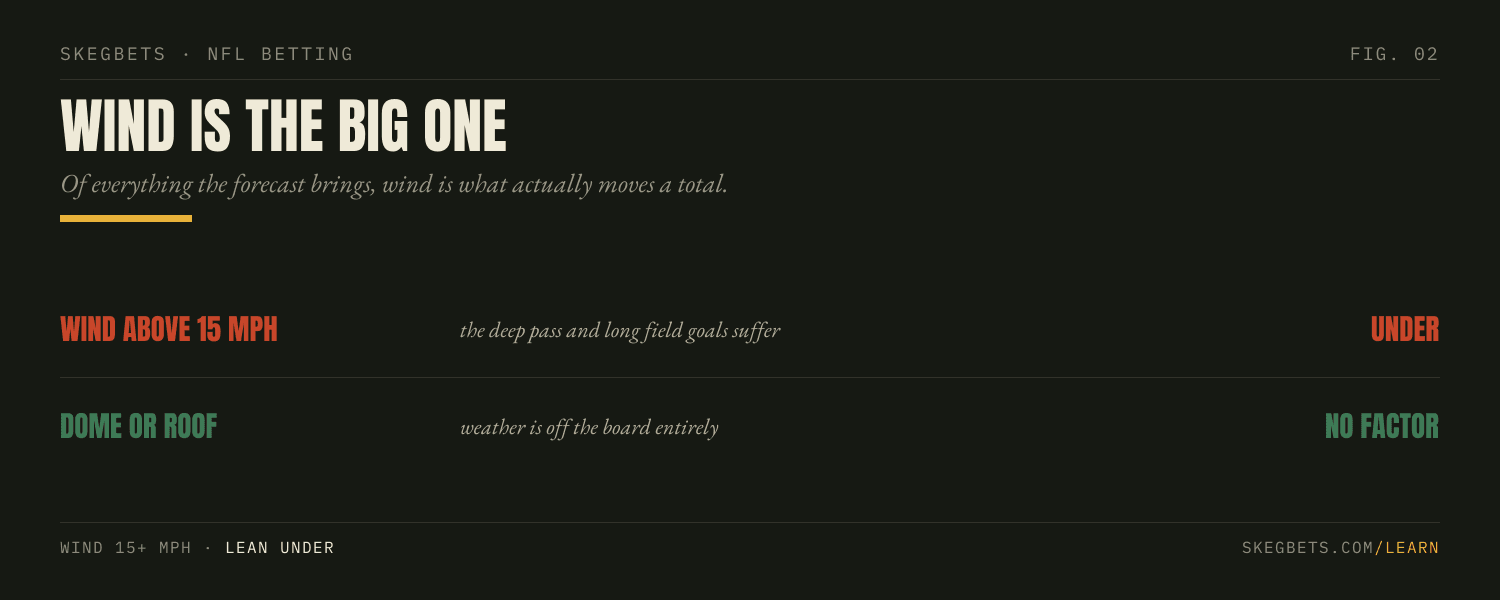
Sustained wind above roughly 15 mph is the strongest weather signal in football. It shrinks the deep passing game and makes long field goals a gamble, and totals fall with it. Cold and rain get more attention than they deserve; a well-bundled offense scores fine at 25 degrees. A dome or retractable roof takes weather off the board completely, which is its own piece of information when you are reading a number.
Pace and game script
Two more forces shape the points: how fast a game is played, and how it ends up being played once the score tilts.
Pace sets the raw number of plays; a fast, pass-first offense manufactures more chances than a ball-control team that grinds the clock. Game script then takes over late. A blowout flips the leader into running the ball and the clock, which quietly kills the over, while a tight back-and-forth keeps both offenses on the field and pushes it. A team’s pace and the spots that produce blowouts are part of situational angles.
Reading a total
Build your own number first: weigh the two offenses, decide whether the matchup runs fast or slow, then dock the passing game for any real wind. Where your number sits well off the posted one, run both prices through the odds converter to see which side the market is underpaying, and take it. That gap is the whole game of expected value, and the stats that feed it are broken down in how to read football stats.
| Lever | What it does | Pushes the total |
|---|---|---|
| Offensive efficiency | How well both move the ball | Strong over, weak under |
| Pace | Plays per game | Fast over, slow under |
| Wind | 15+ mph hurts the pass | Under |
| Dome / roof | No weather factor | Removes the wind angle |
| Game script | Blowout drains the clock | Under |
Frequently asked questions
What is a typical NFL total?+
Most NFL totals sit between 40 and 48 points. Two efficient offenses in a dome push it toward the high 40s or more; two strong defenses, or a windy outdoor game, pull it into the low 40s or below. Offense, pace, and weather do almost all of the work.
Does weather really move NFL totals?+
Wind does, more than anything. Sustained wind above roughly 15 to 20 mph hurts the deep passing game and field goals, which pulls totals down and is a classic under signal. Cold and rain matter less than people think; a dome or retractable roof removes weather from the equation entirely.
What is pace in football betting?+
How many plays a game runs. Teams that play fast, go no-huddle, or throw on early downs run more plays and create more scoring chances, which lifts totals. Ball-control teams that lean on the run and bleed clock run fewer plays and trend under.
Should I lean over or under in the NFL?+
Neither by default. A fast, dome shootout points to the over; wind, two good defenses, or a likely blowout that drains the clock point to the under. Read the specific offenses, pace, and forecast, and let the posted number tell you which side has value.
For the full picture, start with how to bet on football, read the rest-and-spot angles in situational angles, and see the totals we take in our live feed.
Free tools