Most sports scatter their final margins. Football piles them up. A handful of numbers, led by 3 and 7, account for a huge share of how NFL games end, and once you can see that shape you understand why a single half-point is sometimes the whole bet.
Why 3 and 7
NFL points arrive in field goals and touchdowns, so the gaps between teams tend to settle on multiples of those. Plot every margin and two numbers tower over the rest.

About 15% of NFL games are decided by exactly 3 points, and roughly one in ten by 7. After those come 6, 10, 4 and 14, each far smaller. A spread parked on 3 or 7 is sitting on top of the most common results in the sport, which is what makes those lines so valuable, and what makes laying or taking the number around them, covered in the point spread explained, such a precise decision.
What a half-point is worth
Not all half-points are equal. The value of moving a spread depends entirely on which number you cross.
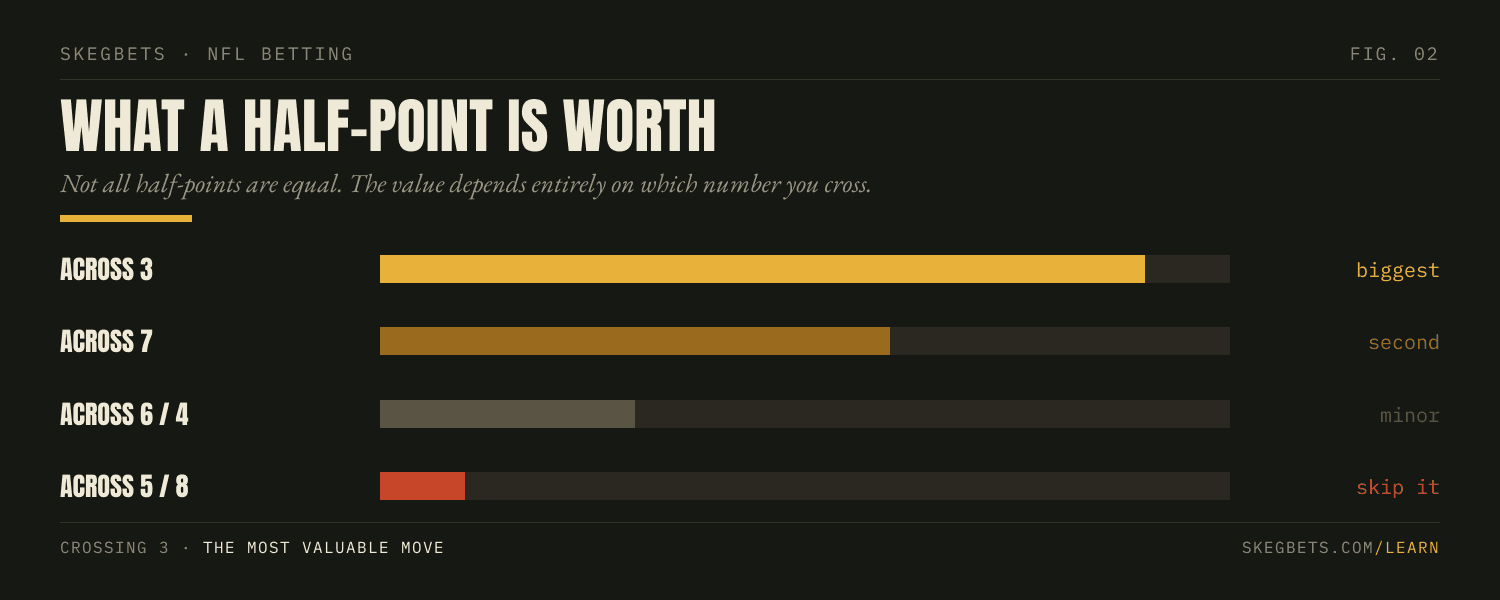
Crossing 3 is the most valuable move in football, with crossing 7 close behind. That is why books charge extra to buy a half-point onto 3, often shifting the price from −110 toward −120 or worse, and why it is still frequently worth paying. A half-point across a quiet number like 5 or 8 moves almost nothing and rarely earns its juice. Knowing the difference is the practical payoff of key numbers.
Crossing the key numbers
The cleanest way to use key numbers is to move a spread across both of them at once, which is exactly what a teaser does.
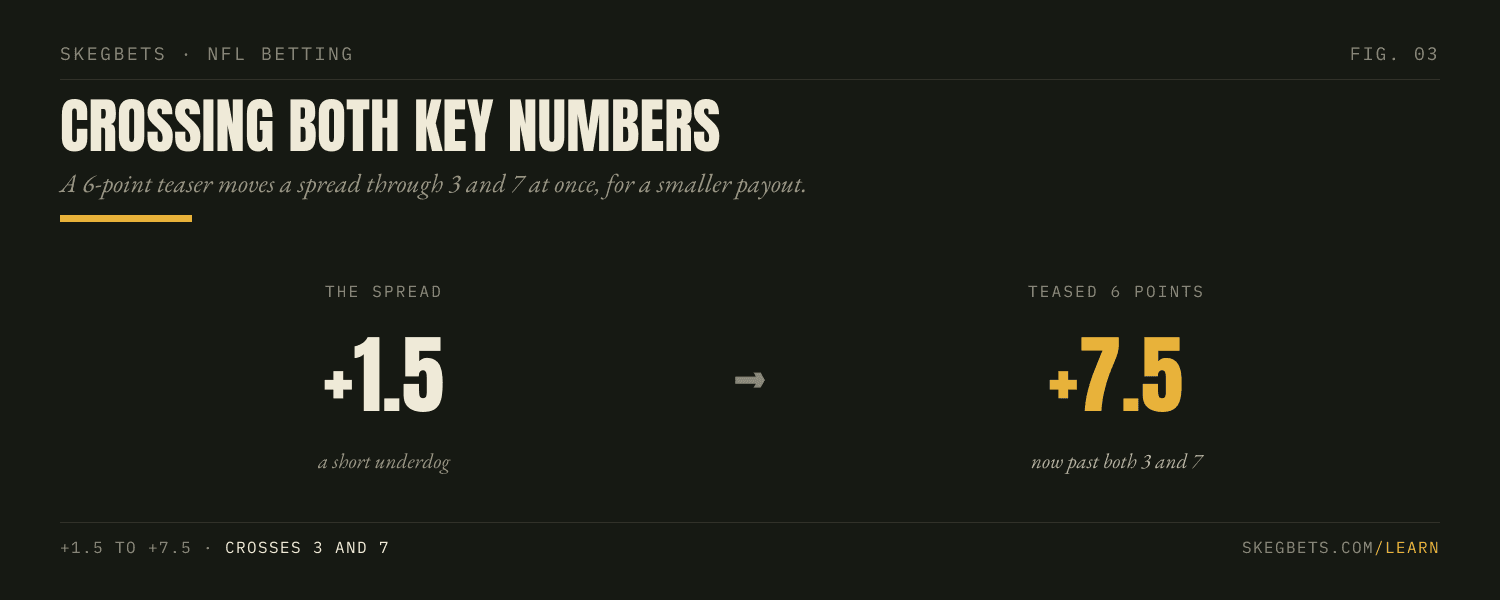
A 6-point teaser moves the spread in your favor for a smaller payout. The classic NFL version takes a short favorite or small dog and moves it through both 3 and 7, turning a +1.5 dog into +7.5, or a −8.5 favorite into −2.5. It buys the two most valuable numbers on the board in one move, which is why it has a following. The mechanics, and when the price is worth it, are in what is a teaser.
Where the half-point earns its keep
Treat 3 and 7 as the lines you protect. Pay the half-point to get onto a key number, refuse it everywhere else, and lean toward dogs that sit just below one. The math is the same expected value you apply to any bet, sharpened by knowing exactly which points are worth buying.
| Margin | How often games land there | Why |
|---|---|---|
| 3 | About 15% of games | A late field goal |
| 7 | Roughly 1 in 10 | A touchdown margin |
| 6 / 10 | The next tier | Two scores, or TD + FG |
| 5 / 8 | Uncommon | Not worth buying across |
Frequently asked questions
What are the key numbers in NFL betting?+
The margins of victory that happen most often. By a wide margin the biggest are 3 and 7, followed by 6, 10, 4 and 14. Because the scoring lands on these numbers, a spread sitting on one is worth far more than a spread a half-point to either side of it.
Why are 3 and 7 so important?+
Because NFL points come in field goals and touchdowns. A one-score game that ends on a field goal lands on 3, and one that ends on a touchdown lands on 7. About 15% of games are decided by exactly 3 and roughly one in ten by 7, so those two numbers carry more weight than all the others combined.
When should I buy a half-point?+
When it moves you onto or off a key number, mainly 3 and 7. Buying a +2.5 underdog up to +3, or a −7.5 favorite down to −7, captures the most valuable half-points in football and is often worth the extra juice. Buying half-points on non-key numbers like 5 or 8 usually is not.
What is a 6-point teaser, or Wong teaser?+
A teaser moves the spread in your favor in exchange for a lower payout. The classic NFL version takes a small favorite or short dog and moves it 6 points so it crosses both 3 and 7, for example a +1.5 dog up to +7.5. It trades price for the most valuable points on the board. See our teaser guide for the mechanics.
For the full picture, start with how to bet on football, apply it on the point spread, and see the numbers we take in our live feed.
Free tools