The point spread is the bet football is built around. It takes a lopsided matchup and prices it to a coin flip, so the question stops being who wins and becomes by how much. Once that clicks, most of the NFL board reads easily.
Laying the favorite
Back the favorite and you lay the points: the team has to win by more than the spread for your bet to cash. Win the game by less, and you lose the bet even though the team won.

Lay a favorite at −6.5 and it must win by seven or more to cover. A six-point win is a loss on the spread, a result that feels unfair the first time it costs you and never stops mattering. The spread is why a team can win comfortably and still lose you money, and why the margin, not the scoreboard, is what you are really betting. For the general idea of a spread across sports, see bet types explained.
Taking the points
The other side is the mirror image. Take the underdog and you are given the points, a cushion that lets the team lose and still cash your bet.
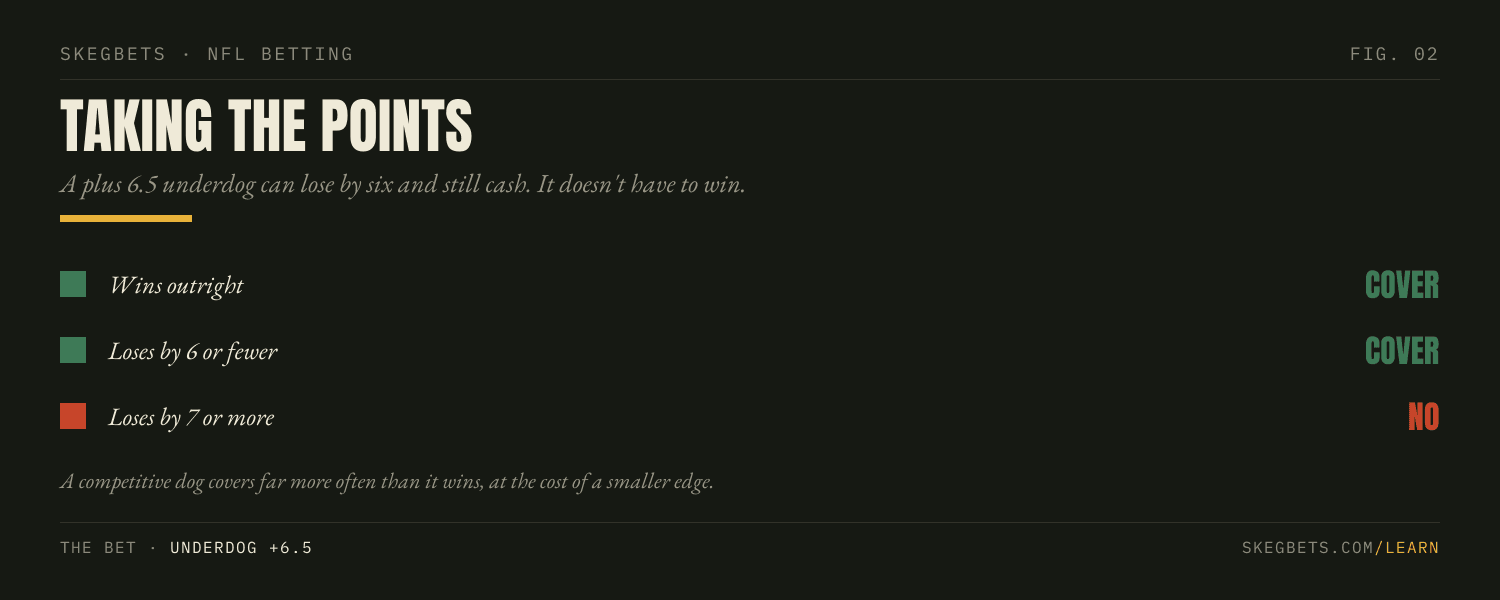
Take a dog at +6.5 and you cash if it wins outright or loses by six or fewer. You do not need the team to win, only to keep it close, which is why a competitive underdog covers far more often than it wins. That higher hit rate is the trade for a smaller edge when it does win the game outright.
The push and the hook
One detail decides a surprising number of football bets: whether the spread is a whole number or carries a half-point.

On a whole-number spread, an exact margin is a push: lay −7, watch the favorite win by exactly seven, and your stake comes back, no win, no loss. The half-point, the hook, removes that tie. A −7.5 favorite can no longer push on a touchdown win, and a +6.5 dog can no longer push on a seven-point loss. Because NFL margins land on 3 and 7 so often, which side of those numbers your hook falls on is worth real money, the subject of key numbers in NFL betting.
When to lay or take
Lay the favorite when you expect a decisive win and the number sits below a key one; take the points when you expect a close game or the dog has a path to keep it within a touchdown. Either way it is a value question: convert the prices with the odds converter, weigh them against your read on the margin, and buy a half-point only when it crosses 3 or 7. That comparison is the whole of expected value.
| Bet | Cashes when | Trade-off |
|---|---|---|
| Favorite −6.5 | Wins by 7 or more | No push, must win clear |
| Underdog +6.5 | Wins, or loses by 6 or fewer | Higher hit rate, smaller spots |
| Whole number −7 | Wins by 8+; ties push | A 7-point win refunds the bet |
Frequently asked questions
What is the point spread in football?+
A handicap that levels the matchup so both sides pay around the same price. The favorite is laid points (it must win by more than the number) and the underdog is given points (it can lose by fewer than the number and still cash). Betting it is called betting against the spread, or ATS.
What does −6.5 (−110) mean?+
It means the favorite must win by seven or more to cover, and the bet pays −110: you risk $110 to win $100. The −110 on both sides is the bookmaker's cut, called the vig or juice, and it is why you need to win about 52.4% of spread bets just to break even.
What is a push in NFL betting?+
A tie against the spread, which happens only on whole-number lines. If the spread is −7 and the favorite wins by exactly 7, the bet pushes and your stake is refunded. Half-point spreads like −6.5 or −7.5 can never push, which is the entire point of the hook.
Should I buy points on the spread?+
Sometimes, and only near the key numbers. Moving a spread from −7 to −6.5, or +2.5 to +3, buys you the most valuable half-points in football and is often worth the extra juice. Buying half-points away from 3 and 7 usually is not. The full logic is in our key numbers guide.
For the full picture, start with how to bet on football, learn why 3 and 7 rule the spread in key numbers, and see the spreads we take in our live feed.
Free tools