The moneyline is the simplest bet on the board and the easiest to misuse. It asks one question, who wins, and answers it with a price. Read that price against your own number and the moneyline turns into one of the steadier ways to back a live underdog.
Favorites and dogs
Every moneyline is just the spread translated into a single price. The bigger the spread, the more lopsided the two numbers.
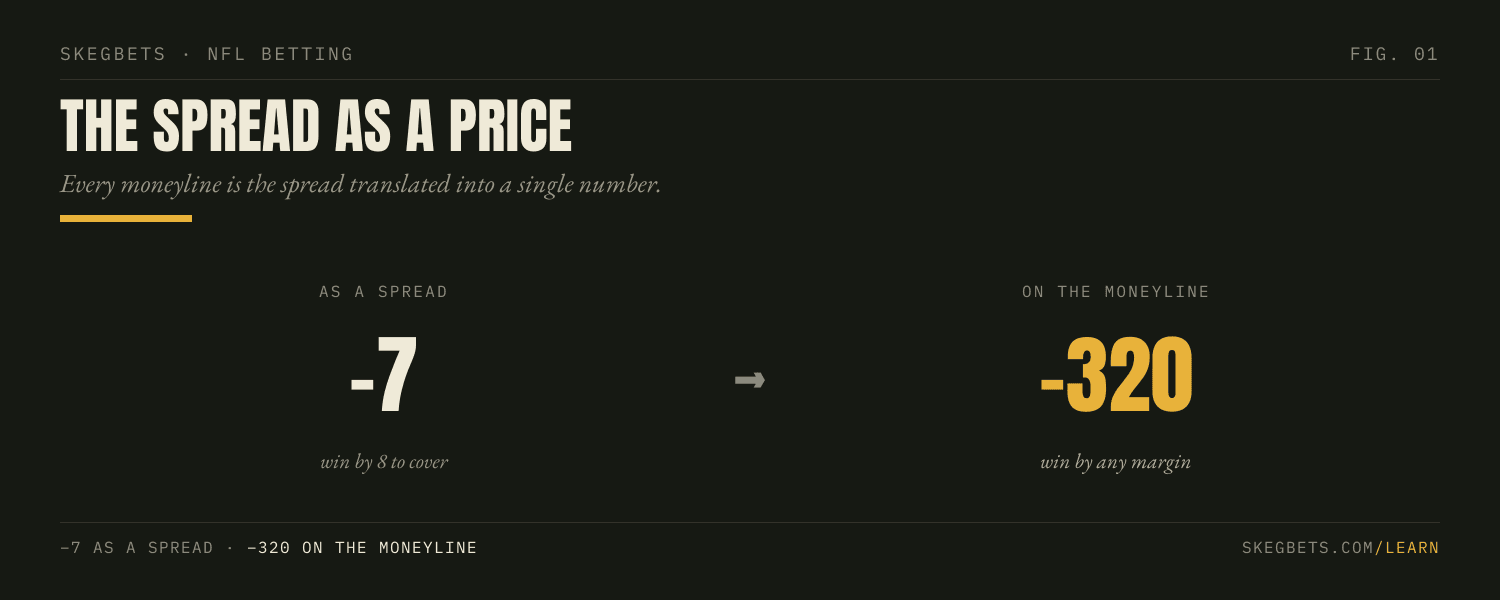
A 7-point favorite might be around −320 on the moneyline, with the dog near +260. The favorite wins the game far more often than it covers the spread, so you pay for the certainty: risk $320 to win $100. The underdog flips it, a smaller stake for a bigger return, because winning outright is the harder result. Convert any price to a win probability with the implied probability tool to see what the number is really asking.
Where dog value lives
The moneyline earns its keep on underdogs you think can win, not just cover.
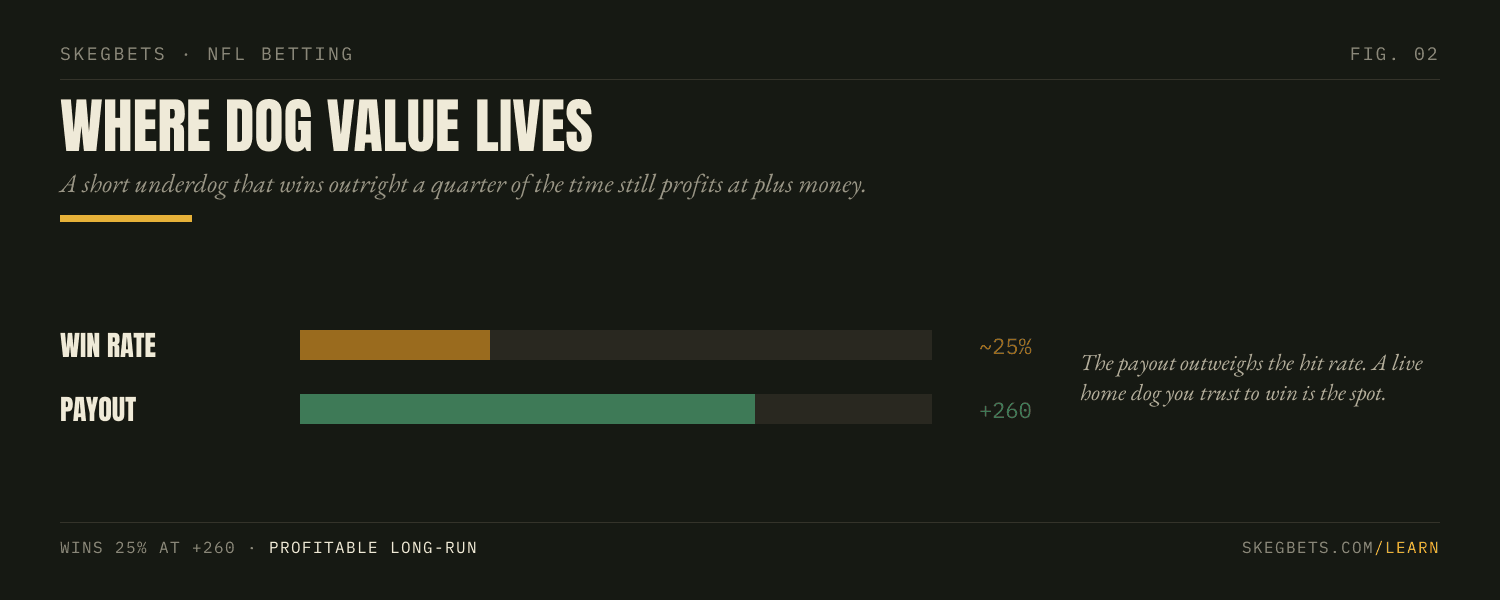
Small underdogs, a field goal or less, win outright often enough that plus money makes them profitable over time, even though they lose more games than they win. A live home dog in a divisional game is the classic spot. Big underdogs are the opposite: they rarely win, so their value sits in the point spread, not the moneyline.
Moneyline or spread?
The choice is really about what you believe will happen, not which bet looks bigger.
If your read is that the dog wins the game, the moneyline pays more than the points. If your read is only that it stays close, take the spread and the cushion that comes with it. For favorites the math usually favors the spread, because laying a steep moneyline risks far too much to win too little, and stacking that chalk into a parlay compounds the bad price.
When to bet it
Reach for the moneyline when you genuinely like an underdog to win, when a game is a near pick’em, or when a half-point on the spread would have cost you a key number anyway. Price your own win probability, compare it to the implied number, and bet only when yours is higher. That gap is expected value.
| Side | Cashes when | Best when |
|---|---|---|
| Favorite ML | Wins by any margin | Rarely; the spread is cheaper |
| Underdog ML | Wins outright | Short dog you like to win |
| The spread | Covers the number | You expect a close game |
Frequently asked questions
What is the moneyline in football?+
A straight bet on who wins the game, with no spread. The favorite carries a minus price (you risk more than you win) and the underdog a plus price (you win more than you risk). Margin does not matter: a one-point win pays the same as a blowout.
Why are NFL favorites so expensive on the moneyline?+
Because the moneyline strips out the cushion the spread gives you. A 7-point favorite wins outright far more often than it covers by 7, so the price climbs to around −320 to balance that. Laying heavy chalk means risking a lot to win a little, which is why stacking favorites in parlays is usually a trap.
Should I bet the moneyline or the spread?+
Depends on your read. If you think an underdog wins the game outright, the moneyline pays far more than taking the points. If you only expect it to keep the game close, the spread is the better bet. For favorites, the spread almost always offers more value than laying a steep moneyline.
Do NFL underdogs win outright very often?+
More than the prices suggest in close games. Small underdogs of a field goal or less win outright a meaningful share of the time, and at plus money that adds up. Big underdogs rarely win, so their value is in the spread, not the moneyline.
For the full picture, start with how to bet on football, compare it to the point spread, and see the moneylines we take in our live feed.
Free tools