Pick almost any NBA game and the spread is doing the real work, handicapping a clear favorite down to roughly even money so your bet rides on the margin rather than the winner. Because both teams score in the hundreds, the half point football bettors fight over barely registers here.
Laying the favorite
Bet the favorite and you are laying the points, which means the cushion now works against you: the team has to clear the spread, not just the scoreboard. A win that falls short of the number still grades as a loss.
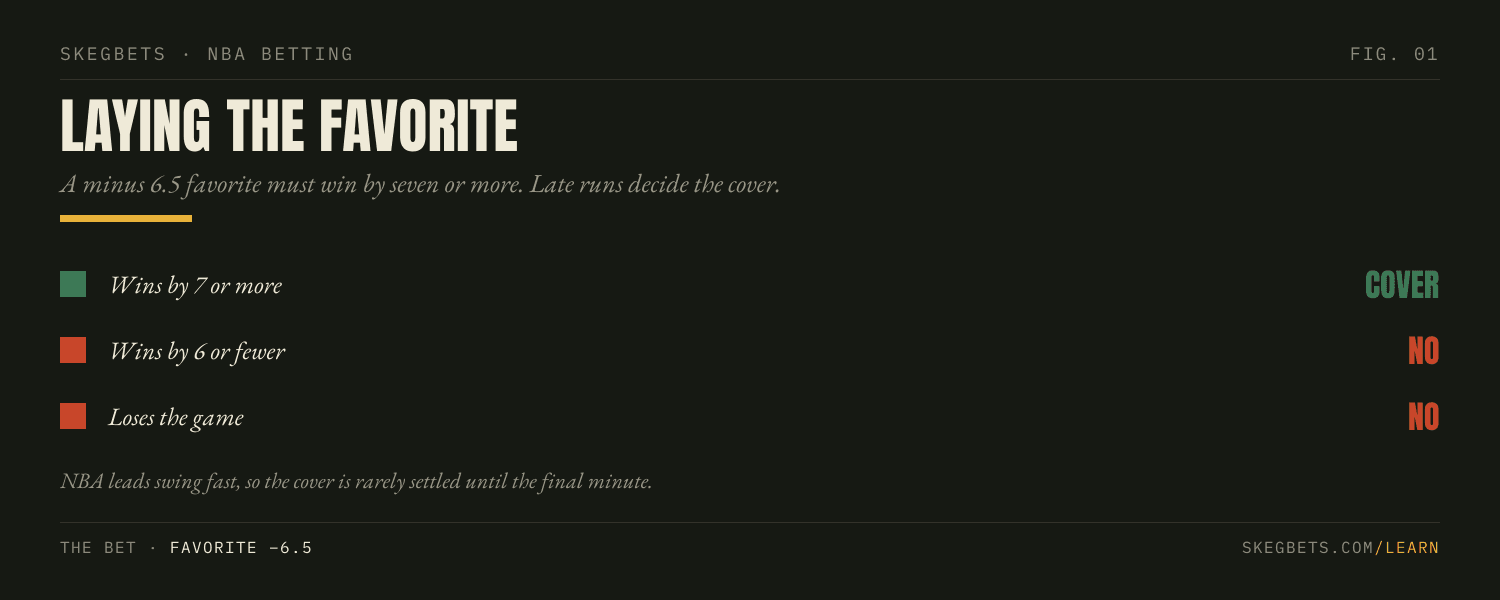
Lay a favorite at −6.5 and it must win by seven or more. Because NBA games swing fast, a comfortable lead can shrink in a late run, or a blowout can pad the margin in garbage time, so the cover is rarely settled until the final minute. The spread, not the scoreboard, is what you are really betting. For the general idea of a spread across sports, see bet types explained.
Taking the points
Flip to the underdog and the math inverts. Taking a dog hands you the points as a head start, so the team can come up short on the floor and your ticket still wins as long as it stays inside the number.
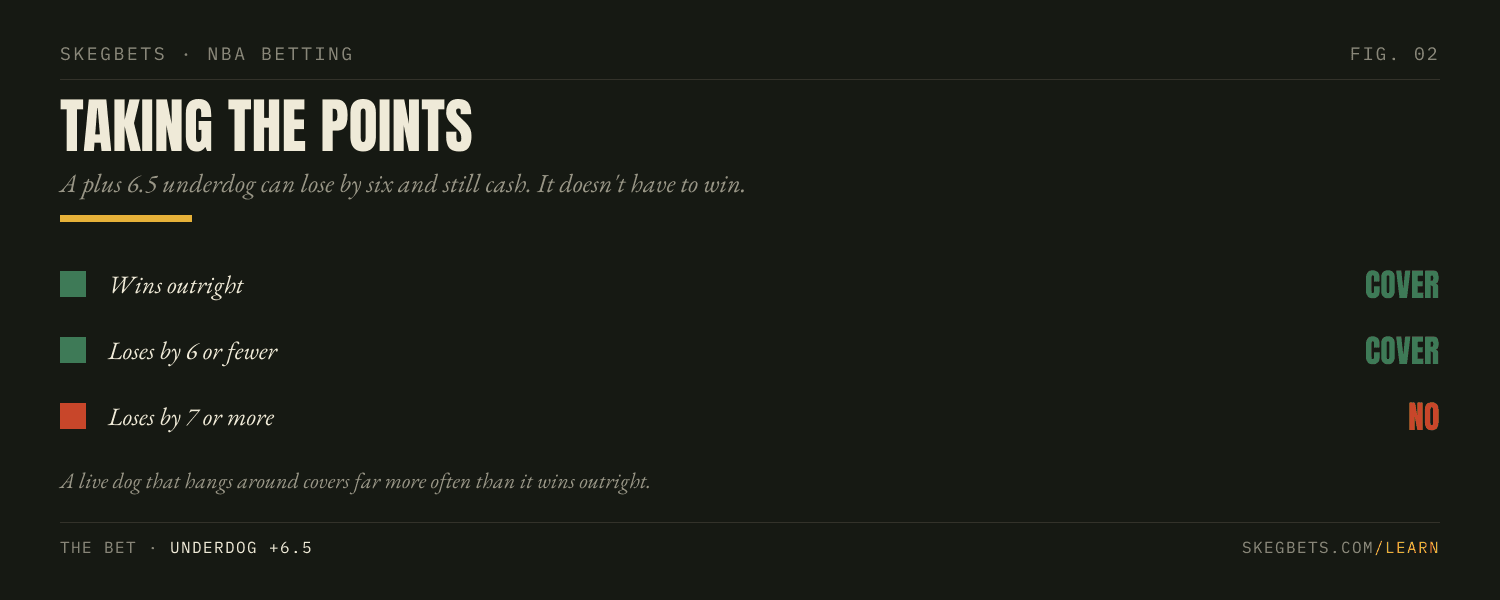
Take a dog at +6.5 and you cash if it wins outright or loses by six or fewer. A live underdog that hangs around covers far more often than it wins, and NBA dogs benefit from the same garbage-time baskets that can betray a favorite. The trade is the smaller edge when the team actually wins the game outright.
Why key numbers matter less
Football bettors obsess over 3 and 7. In the NBA, that instinct mostly leads you astray.

Basketball is high-scoring and its margins are spread thin across many numbers, so there is no equivalent of the NFL’s key numbers. A spread of 6 is not meaningfully safer than 6.5, and buying half-points is almost never worth the extra juice. Your edge in the NBA comes from reading the matchup and who is playing, not from shopping a hook, which keeps the decision squarely on value.
When to lay or take
Lay the favorite when you expect a decisive, sustained edge, and take the points when you expect a close game or a dog that can keep pace. Either way it is a value question: convert the prices with the odds converter, weigh them against your read on the margin, and skip the half-point shopping that pays off in football but not here. That comparison is the whole of expected value.
| Bet | Cashes when | Trade-off |
|---|---|---|
| Favorite −6.5 | Wins by 7 or more | Late runs swing the cover |
| Underdog +6.5 | Wins, or loses by 6 or fewer | Higher hit rate |
| Buying a hook | Moves the number a half | Rarely worth it in the NBA |
Frequently asked questions
What is the point spread in basketball?+
A handicap that levels the matchup so both sides pay around the same price. The favorite is laid points (it must win by more than the number) and the underdog is given points (it can lose by fewer and still cash). Betting it is called betting against the spread, or ATS.
What does −6.5 (−110) mean in the NBA?+
A seven-point win or better covers the −6.5, and the −110 is the price: $110 staked returns $100 in profit. That extra ten cents charged on each side is the book's margin, and it pushes your breakeven win rate up to roughly 52.4%, so clearing half your spread bets is not enough to turn a profit.
Do key numbers matter in NBA betting?+
Far less than in the NFL. Basketball is high-scoring and margins are spread out, so there is no equivalent of football's 3 and 7. Buying half-points is rarely worth the juice, and a spread of 6 is not meaningfully more valuable than 6.5.
What is a backdoor cover?+
A late, often meaningless basket that flips the spread after the game is decided. In garbage time the losing team's bench may hit a three that covers a number nobody was playing for. It is a feature of NBA spread betting and a reason late-game variance cuts both ways.
For the full picture, start with how to bet on basketball, check who’s playing in load management and injuries, and see the spreads we take in our live feed.
Free tools