The short version
Draw no bet removes the draw by refunding your stake if the match ends level. You trade a lower payout for insurance against the tie. Here is how it prices and when it earns its cost.
Draw no bet hands your stake back when a match ends level, so a tie costs you nothing instead of the whole wager. You give up payout for that safety net: a favorite worth about 1.70 to win outright is often near 1.30 once the draw is refunded. It is the market for the bet you trust to avoid losing but do not trust to avoid a stalemate.
Three outcomes, one refund
A soccer match has three results, and draw no bet resolves cleanly into each of them. Back a team and the wager pays at the DNB price if they win, loses if they lose, and refunds your stake if the match ends level. The third row is the whole reason the market exists, and it is what separates DNB from a straight win bet on the 1X2 market, where a draw counts as a loss.
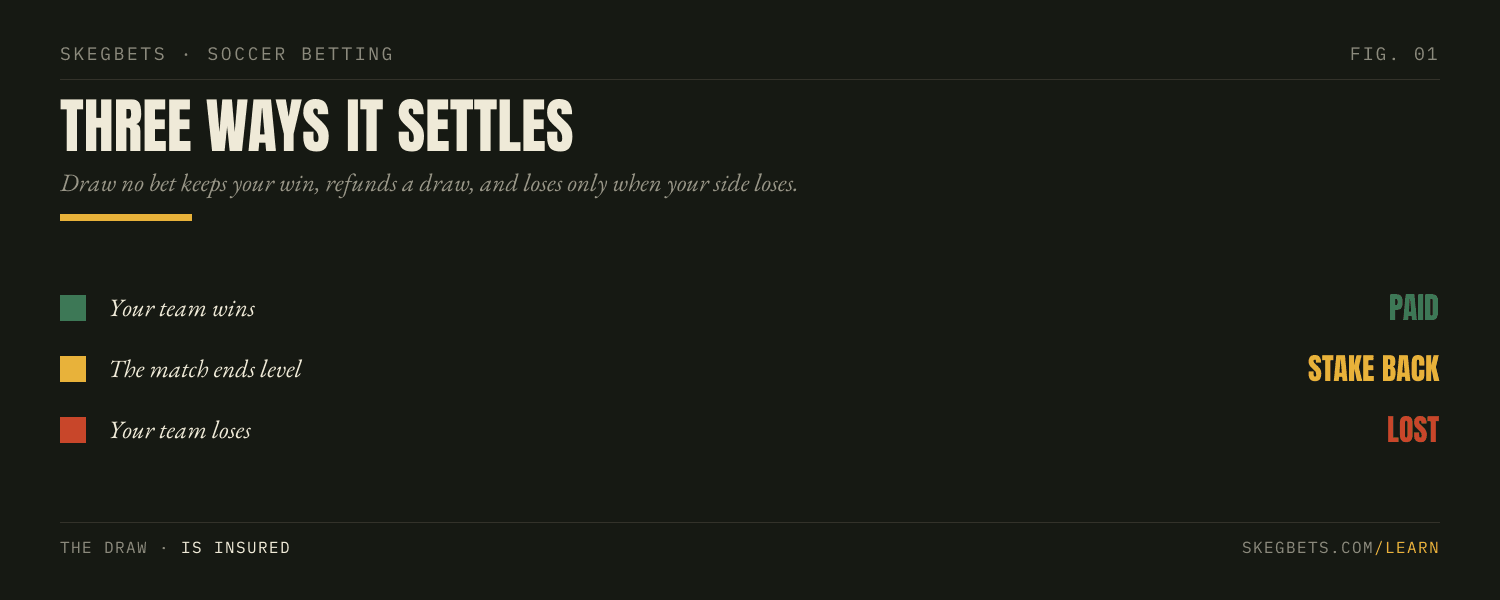
Read the grid below as the entire settlement logic in one place. There is no push math, no half-line, no partial payout. Every match lands in exactly one of the three rows, and the middle row is the only place your money moves sideways instead of up or down.
| Result | How it settles | Your money |
|---|---|---|
| Team wins | Bet is paid at the DNB price | Profit |
| Draw | Stake refunded, bet void | Break even |
| Team loses | Stake lost | Loss |
Why the price drops
Removing a losing outcome is not free. In a standard three-way soccer market, the draw lands in roughly a quarter of matches, and the book keeps your stake every time it happens. Draw no bet gives that stake back, so the book lowers the payout on the wins it still pays to cover the draws it no longer keeps. That is the trade in one sentence: a smaller return in exchange for insuring the tie.
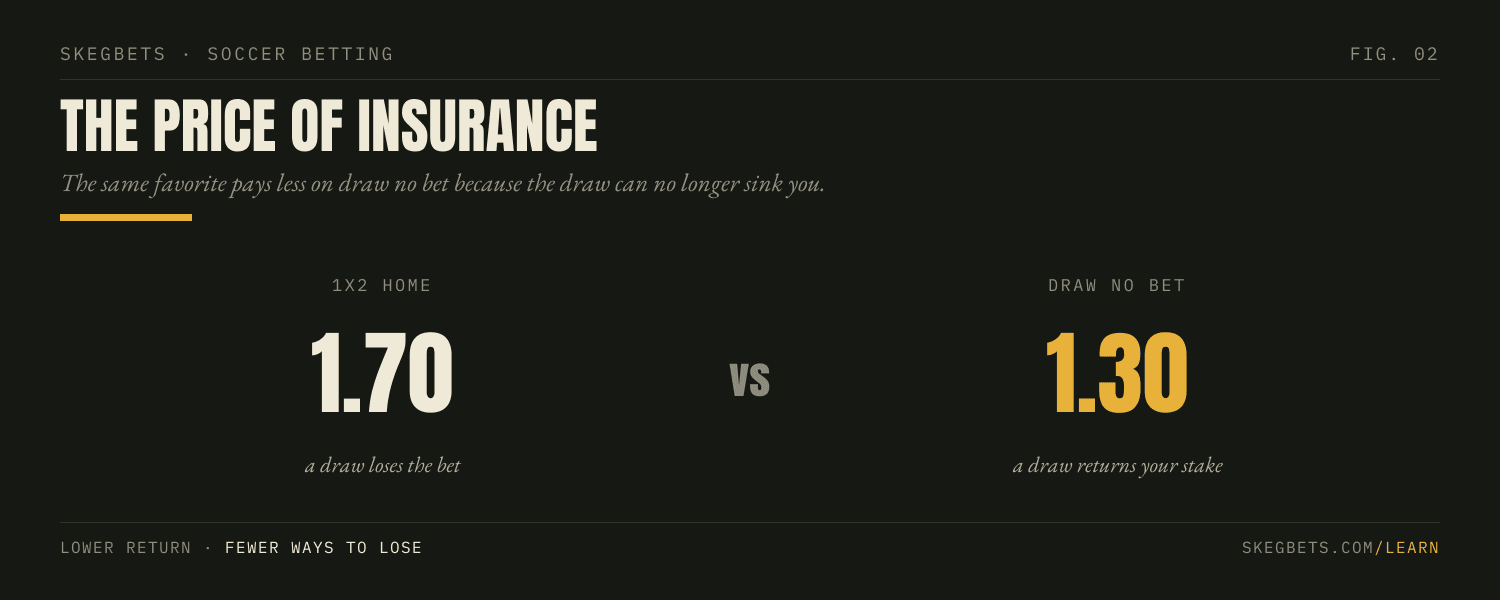
The gap between the two prices is the cost of the insurance, and it widens as a draw grows more likely. A dominant favorite whose only real risk is a goalless afternoon pays close to its 1X2 price on DNB, because there is not much draw to insure. A tight matchup where the tie is a live outcome sees a much bigger drop. The table shows the pattern at a few example prices.
| 1X2 home win price | Roughly the DNB price | Payout given up |
|---|---|---|
| 1.50 | 1.25 | 0.25 |
| 1.70 | 1.30 | 0.40 |
| 2.00 | 1.50 | 0.50 |
| 2.50 | 1.75 | 0.75 |
When it earns its cost
Draw no bet is worth the shorter price only when a draw is a real threat and a loss is not. Picture a first-place side hosting a team that sits ten behind the ball and plays for a point. You expect the favorite to control the match, but a 0-0 or 1-1 is very much on the table. On the 1X2 that stalemate is a full loss. On DNB it is a refund, and you live to bet another day.
The classic spots share that shape: a strong favorite against a park-the-bus opponent, a derby where form goes out the window, or a team missing the striker who supplies most of its goals. In each case you rate the side to avoid defeat but not to avoid a tie. If instead you think the draw is unlikely, skip the insurance and take the full 1X2 win price. The cheaper way to shade the same idea without voiding on a draw is the Asian handicap, which splits your stake across lines rather than refunding the whole thing. Whichever you choose, price the same side at more than one book before you bet, since a small difference on a short DNB price is a large slice of a thin margin. Our free betting tools convert odds and size the stake in seconds.
A worked example
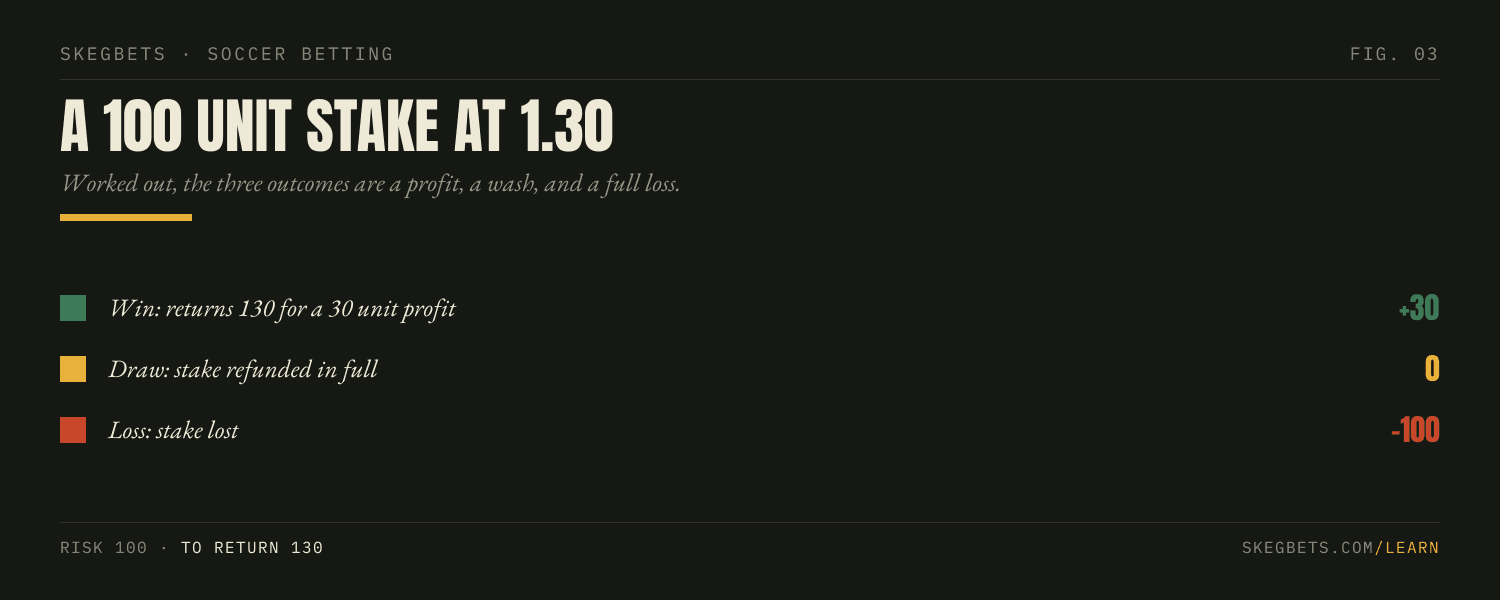
Take a 100 unit stake on a home favorite at 1.30 on draw no bet. Three things can happen. The favorite wins and the bet returns 130 units, a 30 unit profit. The match ends level and your 100 units come straight back, no gain and no loss. The favorite loses and the 100 units are gone. That is the whole risk profile, and the middle row is exactly what you paid the shorter price to buy.
| Match result | What the book does | Returned on 100 |
|---|---|---|
| Favorite wins | Pays 100 at 1.30 | 130 units |
| Draw | Refunds the stake | 100 units |
| Favorite loses | Keeps the stake | 0 units |
Compare that to the same 100 units on the 1X2 win at 1.70. A win there returns 170, a 40 unit edge over the DNB payout. But a draw turns a 100 unit refund into a 100 unit loss. Reach for draw no bet when your read is “this side will not lose” and your worry is “but they might not win either.” Match the market to that read and the shorter price stops looking like a tax and starts looking like a hedge.
Frequently asked questions
What happens to a draw no bet if the match is a draw?+
Your full stake is returned and the bet is void. A 100 unit draw no bet on a match that ends 1-1 gives you 100 units back, no profit and no loss. The draw is treated as if the bet never happened, which is the entire point of the market.
Is draw no bet the same as a moneyline?+
No. A two-way moneyline in a sport with no draws pays or loses with nothing in between. Soccer has a real third result, so draw no bet is closer to a moneyline with the draw refunded rather than counted as a loss. That refund is why the DNB price is lower than the same team's 1X2 win price.
Why is the draw no bet price lower than the 1X2 win price?+
Because you are buying insurance. The 1X2 price pays more because a draw costs you the stake. Draw no bet hands that stake back on a draw, so the book lowers the payout to cover the outcomes it now refunds instead of keeps.
When should I use draw no bet instead of the 1X2 win?+
When you are confident a team will not lose but genuinely fear a draw. A strong favorite against a defensive side that parks the bus, a derby, or a team missing its main scorer are the classic spots. If you think a draw is unlikely, take the full 1X2 price instead and keep the extra payout.
Does draw no bet cover a penalty shootout or extra time?+
Almost always no. Draw no bet settles on 90 minutes plus stoppage time, the same regulation window as the 1X2 market. A cup tie level after 90 minutes settles as a draw and your stake is refunded, even if your side goes on to win in extra time or on penalties. Check the book's rules if a match can go beyond 90.
Related reading: how to bet on soccer, the 1X2 market, and the Asian handicap. See the soccer bets we’re making now in our live soccer feed.
Free tools