The short version
BTTS is a yes/no bet on whether both sides score at least once. Yes lands roughly 48 to 56 percent of the time, and it is close to but not the same as over 2.5.
BTTS strips a soccer match down to one question: did both teams score at least once. It ignores the winner and the margin, which is what makes it such a clean read. Yes lands somewhere between 48 and 56 percent of the time depending on the league, so the market lives close to a coin flip, and the edge comes from knowing which side of that flip a given matchup sits on.
How the two outcomes settle
There are exactly two bets here. BTTS yes wins when each team scores one goal or more. BTTS no wins when at least one team is kept off the board, which includes every clean sheet and every 0-0. The scoreline past the first goal for each side is irrelevant: a 4-3 thriller and a 1-1 draw both settle yes, and a 3-0 rout and a goalless draw both settle no.
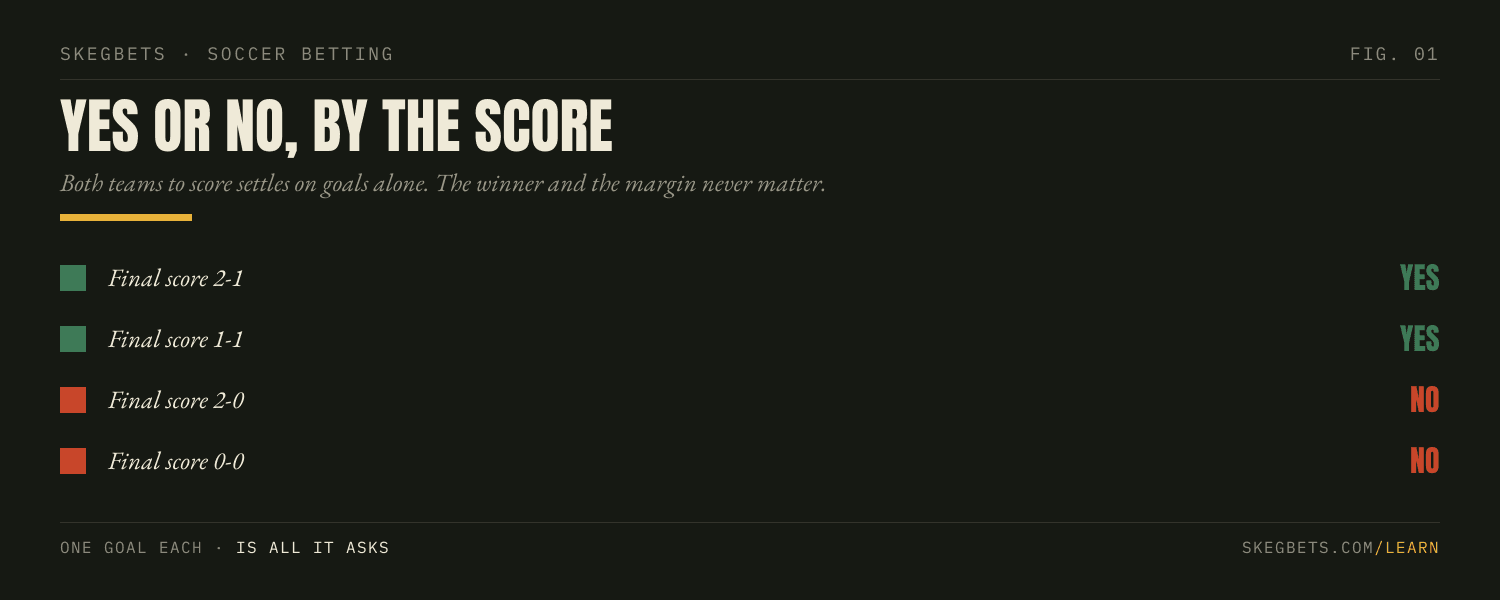
Because the winner does not matter, BTTS grades off two independent facts: did the home side score, and did the away side score. That is why a heavy favorite winning 2-0 still loses a yes ticket, and why an even, back-and-forth match is where yes cashes most reliably.
| Final score | Did both teams score | BTTS result |
|---|---|---|
| 2-1 | Yes, each side scored | BTTS yes |
| 1-1 | Yes, each side scored | BTTS yes |
| 2-0 | No, one team was shut out | BTTS no |
| 0-0 | No, neither team scored | BTTS no |
How often yes lands
Across a full top-five European season, BTTS yes hits about 51 to 52 percent of the time, but the league matters more than most bettors assume. Open, high-scoring leagues run several points above that baseline; disciplined, low-block leagues run below it. The spread is wide enough that the same BTTS yes price is a very different bet in Munich than it is in a Serie A relegation scrap.
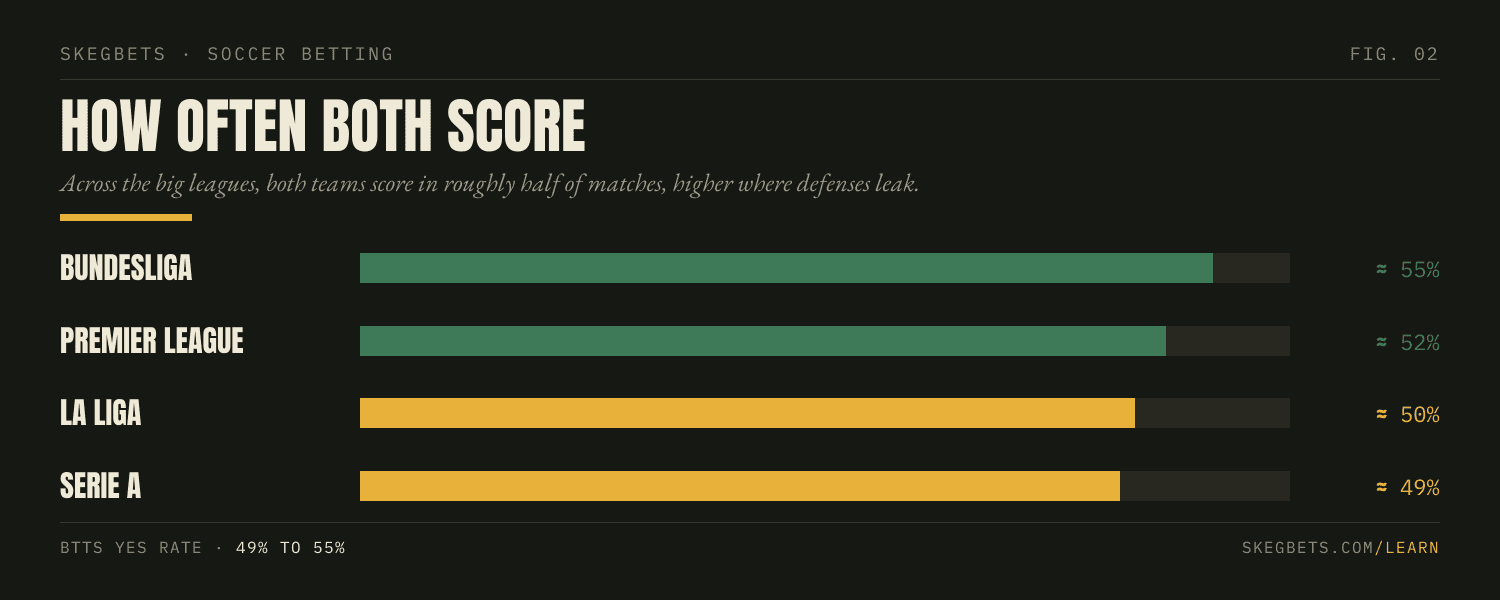
| League | Style | BTTS yes rate |
|---|---|---|
| Bundesliga | Open, high goals | ~55% |
| Premier League | End to end, balanced | ~52% |
| La Liga | Technical, mid-tempo | ~50% |
| Serie A | Tightest of the four in this span | ~49% |
Treat those numbers as a starting anchor, not a lock. A league rate tells you where the average match sits, then the specific fixture pulls it up or down. Two mid-table sides that both attack and both leak will beat their league yes rate handily; a title contender hosting a bottom club will fall well under it.
What moves the number
A handful of inputs decide which way a fixture leans. On the yes side, look for two teams that both create real chances, defenses that concede at a steady clip, and a matchup where both attacks project meaningful expected goals. When both sides carry an xG projection north of about 1.2, yes is usually the honest read even at a shorter price.
The no side is driven by concentration of quality. A dominant defense with a high clean-sheet rate suppresses one half of the bet by itself. A lopsided mismatch does the same from the other direction: a strong favorite tends to control possession, limit the underdog to scraps, and win by shutting them out rather than trading goals. Where the goals total asks how many, BTTS asks whether both, and a 3-0 answers the total question one way and the BTTS question the other.
| Signal | Points toward | Why |
|---|---|---|
| Both attacks strong, both defenses leaky | Yes | Two independent paths to a goal |
| High xG projected for both sides | Yes | Each team likely to convert once |
| One elite defense, high clean-sheet rate | No | One half of the bet suppressed |
| Lopsided favorite vs weak underdog | No | Control and a likely shutout |
BTTS and over 2.5
BTTS yes and over 2.5 goals move together often enough that new bettors treat them as the same bet. They are not. Over 2.5 needs three goals from anyone; BTTS needs one goal from each of two specific teams. Those conditions overlap in most matches but part ways at the edges, and the gap is where the two markets price differently.
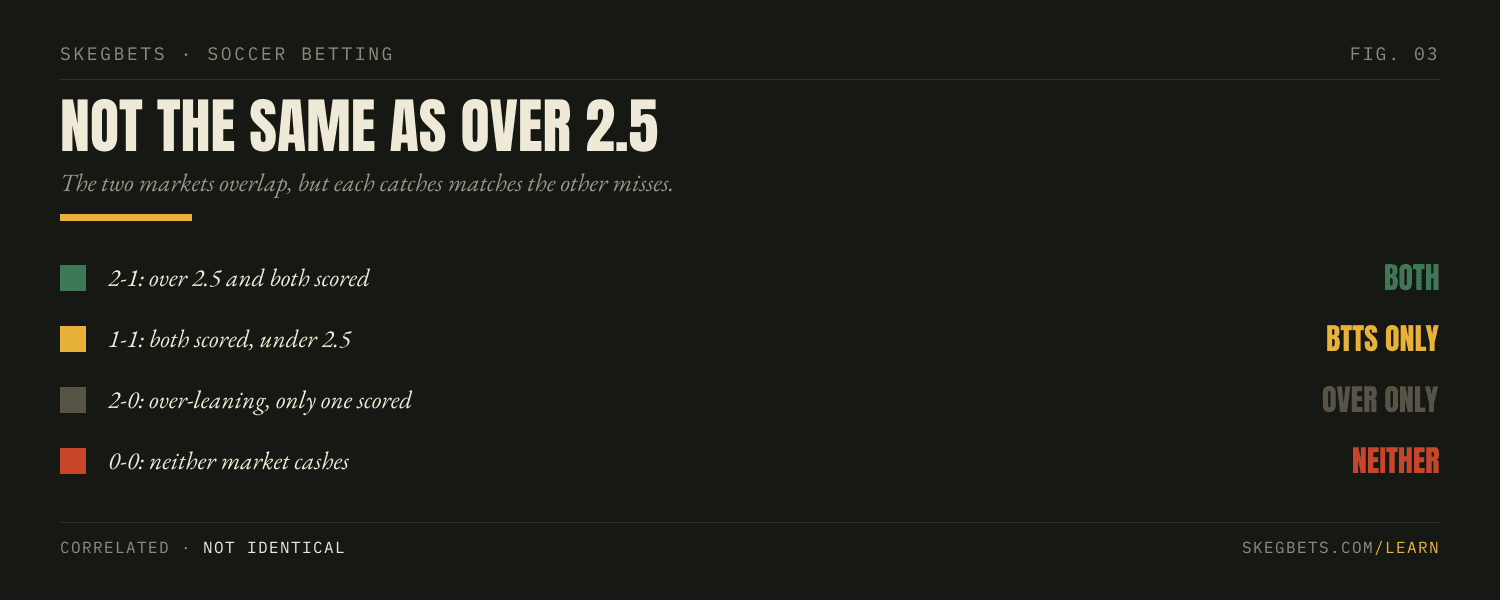
Two scorelines make the split obvious. A 2-0 clears the goals side of over 1.5 and sits one goal short of over 2.5, yet it is BTTS no because one team was blanked. A 1-1 is BTTS yes, both teams scored, yet it lands under 2.5 on just two goals. When you expect goals but also expect one side to dominate, the total and BTTS can disagree, and the right bet is whichever question your read actually answers. If the whole goals-total picture is new, start with betting soccer totals, then come back to BTTS as the tighter, two-sided version of the same idea.
Reading a match, not a habit
The bettors who lose on BTTS are the ones who back yes every week out of habit, paying a shorter price for a bet that only clears 51 percent on average. The edge is fixture by fixture: fade yes when one defense is a wall or the game is a mismatch, back it when both sides genuinely threaten. For the broader soccer framework see how to bet on soccer, size BTTS goal scorers and shots on soccer player props, run the price through our betting tools, and see the matches we are backing in the soccer picks feed.
Frequently asked questions
What does both teams to score mean?+
It is a yes/no bet on whether both sides find the net at least once. Yes wins when each team scores one or more goals. No wins when at least one team is kept off the scoresheet, including a 0-0. The final margin and the winner do not matter, only that both teams did or did not score.
How often does both teams to score hit?+
BTTS yes lands roughly 48 to 56 percent of the time depending on the league, and about 51 to 52 percent across a typical top-five European season. High-scoring, open leagues like the Bundesliga sit near the top of that band; tighter, more defensive leagues sit near the bottom.
Is BTTS the same as over 2.5 goals?+
No. They are correlated but not identical. A 1-1 draw is BTTS yes but under 2.5. A 2-0 win is over 1.5 and leans toward goals but is BTTS no because one side was shut out. Any game with two or more goals where one team scores zero splits the two markets.
What is GG and NG in betting?+
GG means goal-goal, the same as BTTS yes: both teams score. NG means no-goal, the same as BTTS no: at least one team is held scoreless. Some books and regions label the market GG/NG instead of BTTS, but the bet and how it settles are identical.
When is BTTS no the better side?+
When one team is a clear defensive standout or the matchup is a lopsided mismatch. A side that keeps clean sheets at a high rate, or a heavy favorite likely to control the game and shut out weaker opposition, pushes the no side. A dominant defense is the single strongest signal against BTTS yes.
From here, the natural next reads are how to bet on soccer, soccer totals, and soccer player props.
Free tools