The short version
The average match lands near 2.7 goals, so books hang the total at 2.5. Why goals follow a Poisson curve, why half-goal lines avoid pushes, and the five levers that move the number.
The average match in Europe’s top leagues finishes with about 2.7 goals, which is why the total sits at 2.5 more often than any other number. Soccer scoring is low and clustered, so betting the over/under is really a bet on the shape of a curve, not on a coin flip.
Why 2.5 is the anchor
A soccer total is a bet on the combined goals both teams score, and it ignores the result. Books post a line and price each side around it. The line clusters at 2.5 because the underlying scoring rate does: across the Premier League, La Liga, the Bundesliga, and Serie A, matches average somewhere between 2.6 and 2.8 goals, so a 2.5 line splits the outcomes almost down the middle.
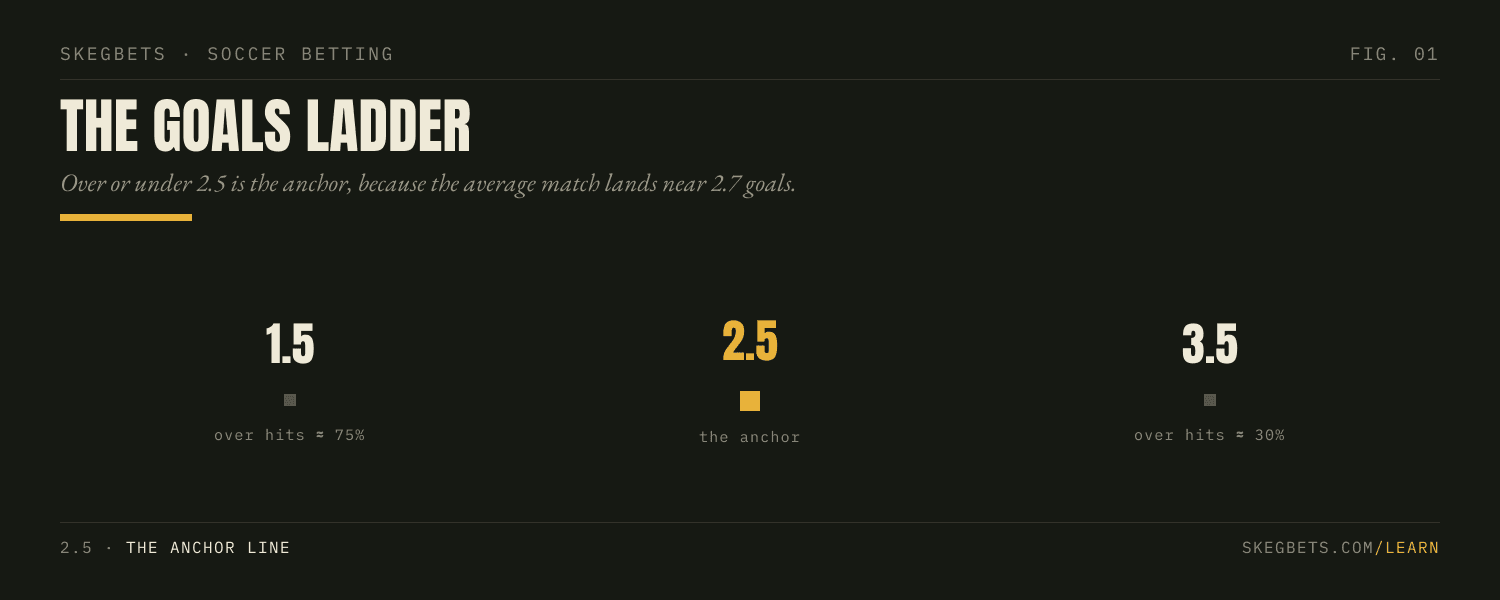
When a matchup projects to score more, the book climbs the ladder to 3.0 or 3.5; when it projects tight, it drops to 2.0. New to the market mechanics behind an over/under, start with how to bet on soccer. The one number to keep in mind: because 2.5 sits so close to the true mean, over 2.5 comes in roughly half the time, which is what makes it the cleanest teaching line in the sport.
| Total line | What over needs | Over hits (long run) |
|---|---|---|
| Over 1.5 | 2+ goals | ~75% |
| Over 2.5 | 3+ goals | ~52% |
| Over 3.5 | 4+ goals | ~30% |
Goals follow a curve, not a line
Goals arrive as rare, roughly independent events, so the count of them in a match follows a distribution close to Poisson: heavily weighted toward one, two, and three goals, with a long thin tail for the blowouts. A game finishing 0-0 and one finishing 4-3 are both common enough to price, but the middle of the curve is where most matches live.
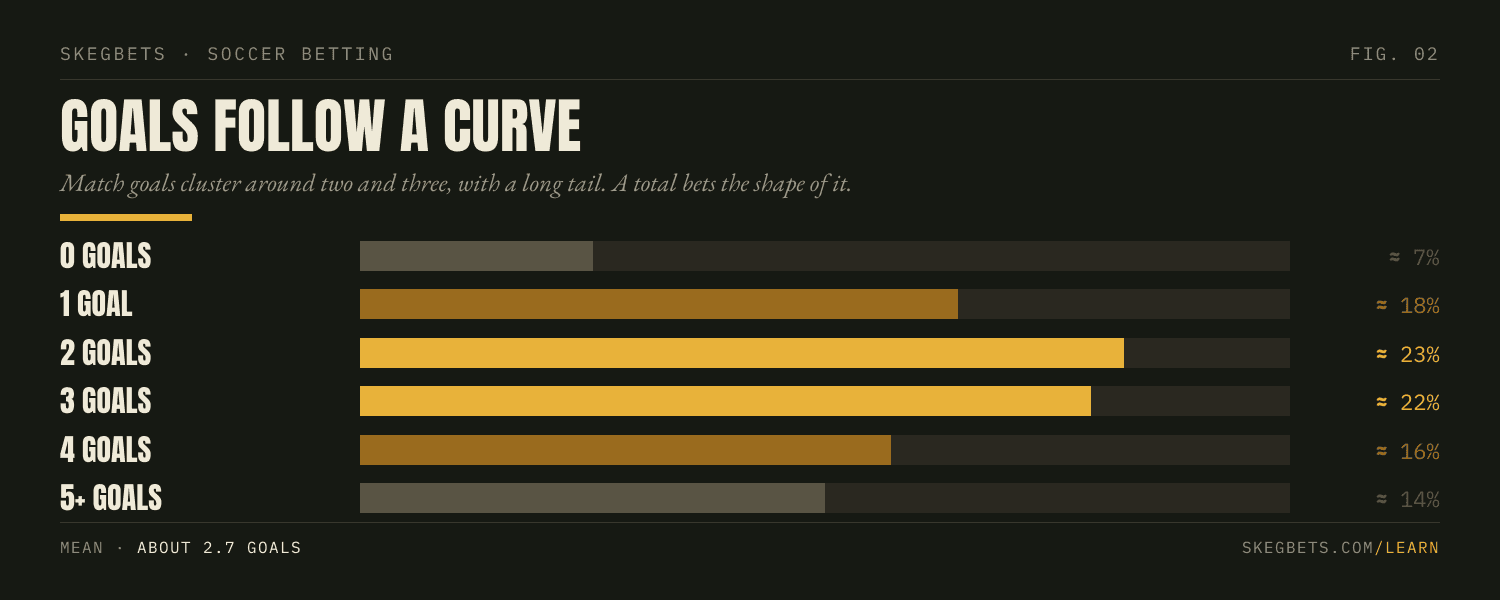
Reading the total as a curve changes the question from “will this be a high-scoring game” to whether the book has placed 2.5 at the right point on that curve. Shift the mean a few tenths of a goal and the whole shape slides, which is why a matchup the model reads as 3.1 expected goals can be a live over even when the market is comfortable at 2.5.
| Total goals | Cumulative | Share of matches |
|---|---|---|
| 0 goals | 7% | ~7% |
| 1 goal | 25% | ~18% |
| 2 goals | 48% | ~23% |
| 3 goals | 70% | ~22% |
| 4 goals | 86% | ~16% |
| 5+ goals | 100% | ~14% |
Half-goal lines vs whole-goal lines
The 2.5 you see at most books is a half-goal line, and the half exists to kill the push. No match ends on 2.5 goals, so the bet always settles win or loss. Move to a whole number and that certainty disappears: a total of 3.0 refunds your stake if the game ends with exactly three goals, since three is neither over nor under three.
Whole-goal totals live mostly on the Asian goal market, alongside quarter lines such as 2.75 that split your stake across two totals so one half can push while the other resolves. Those markets often carry lower juice and let you take a position between the standard rungs, but the trade-off is the push math you have to track. For most bettors the plain 2.5, 3.5, or 1.5 half-goal line is the simpler read, and the one where value is easiest to compare across books through line shopping. If you want the result-side version of Asian lines rather than the goals version, that is covered in Asian handicap explained.
What moves the number
Five inputs set where the goal expectation lands, and the total slides with them. The bettor's job is to notice one shifting while the posted line still reflects last week's version of the matchup.

Attack and xG come first: two front lines generating high expected goals push the curve right. Defense and xGA pull it back, and a stingy pair of back lines can hold a total down even with talented forwards on the pitch. Tempo and game statematter because an open, end-to-end game produces more chances than a cagey one, and a side that needs a result will chase late. Weather and pitch shave the number when heavy rain, wind, or a slow surface break up passing moves. The referee rounds out the five: a strict whistle stacks fouls, cards, and set-piece and stoppage-time chances, while a lenient one lets play flow and can drain a half-chance count. Whether both attacks are likely to score is a related but separate question, handled in both teams to score, and the single-player angle sits in soccer player props.
| Lever | Raises the goal expectation | Lowers it |
|---|---|---|
| Attack + xG | Two high-xG front lines | Blunt attacks, low xG |
| Defense + xGA | Leaky back lines, high xGA | Stingy pair, low xGA |
| Tempo + game state | Open game, a side chasing | Cagey, both content |
| Weather + pitch | Dry, fast surface | Heavy rain, wind, slow pitch |
| Referee | Strict, card-heavy whistle | Lenient, lets play flow |
Frequently asked questions
What does over 2.5 goals mean in soccer betting?+
Over 2.5 means three or more total goals are scored by both teams combined; under 2.5 means two or fewer. The half-goal removes any chance of a push, so exactly two goals loses the over and wins the under. It is the most-traded total because the average top-league match lands near 2.7 goals.
Why is 2.5 the standard soccer total?+
Because the long-run average across the big European leagues sits around 2.6 to 2.8 goals per match, so 2.5 splits the field almost evenly. That is why over 2.5 hits roughly half the time. Higher-scoring leagues and matchups get pushed to 3.0 or 3.5; low-event ones drop to 2.0.
Can a soccer total push?+
Only on a whole-goal line. A total of 2.5 can never push because no match ends on 2.5 goals. A total of 3.0, common on Asian goal markets, pushes and refunds the stake if the match ends with exactly three goals. Quarter lines like 2.75 split your stake across two totals so half can push.
What moves a soccer goals total the most?+
The two attacks, read through expected goals rather than raw scoring. After that: defensive solidity and expected goals against, match tempo and how open the game figures to be, weather and a heavy pitch, and the referee, since a strict whistle adds stoppage-time and set-piece chances while a lenient one lets play flow.
Is over or under the better soccer bet?+
Neither side is inherently better; the value is in the price versus the true goal expectation. Public money leans over because rooting for goals is more fun, which can leave the under a touch cheaper in high-profile matches. Read the goal expectation first, then take whichever side the number misprices.
More on the goals markets: how to bet on soccer, both teams to score, soccer player props, and Asian handicap explained. Compare goal lines with the betting tools, and see our reads in the soccer picks feed.
Free tools