The short version
Soccer's player markets, from anytime goalscorer to shots on target, assists, tackles, and cards. What prices each one, and how to read a player's per-game hit rate against the line.
A single soccer match carries dozens of player markets, and almost none of them are about the scoreline. You can bet whether a striker scores, how many times a winger hits the target, whether a holding midfielder wins two tackles, or whether a hard-tackling fullback sees a card. Each one is priced off the player's role, and each one is beatable by reading a hit rate.
The player markets
Player props split into three families. Scorer markets bet on goals, volume markets bet on counting stats like shots and tackles, and card markets bet on bookings. What ties them together is that role and position set the base number before form or matchup touches it.
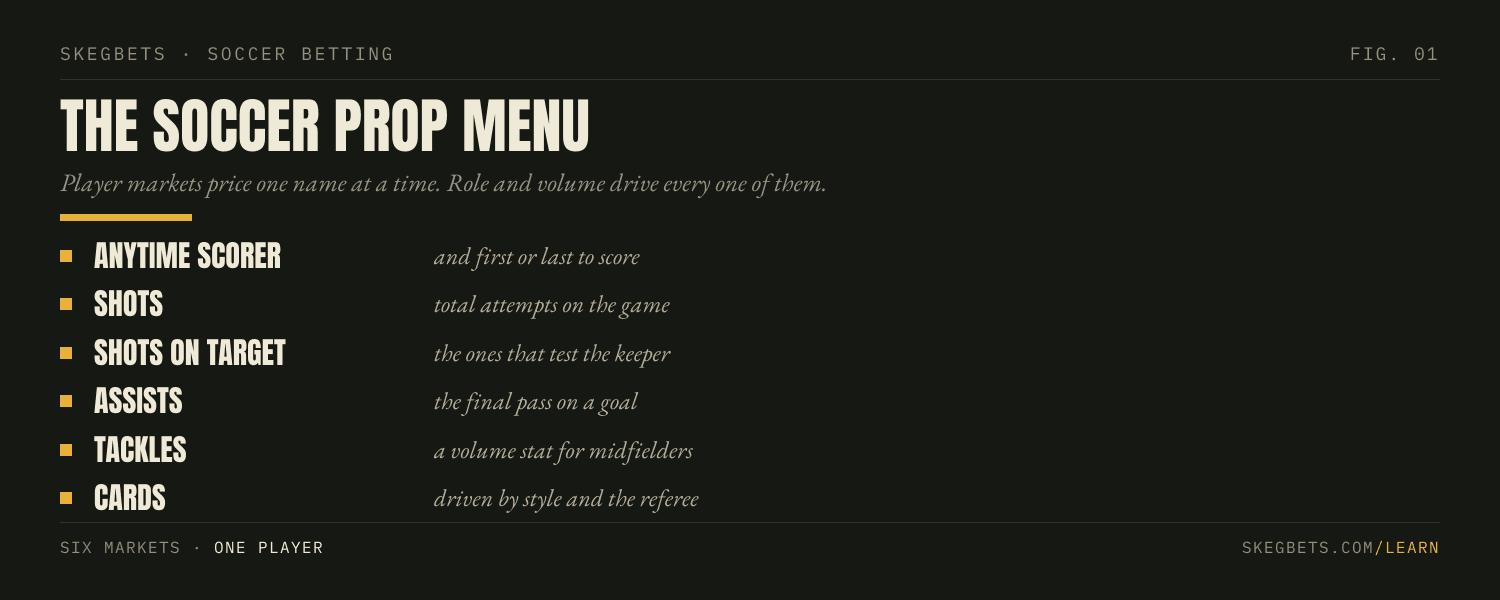
Props reward preparation more than the match markets do, and the sport-agnostic case for that sits in player prop betting strategy. This is the individual-player half of the soccer board; team goal lines and both teams to score are covered separately in soccer totals and both teams to score.
Anytime goalscorer
The most-bet player market keys almost entirely on position. A central striker gets the highest-value chances and touches the ball closest to goal, so he prices shortest. Move out to the wing and the number lengthens; move back to defense and it lengthens again.
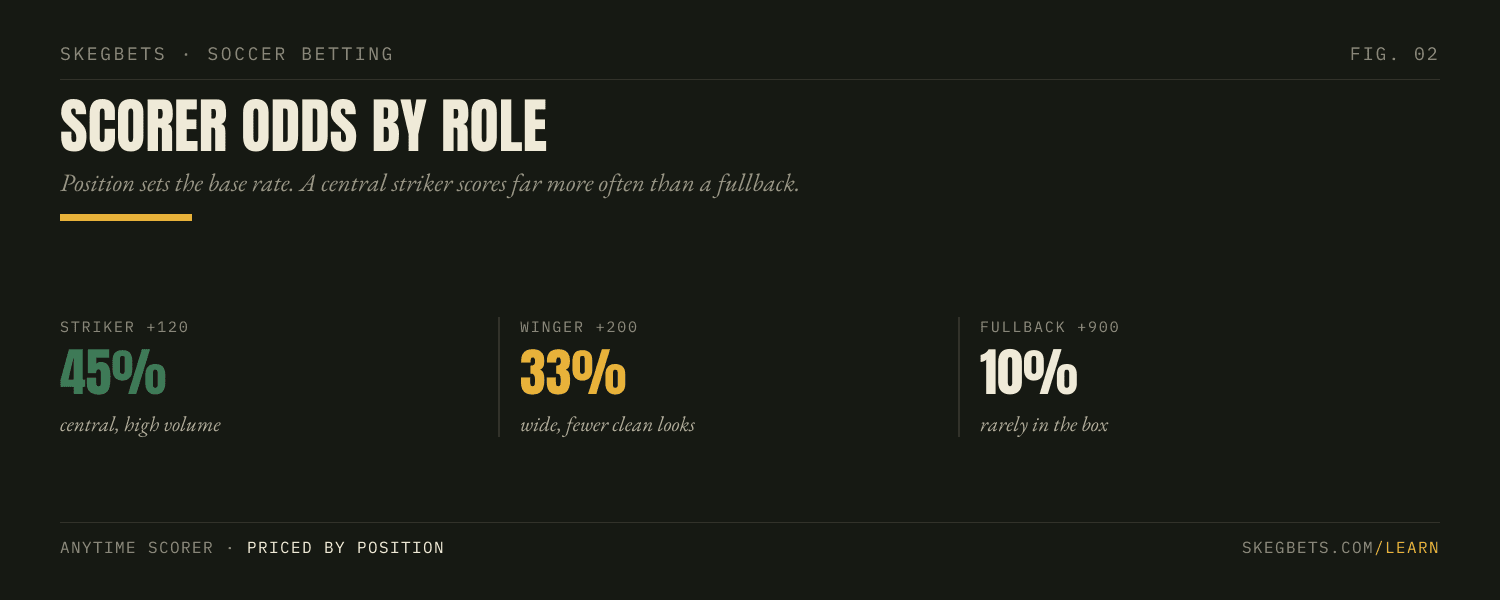
A starting striker around +120 is priced to score roughly 45 percent of the time, a winger near +200 about 33 percent, and an attacking fullback out at +900 only about 10 percent. Those are the raw role odds; the reads that move them are penalty duty, which quietly lifts a scorer's chance, the strength of the defense he faces, and his recent form in front of goal. First scorer and last scorer are the same event narrowed to timing, so they pay far longer and carry more variance. Turning any of those prices into a percentage is exactly what the implied probability tool does.
| Role | Typical anytime price | Implied probability |
|---|---|---|
| Central striker | +120 | 45% |
| Second striker | +160 | 38% |
| Winger | +200 | 33% |
| Attacking mid | +320 | 24% |
| Fullback | +900 | 10% |
Shots, tackles, and passes
Volume markets bet a counting stat over or under a line, and they reward players whose role generates repetition. A winger takes shots, a holding midfielder wins tackles, a deep playmaker completes passes. The line follows the role, so the edge lives in how steady that player's recent rate is.
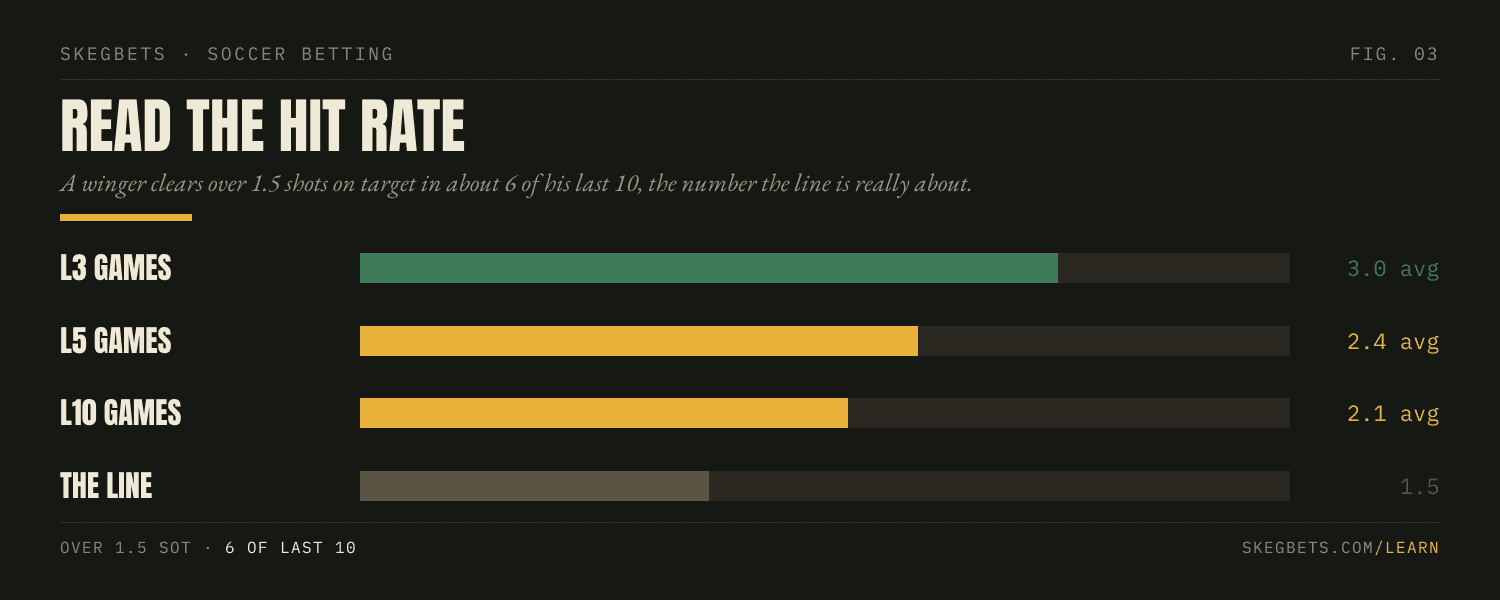
Take a winger with a shots on target line of 1.5. Over his last 10 matches he cleared it 6 times, a 60 percent hit rate. If the over pays a price that implies less than 60 percent, the number is on your side. The same discipline applies to a defensive midfielder's tackle line and a deep-lying playmaker's pass count: find the role that produces the stat in volume, then check the recent per-game log against the posted line before you touch the price.
| Last 10 games | Shots on target | Cleared over 1.5? |
|---|---|---|
| Games 1 to 3 | 2, 3, 1 | Yes, yes, no |
| Games 4 to 6 | 0, 2, 2 | No, yes, yes |
| Games 7 to 10 | 3, 1, 2, 1 | Yes, no, yes, no |
| Hit rate | 6 of 10 | 60% |
Assists sit slightly apart. They depend on a teammate finishing the chance you create, so even a high-volume creator can go several games without one. Treat assist props as the noisiest of the volume family and lean on a longer sample before backing an over.
Card props
Bookings are the one market where the referee matters as much as the player. A card prop asks whether a specific player is shown a yellow or red, and the base number comes from his style, then the official scales it up or down.
A ball-winning defensive midfielder or a physical center back who leads his team in fouls carries a real booking chance; a forward who rarely tackles does not. On top of that sits the referee. A strict official who averages 5 or more cards a match lifts every player's number, while a lenient whistle drags them down. Derbies and high-stakes fixtures push the whole board up again. Reading a card prop means pairing the player's foul and booking history with the referee's tendencies, the same two-part read that shapes a team's goal environment.
Read the hit rate, not the reputation
Every one of these markets comes down to the same move. Pull the player's recent per-game log, count how often he has actually cleared the posted line over his last 5 and last 10 matches, and turn that share into a percentage. Then convert the book's price into its own implied probability and compare.
A striker who has scored in 5 of his last 8 is hitting 63 percent; if his anytime price implies only 50 percent, that 13-point gap is the whole case. The odds and implied probability tools do the price conversion for you, and the same recent-form read runs under every pick in our soccer picks feed. When the rate and the price disagree in your favor, you are holding expected value; when they agree, there is no bet.
| Market | What prices it | The key read |
|---|---|---|
| Anytime scorer | Role, position, penalties | Role odds vs form |
| Shots on target | Attacking usage | Per-game hit rate |
| Tackles / passes | Defensive or deep role | Recent volume |
| Assists | Chance creation + finishing | Longer sample |
| Cards | Player style + referee | Fouls and the whistle |
Frequently asked questions
What are the main soccer player prop markets?+
Anytime goalscorer is the headline, alongside first and last scorer. Then come the volume markets: shots and shots on target, assists, tackles, and passes completed. Cards, also called bookings, round out the board. Scorer props reward strikers, volume props reward high-usage roles, and cards depend on style plus the referee.
How is anytime goalscorer priced?+
By role and position first. A central striker who takes 4 shots a game might sit near +120 to score, a winger nearer +200, and a defender out past +900. The book starts from how many good chances the player's role generates, then adjusts for form, the opponent's defense, and whether he takes penalties.
What makes a good shots on target prop?+
A stable per-game rate against the posted line. A winger who has cleared 1.5 shots on target in 6 of his last 10 games is hitting about 60 percent, so an over that pays worse than that implied rate is value. Volume markets reward the reader who checks the recent hit rate rather than the reputation.
What drives soccer card props?+
Two things: the player and the referee. A combative defensive midfielder who leads the team in fouls carries a higher booking chance than a forward, and a strict referee who averages 5 or more cards a game lifts every player's number. Card props are one of the few markets where the official is a first-order input.
Where do I see a soccer player's prop hit rate?+
Read the player's recent per-game log: how often he has actually cleared each line over his last 5 and last 10 matches. That share, compared against the price the book turns into an implied probability, is the same read our stats pages teach for every sport. Bet only when the hit rate beats the price.
The wider soccer cluster starts at how to bet on soccer; player prop betting strategy covers the cross-sport fundamentals, and the implied probability tools turn any posted price into a percentage you can test against a hit rate.
Free tools