A tennis moneyline carries no draw and no point spread baked in, just two players and a price on each. The better player wins slightly more points on every exchange, and that small edge stacks up across an entire match until the favorite is heavy chalk. Read the price as a probability and the market stops looking lopsided.
How match betting works
Tennis match betting is the simplest bet on the board: pick the player who wins the match. There is no draw, unlike a soccer moneyline, because the match plays until someone wins the required sets. Two outcomes, two prices, and the one you back has to take the whole match, not a set or a game.
Because there are only two outcomes, the two prices have to cover the full 100 percent between them, plus the book’s margin. That is the match winner, the core market in the tennis betting guide. Once you have a feel for it, the spread-style markets follow: set betting and game handicaps lay a favorite to win by a margin, and the total games prices how long the match runs.
Why favorites run steep
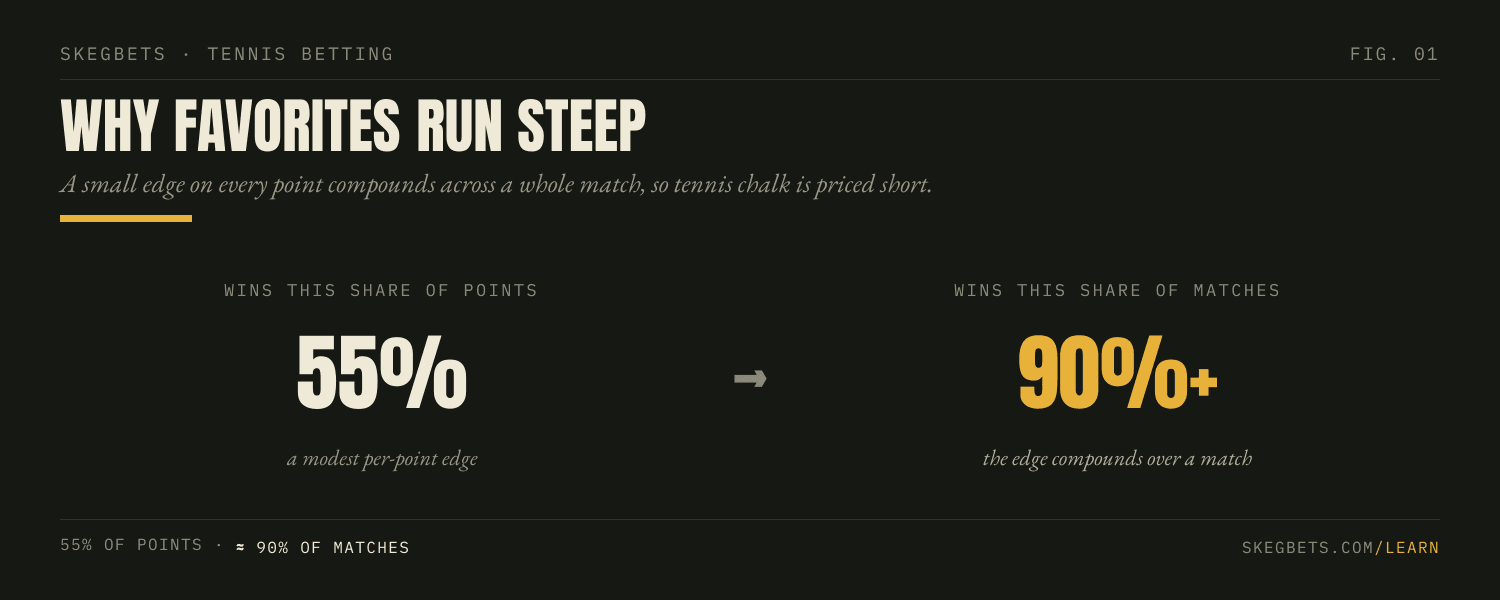
Tennis prices look extreme next to other sports, and the math is the reason. A player who wins just 55 percent of total points does not win 55 percent of the time. They win something north of 90 percent of matches, because that small per-point edge gets compounded through every game, every set, and every tiebreak. The format hands the better player dozens of fresh chances to apply the same small advantage, and it adds up.

So a clear favorite at -300 is not the book overcharging. It is the honest translation of a points edge into a match price. The number to carry: -300 means the market gives that player about a 75 percent chance to win. Convert any price the same way with the odds converter, and read the steep line as a probability rather than a deterrent. Where you actually read those edges is on the serve and return splits at our tennis stats pages.
Best of three vs best of five
Most ATP and WTA events play best-of-three: first to two sets wins. The men’s Grand Slams play best-of-five. That single difference moves how you read every favorite. A best-of-five match gives the stronger player two extra sets to assert, which lowers variance and makes a single hot set from the underdog matter less.
The practical read: favorites are safer in best-of-five, and underdogs are worse value there than the same dog would be over best-of-three. A live dog with a real upset case is a better bet in a best-of-three event, where one run of serve can decide the whole thing. Knowing the format is part of the wider picture covered in situational angles.
Retirements and walkovers
Tennis is one player with no bench, so an injury or a walkover ends the match outright, and the books do not all settle the same way. Some void the bet and refund your stake if a player retires at any point. Some settle once one set is complete. A few settle once a single ball has been played.
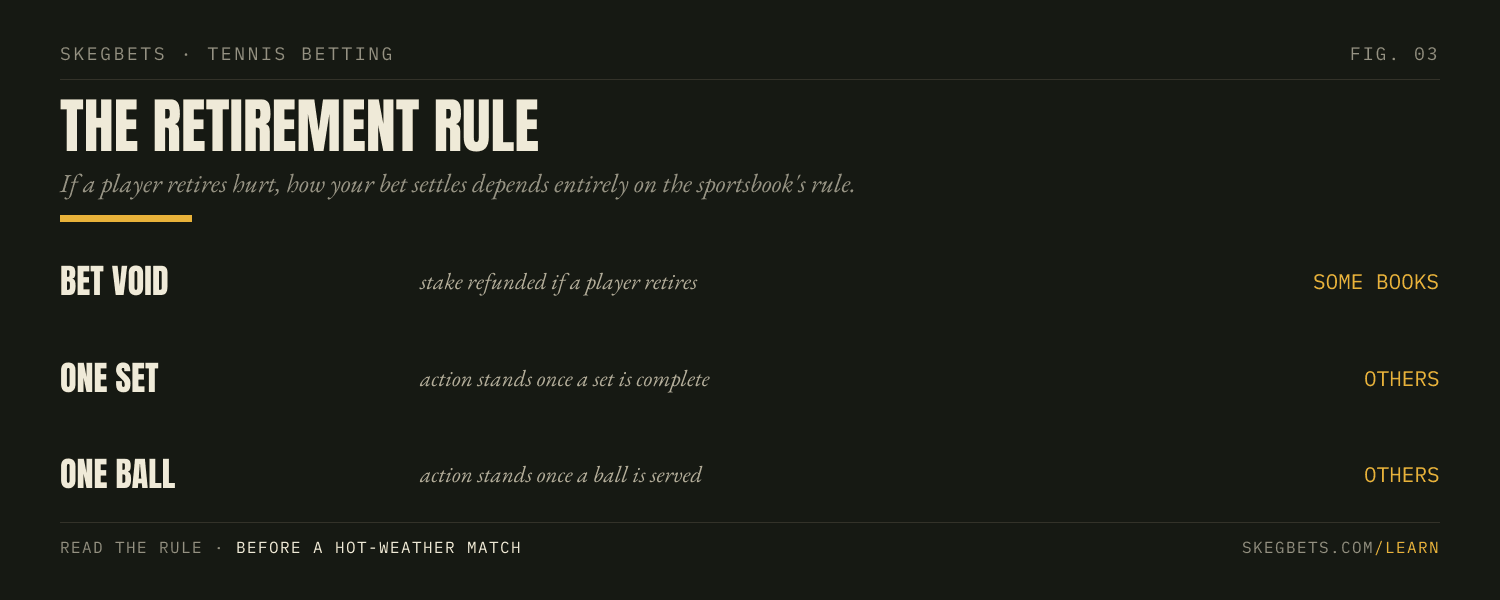
That rule lives in the book’s tennis terms, and it matters most in heat, on a long schedule, or when one player is carrying a knock. Back a fresh-off- injury favorite under a void-on-retirement rule and a first-set pull-out refunds you; under a one-set rule the same pull-out can settle against you. Read the rule before you bet a borderline player, and weigh fitness with the same care you give the stats.
Where the value sits
The ranking favorite is the one to question. A high seed coming off an injury layoff, or dropped onto a surface that does not suit them, is often priced on reputation rather than form, and that is where the overpriced favorites live. A clay grinder is not the same bet on grass, the subject of surface betting, and a player a week back from a layoff is reading differently than the ranking says.
| Price | Implied chance to win | Read |
|---|---|---|
| -110 | 52% | Near coin-flip; pick'em match |
| -200 | 67% | Solid favorite, live dog |
| -350 | 78% | Clear favorite, thin dog value |
| -700 | 88% | Heavy chalk; mismatch |
The discipline is the same as any market. Turn the price into a probability, form your own number from serve, return, and surface, and bet only when your number is higher than the one the book implies. That is the whole of expected value betting, and the implied probability tool does the conversion for you. See the tennis match prices we are taking, with the read, in our live feed.
Frequently asked questions
Is there a draw in tennis betting?+
No. A tennis match plays until one player wins the required sets, so the match winner is a two-way market with no draw to price. That is the main thing that separates it from a soccer moneyline, where the tie is a third outcome and the two sides are priced longer to make room for it.
Why are tennis favorites so short?+
Because a small per-point edge compounds across a whole match. A player who wins 55 percent of points wins something north of 90 percent of matches, since every game, set, and tiebreak gives that edge another chance to show. So a clear favorite is often laid at -300 or shorter, well past where a single-game team sport would price the same gap.
What happens to my bet if a player retires?+
It depends on the sportsbook. Some void the bet and refund your stake if a player retires at any point. Others settle once one set is complete, and a few settle once a single ball has been played. The rule is in the book's tennis terms, and it matters most in heat or on a nagging injury, so read it before you bet a live or borderline player.
Is best-of-five safer for favorites?+
Yes. Best-of-five gives the stronger player more sets to assert the edge, so a single hot set from the underdog matters less and the upset rate falls. That makes favorites safer at the men's Grand Slams, where best-of-five is used, and it makes underdogs worse value there than in a best-of-three event.
Go deeper: how to bet on tennis, set betting and handicaps, surface betting, and reading the stats.
Free tools