A tennis price is built off serve, surface, and ranking, and then the calendar quietly bends it. A player can arrive drained from a deep run, out of sync after three time zones, gassed in the heat, or flat the week after a major. Read the schedule before the market fully prices it and the soft spots are easy to spot.
Fatigue and deep runs
Tennis hands the tired player no relief. There is no bench, no rotation, no clock to run out. Whatever a pro spent yesterday, they carry into today, and the longer the match the more it tells.
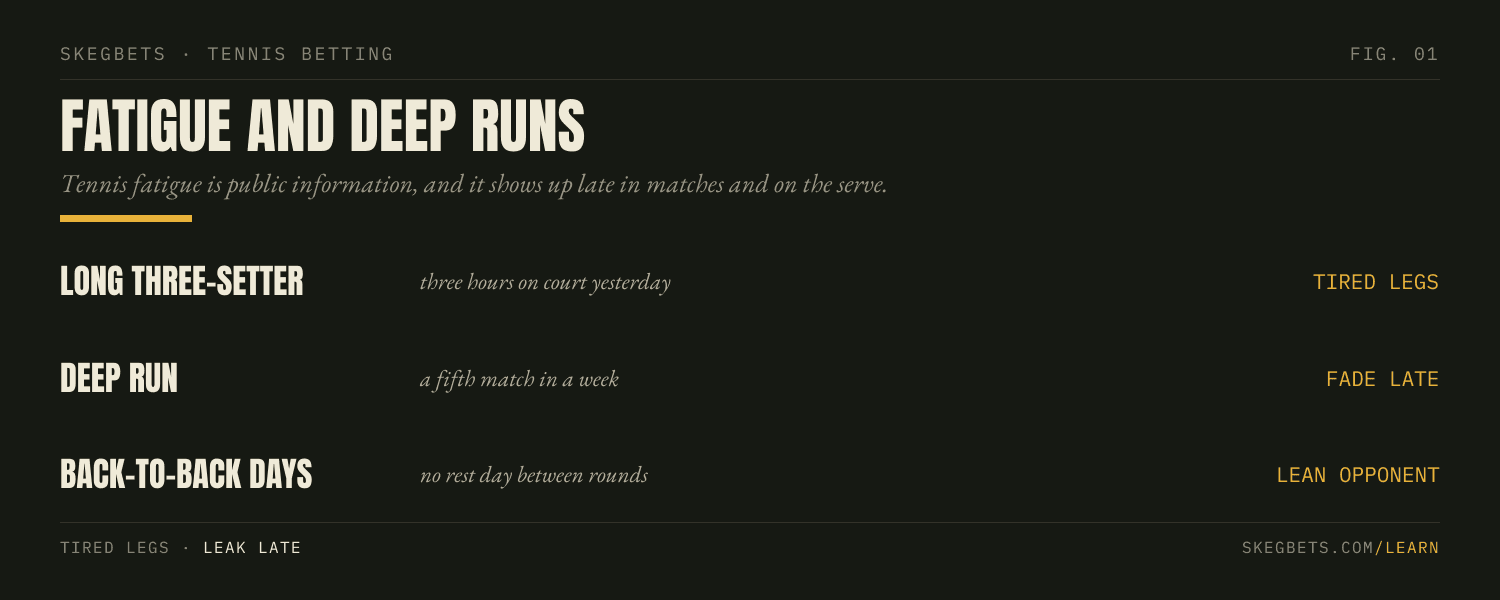
A three-hour, three-set win the day before is the cleanest version of the angle. So is a deep run that has a player stacking singles and doubles across a single week, or the best-of-five toll at a Grand Slam, where two five-setters in a week can hollow a player out by the quarterfinals. Smaller events compress it further: back-to-back days with no rest leave a player serving on tired legs in the second match. Fatigue almost never surfaces on the opening ball. It surfaces late, in the third set and on serve, where a half-step slower and a tick down on first-serve speed turns routine holds into break points. That is the same serve battle how to read tennis stats teaches you to track, and the recent-match workload sits on our tennis stats pages.
Travel, altitude, and heat
Conditions move the number as much as form does, and two players with identical rankings can need very different prices once you know where the match is being played.

A player who flew across several time zones into an early start can be a body-clock match behind their opponent for a round or two. Altitude is the sharper edge: Madrid sits near 2,100 feet and Bogota far higher, and the thin air lets the ball fly and bounce up, so serves and aces climb and rallies shorten. A big server gains, a clay grinder who lives on heavy topspin and long exchanges loses some of the surface's usual help, which is why the same dirt plays closer to a quick hard court. That is a surface story as much as a travel one, the subject of tennis surface betting, and it lifts the total and the ace prop together. Heat and humidity drain stamina and tilt a close match toward the fitter, better-conditioned player, especially in best-of-five. These are public conditions, knowable before the line settles, the same way when you place the bet decides how much of the move you capture.
Motivation and scheduling
Not every match has the same thing riding on it, and the price does not always reflect that. A few scheduling spots recur every season.

The post-Grand-Slam letdown is the most reliable. The week after a two-week major, players who went deep show up at the next 250 or 500 drained and flat, sometimes entered only to meet a commitment, and a freshly minted favorite there is often overpriced against a rested opponent who skipped the major or lost early. Flat early rounds catch top seeds too: a distracted favorite easing into a first-round match against a hungry qualifier can drop a set or the whole thing. Dead rubbers and exhibitions, an offseason exo or a tie already decided, carry no real stakes, and effort there is a guess rather than a read, so the smart move is usually to pass. The same logic covers end-of-season weeks, where a player out of the race for a Tour Finals spot or a ranking defense has little to chase. None of these is a bet on its own. Each is a tiebreaker that nudges a close price.
Live betting and momentum
Tennis swings harder than almost any sport on a single play. One break of serve flips a set, and the live price moves with the scoreboard even when the better player has not gone anywhere.
A favorite who loses a tight first set on two or three break points has often been the stronger server and returner the whole way, and now sits at a longer price than they were pre-match. That gap is where live value lives, the same overreaction the general live betting guide describes across sports. The discipline is to read the serve battle rather than the set score: who is holding comfortably, who is saving break points, whose first serve is landing. A player breaking and getting broken in a chaotic set is a different bet from one cruising on hold after hold. See the live tennis spots we are taking, with the price and the read, in our live feed, and start from the tennis betting pillar if the markets are still new.
| Angle | The spot | The lean |
|---|---|---|
| Deep run / tired legs | Long three-setter or best-of-five toll, back-to-back days | Fade the tired side late + on serve |
| Altitude | Madrid, Bogota: thin air, ball flies | Server + over + ace prop up |
| Heat & humidity | Draining conditions, best-of-five | Lean the fitter player |
| Post-Slam letdown | Week after a major, drained favorite | Fade the overpriced favorite |
| Live after a lost set | Favorite drops a tight first set on break points | Back at the longer price |
Frequently asked questions
Does fatigue matter in tennis betting?+
Yes, more than the ranking suggests. A player coming off a three-hour, three-set win the day before, or deep into a week of singles and doubles, fades late in matches and on serve. Best-of-five rounds at the Grand Slams stack that toll across two weeks, and back-to-back days at smaller events leave no recovery window. Fatigue rarely shows on the first ball, it shows in the third set.
How does altitude affect tennis?+
Thin air at altitude, at Madrid or Bogota, lets the ball travel faster and bounce higher, so serves and aces climb and rallies shorten. A big server gains, a clay grinder who relies on heavy topspin and long exchanges loses some of the surface's usual help. The same clay plays closer to a fast hard court, which moves the total and the ace prop.
Is there a post-Grand-Slam letdown in tennis?+
It is a real and repeatable spot. The week after a two-week major, players who went deep arrive at a smaller 250 or 500 event physically drained and mentally flat, sometimes only entered to fulfill a commitment. Treat a freshly crowned favorite at the next stop as potentially overpriced, especially against an opponent who skipped the major or lost early and is rested.
Can you bet tennis live?+
Yes, and tennis is one of the best sports for it. The scoring swings hard on a single break of serve, so a live price can overreact to one game. A favorite who drops a tight first set on a couple of break points is frequently still the better player and now sits at a longer price. Read the serve battle, not the scoreboard, before clicking.
For the full picture, start with how to bet on tennis, tie conditions to the court in surface betting, learn the serve and return reads in how to read tennis stats, and find the spots we play in our live feed.
Free tools