The NBA plays nearly every night, which turns the schedule into a betting edge of its own. Fatigue, travel, and rest gaps move lines as much as matchups do, and the market is slow to fully price the spots where a good team is simply running on empty.
The back-to-back
One schedule spot matters more than the rest. A team on the second night of a back-to-back carries two disadvantages onto the floor.

A team on the back end of a back-to-back is a step slow, shoots worse on tired legs, and is more likely to rest a starter, which ties straight into load management. Against a rested opponent the disadvantage stacks, and the tired side and the under are both worth a look. The line moves for it, but often not the full distance.
Schedule density and travel
Beyond the strict back-to-back, the broader workload tilts games in quieter ways.

A team playing its fourth game in five nights, or closing a long road trip, runs low on energy in the fourth quarter, where tired teams leak late. Travel compounds it: a back-to-back that also crosses time zones is harder than either alone. A rest differential, one team fresh and the other deep in a stretch, is the cleanest version of the angle, and the schedule context is on our NBA stats pages.
Rest advantage and home court
Two more pieces round out the picture, and one of them is bigger in basketball than anywhere else.
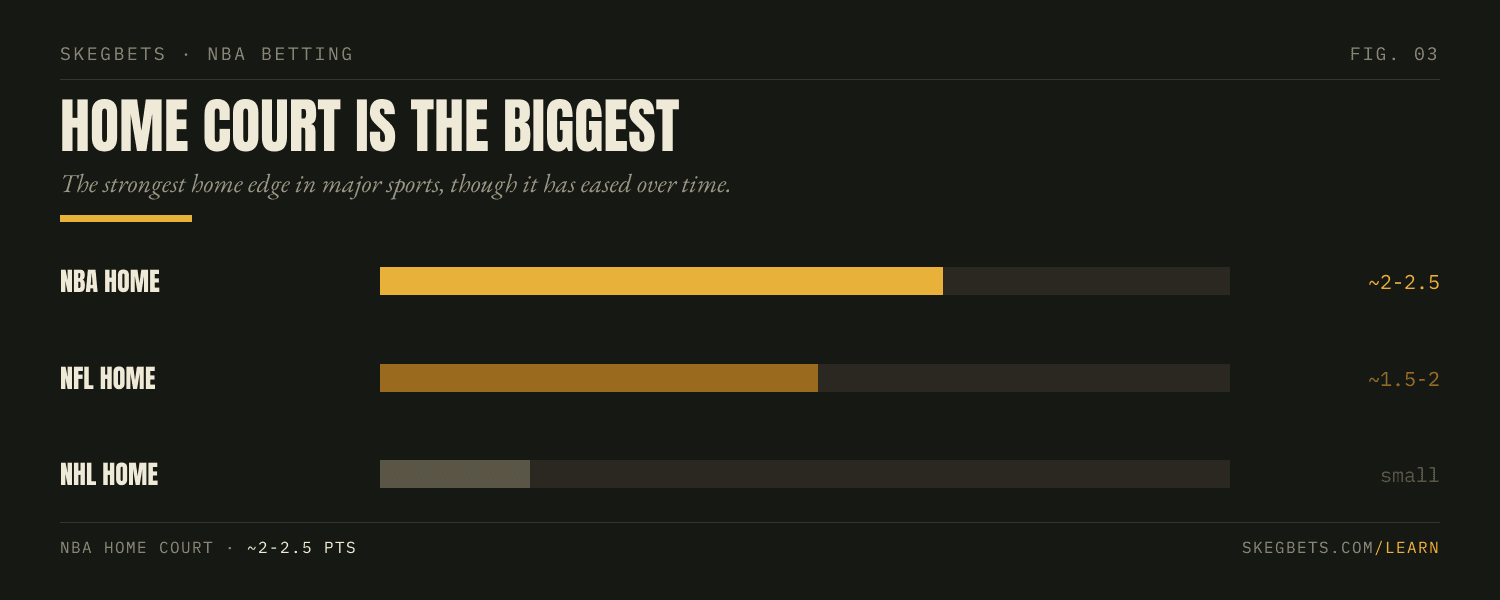
Home court is the strongest home edge in the major sports, once worth around 3 points and now closer to 2 to 2.5 as the league has evened out. Pair it with a rest gap and you have the textbook spot: a rested home team against a tired traveler. The reverse, a strong road team in a schedule loss, is where the tired side is quietly the better bet.
Counting the rest gaps before tip
Lead with the back-to-back, layer in schedule density and travel, and weigh home court as a real but shrinking edge. Before you bet, total each side’s days of rest and miles flown: a fresh home team against a traveler on the second of a back-to-back is the spot the number tends to undersell. Catching that imbalance while it is still in the price, not after the steam, is where closing line value comes from, and it pairs with the pace and rest reads in betting NBA totals.
| Spot | What it does | How strong |
|---|---|---|
| Back-to-back | Tired legs, possible rest | Strongest |
| Schedule density | 4-in-5 or long road trip | Strong |
| Travel | Time zones on no rest | Compounds fatigue |
| Home court | Crowd + no travel | Real (~2-2.5 pts) |
| Schedule loss | Good team in a fatigue spot | Back the tired dog |
Frequently asked questions
What is a back-to-back in the NBA?+
Two games on consecutive nights. The team on the second night plays on tired legs, tends to shoot worse, and is more likely to rest a player. It is the most common and most reliable schedule angle in basketball, especially when the opponent is rested.
Does rest really matter in NBA betting?+
Yes. A clear rest edge, a rested team against one on the second night of a back-to-back or deep in a stretch of games, shows up in energy, defense, and shooting late. The market prices some of it, but a strong team in a fatigue spot is regularly overvalued.
How much is home court worth in the NBA?+
More than in any other major sport, historically worth roughly 3 points, though it has eased toward 2 to 2.5 in recent seasons. Crowd, familiarity, and the lack of travel all help, so an NBA home edge is real, but do not treat it as a fixed 3 the way old numbers suggested.
What is a schedule loss?+
A game a good team is set up to drop because of fatigue, not matchup: a road back-to-back, a fourth game in five nights, or a trap spot before a marquee opponent. Spotting these before the line accounts for them is a steady source of value on the tired side.
For the full picture, start with how to bet on basketball, check who’s resting in load management, and see the spots we play in our live feed.
Free tools