A tennis match is two numbers wearing a scoreboard. How often a player wins a point on serve, and how often they win one on return, set almost everything downstream: the holds, the breaks, the game total, the price. Read those two and the rest of the stat sheet stops being a glossary and starts being a bet.
Serve and return points won
Serve points won is the share of points a player takes on their own delivery; return points won is the share they steal on the opponent’s. The best men win 68 to 72 percent of serve points and 38 to 42 percent of return points. Add the two and you get close to a player’s dominance ratio, the cleanest one-line summary of how good they have been.
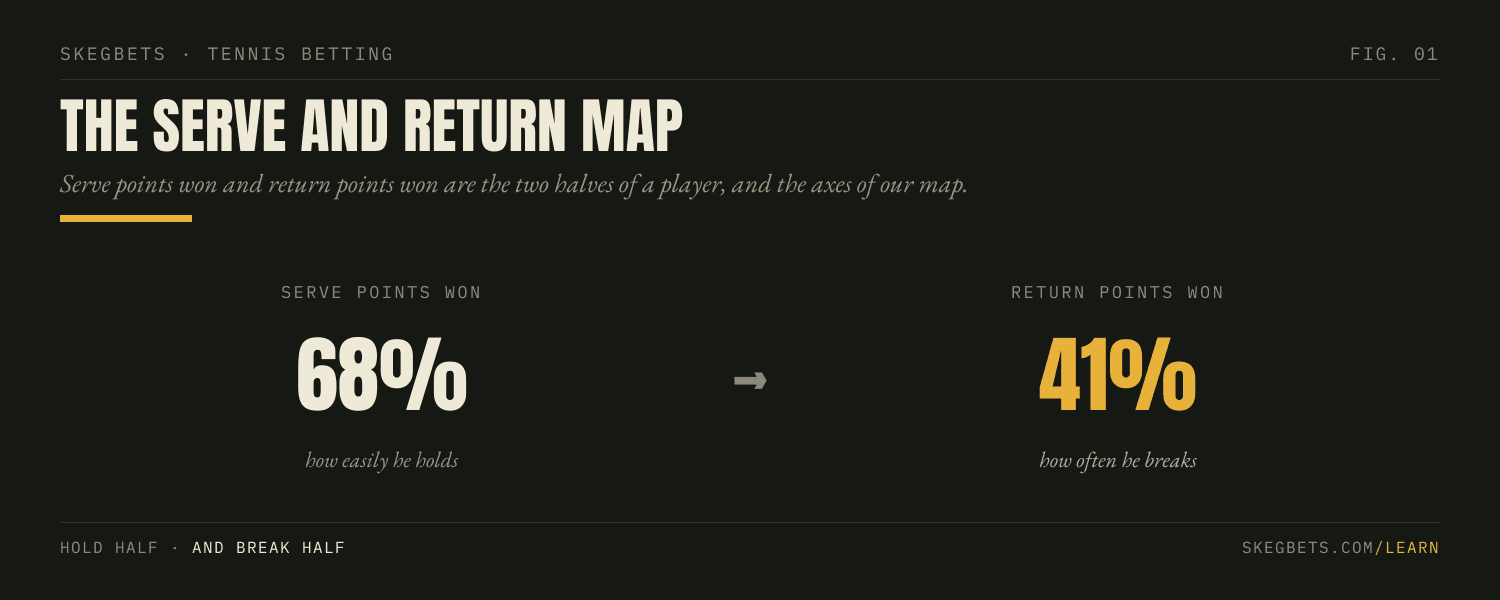
Those two numbers are the axes of the serve and return map on our tennis stats pages. Every tour player is plotted as a cloud, with the player you are looking at picked out as a gold dot and the tour medians drawn as crosshairs. Top right is a complete player who wins on both ends; bottom right is a server who lives on hold; top left is a returner who breaks for a living; bottom left is still developing. Where a name sits, and where the opponent sits, tells you whether a match is a hold-fest that stays low or a break-trading affair that runs long. The percentile bars below the map say the same thing against the field: serve, return, ace rate, double-fault discipline.
Break points and holds
Serve and return points are the season-long averages. Break points are where they get spent. Break points saved measures a server under the most pressure they face; break points converted measures a returner with a chance to flip the set. Together they roll up into hold rate and break rate, the two numbers that actually decide who wins a tight match.

When two players hold 85 percent of the time, a set can hinge on a single break, so the player who saves break points or steals them is worth more than a raw serve number suggests. Our player page surfaces break points saved and converted in the percentile bars, and the serve-anatomy funnel right below breaks the hold down further: first-serve in percent, then first-serve points won, then the second-serve points won that exposes who wobbles on the big point. The tiebreak and deciding-set win rates on the at-a-glance board are the same clutch story in match terms.
Elo over the ranking
A world ranking is a 52-week tally of results, weighted by how big the tournament was. It is a fair record of a season and a poor guide to tonight. It lags injury layoffs, it lags hot and cold form, and it carries no sense of the surface. An Elo rating fixes all three: it updates after every match, moves more when a player beats someone strong, and can be kept separately for hard, clay, and grass.
The two often disagree, and the gap is where the value sits. A seed defending points from a title run a year ago can hold a high ranking while their Elo, fed only by recent results, has already slipped. The at-a-glance board on our tennis stats pages leads with overall Elo plus a hard, clay, and grass Elo on every pro, alongside 52-week win percent, so you can see the ranking favorite and the Elo favorite side by side before you take a price. When the model on our live picks feed flags an overpriced seed, an Elo and ranking that point in different directions is usually why.
Surface splits
The same player is a different bet by surface. A flat hitter who serves big gains on fast grass and gives ground on slow clay, where the high bounce neutralizes the serve and rewards a grinder’s legs. Read the career average across all three and you blur a player who is a 70 percent serve machine on grass and a break-trading returner on clay into a meaningless middle.
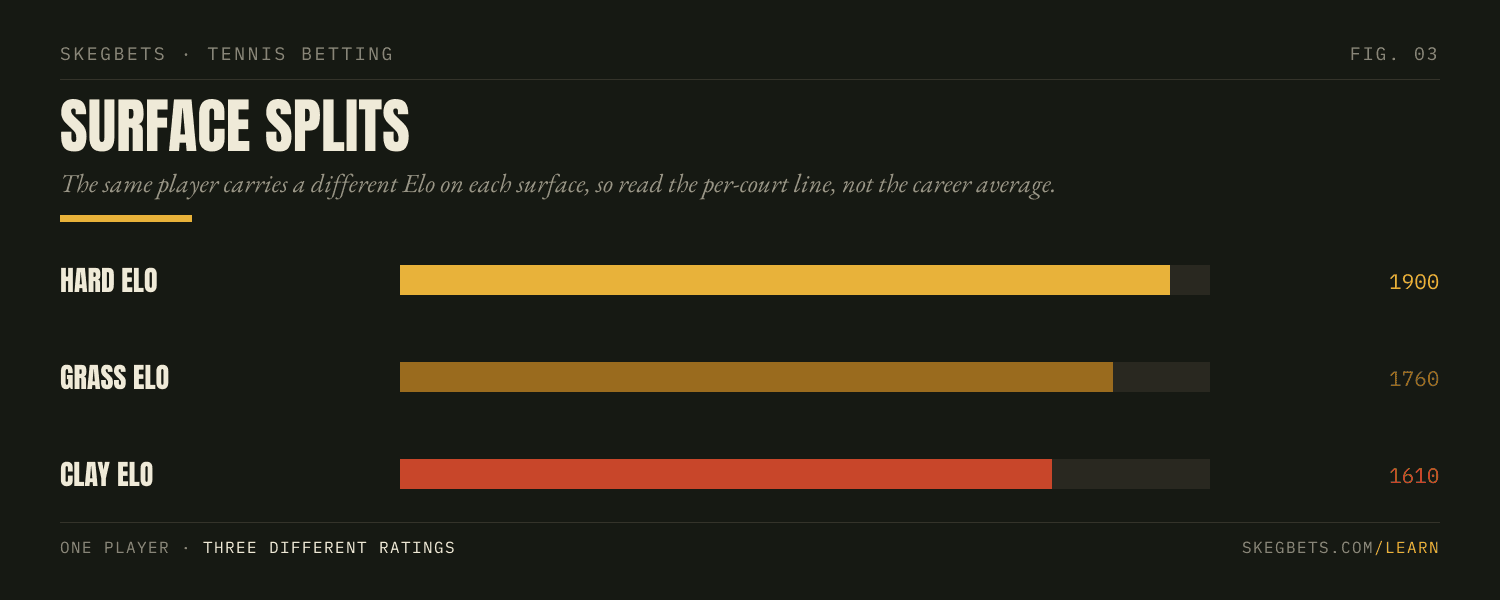
The surface-splits table on our tennis stats pages is built for exactly this read, with a career, 52-week, and season toggle so you can weigh a long sample against current form. Pair it with the per-surface Elo on the same page and you are reading the player on the court the match is actually on, which is the whole point of tennis surface betting. The match log at the bottom is the receipt: recent results with the surface attached, so you can check whether the splits are holding up this swing or going stale. Run the serve and return read through the game total and the clutch numbers through player props, and start from how to bet on tennis if the markets are new. The general how to bet on sports guide covers odds and bankroll first, and the prop research tool turns these numbers into a line read.
| Stat | What it tells you | Where to find it |
|---|---|---|
| Serve points won % | How hard a player is to break | /stats/tennis player page, serve/return map x-axis |
| Return points won % | How often they steal the opponent's serve | /stats/tennis player page, serve/return map y-axis |
| Break pts saved / converted | Who holds up, and who flips, the big point | /stats/tennis player page, percentile bars |
| Elo (overall + surface) | Next-match strength, not last year's points | /stats/tennis player page, at-a-glance board |
| Surface splits | The same player by hard, clay, grass | /stats/tennis player page, surface-splits table |
Frequently asked questions
What tennis stats matter most for betting?+
Serve points won and return points won come first, because every other number flows from them. Add break points saved and converted, the hold and break rates they produce, and a surface Elo, and you have the spine of a tennis read. Raw ranking and win-loss record describe a season; these numbers forecast the next match.
Is Elo better than the ATP or WTA ranking for betting?+
For predicting a single match, yes. The world ranking is a 52-week points tally weighted by tournament size, so it lags injuries, form, and surface. An Elo rating updates after every result and can be kept per surface, so it answers the question a bettor actually has: who is more likely to win tonight, on this court.
What is serve points won in tennis?+
Serve points won is the share of points a player takes while serving, first and second serve combined. The best men sit in the high 60s to low 70s. It is the single cleanest measure of how hard a player is to break, and paired with return points won it sets the hold rate, the break rate, and the game total all at once.
Why do surface splits matter in tennis betting?+
Because the same player posts different serve, return, and Elo numbers on hard, clay, and grass. A big server gains on grass and loses ground on slow clay; a grinder is the reverse. Betting the career average treats three different sports as one, so read the per-surface line for the court the match is actually on.
Go deeper: how to bet on tennis, surface betting, totals, and player props, then read every number live on our tennis stats pages.
Free tools