A tennis total is one of the cleaner numbers on the board, and one of the most misread. It counts combined games, not sets and not minutes, and the single thing that decides it is how often serve gets broken. Get that lever right and the over/under reads itself, even when the serve stats point the other way.
How the total works
The total is the combined number of games both players win across the whole match, priced over or under a line like 22.5. A 6-4 6-3 win counts 19 games. A 7-6 7-6 win counts 26. The match winner is irrelevant to the total, which is why it pairs so well with a side: you can be sure who wins and still have a live read on how many games it takes.

The total sits next to the game handicap, and the two move together: a favorite laid at −4.5 games is priced off the same expectation of how lopsided the games run. If betting itself is new, the general how to bet on sports guide covers odds and bankroll first, and how to bet on tennis is the starting point for the rest of the board.
What moves a game total
Here is the counterintuitive part, and the one that separates a sharp tennis read from a guess. Two heavy servers do not produce a low total. They hold so easily that almost no games break, sets crawl to 6-6, and the tiebreak tacks a 13th game onto each one. A straight-sets win between two big servers often reads 7-6 7-6, which is 26 games and sails over a 22.5 line. The thing that drags a total under is the opposite: frequent breaks, which produce lopsided 6-2 6-3 sets worth about 17 games.
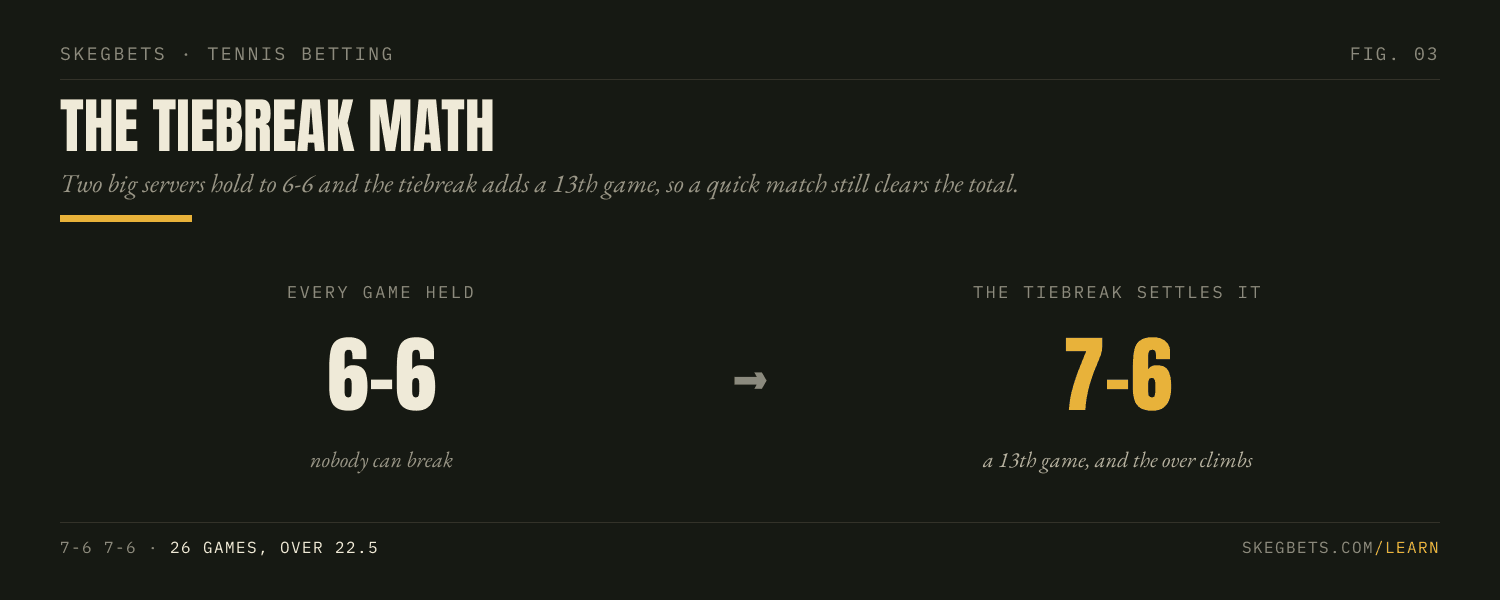
So the lever you read is breaks per set, not serve quality. You build it from combined hold and break rates: how often each player holds, and how often they break, on this surface. Two elite returners who break often pull the total down even if their own serves are strong. A returner who never breaks against a server who never gets broken means tiebreaks, and tiebreaks mean the over. The serve and return splits that feed this read live on our tennis stats pages, and reading them is covered in how to read tennis stats.
Surface and the total
Grass and fast hard courts hand the advantage to the server. Holds become routine, returners struggle to manufacture break points, and sets drift to tiebreaks, all of which push the game count up. Slow clay does the reverse: the surface neutralizes the serve, returners get more looks, and breaks come more often, which produces lopsided sets and pulls the total down.

There is a tension on clay worth holding in your head. Clay breaks more, which lowers the game count, but clay rallies run longer, so each game eats more time. That matters for a minutes market, not a games total. For the over/under on games, the break rate wins, and clay leans under more often than a casual look at the long, grinding points would suggest. Because the same two players price differently court to court, surface belongs in every total read, which is the subject of tennis surface betting.
Best of three vs five
Match format sets the ceiling. Best-of-three, the standard on the regular tour, tops out at three sets and usually posts a total around 21.5 to 23.5 games. Best-of-five, used in the men’s Grand Slam draw, can run to five sets, and a five-setter can clear 40 games on its own. The same two players, same surface, carry a much higher line at a major than they would at a tour stop, purely because more sets fit more games.
Two implications follow. A best-of-five total is more sensitive to whether the match goes the distance, so a likely blowout and a likely war price far apart. And the over wants length: a tight, serve-heavy best-of-five between two players who refuse to break each other is the classic over, since deuce sets and tiebreaks pile up across five frames. Schedule and fatigue bend this too, the subject of situational angles.
| Driver | Pushes the total | Why |
|---|---|---|
| Two big servers | OVER | Holds reach 6-6, tiebreaks add a 13th game |
| Frequent breaks | UNDER | Lopsided 6-2 6-3 sets, ~17 games |
| Grass or fast hard | OVER | Server-friendly holds and tiebreaks |
| Slow clay | Mixed | More breaks pull down, longer games push up |
| Best-of-five | Higher line | More sets fit more games, a war clears 40 |
Frequently asked questions
Do two good servers mean a low tennis total?+
No, usually the opposite. Two big servers hold easily, so few games break and sets drift to 6-6, where a tiebreak adds a 13th game. A straight-sets win can read 7-6 7-6, which is 26 games and clears most totals. The lever is breaks per set, not serve quality. Frequent breaks, not big serves, are what pull a total under.
How does the court surface affect a tennis total?+
Grass and fast hard courts reward the server, so holds are routine and sets reach tiebreaks, which pushes the game count up. Slow clay produces more breaks and lopsided sets, which pulls it down, though clay rallies run longer so individual games take more time. For game totals, read the break rate the surface produces, not the minutes.
What is a typical tennis total?+
Best-of-three matches usually post around 21.5 to 23.5 games. A serve-heavy matchup on a quick court sits higher, a break-prone matchup on clay sits lower. Best-of-five Grand Slam matches run far higher, often in the 30s, because a five-setter simply contains more games than a two-set sweep.
How do tiebreaks affect tennis totals?+
A tiebreak is the over's best friend. When a set reaches 6-6, the tiebreak counts as one extra game, turning a 6-all set into 7-6. Two tiebreak sets add two games a straight-sets match would not otherwise have. Matchups full of holds and tiebreaks beat their total far more often than the serve quality alone would suggest.
For the full picture, start with how to bet on tennis, pair the total with set betting and handicaps, read the serve and return form in how to read tennis stats, and see the totals we take in our live feed.
Free tools