The match winner pays one price for any win, a 6-0 6-0 rout and a three-set survival job alike. Set betting and the handicaps charge for the margin instead. They ask how the favorite wins, or how close the underdog keeps it, and they reward a sharper read than picking the side.
Correct set score
Set betting is a correct-score market on the sets. A best-of-three match has four possible scorelines, 2-0 and 2-1 for each player, and you pick the exact one. Best-of-five at the majors widens the menu to 3-0, 3-1, and 3-2 per side. The narrower the result you name, the bigger the price, because you are betting the manner of the win, not just the win.

Backing a favorite to win 2-0 pays more than their match winner price, because a straight-sets result is a subset of all their wins. You give up the 2-1 outcomes to get the better number. The read that justifies it is a favorite who breaks early and closes, against an opponent who is unlikely to nick a set. Bet 2-1 instead when you expect the favorite to win but to drop a set along the way, which is common on slow surfaces where the underdog can steal a tiebreak.
The set handicap
The set handicap collapses those scorelines into a two-way bet. A favorite at minus 1.5 sets must win in straight sets: a 2-0 covers, a 2-1 does not, because winning by one set is short of the 1.5 line. It is the same outcome as backing 2-0 in set betting, priced as a handicap rather than a scoreline.
The other side, plus 1.5 sets on the underdog, is the cushioned bet. It cashes if the underdog wins a single set or wins the match outright. So a dog who loses 6-4 in the third still pays, because they took a set on the way. That makes plus 1.5 sets a softer way to back a live underdog than the match winner: you are paid for keeping it competitive, not only for the upset.
The game handicap
The game handicap is tennis's spread, set in games. The favorite is laid at a band like minus 4.5, sometimes minus 3.5 or minus 5.5 in a lopsided matchup, and must win by that many clear games across the whole match. The underdog takes the matching plus number as a head start.

The cover math runs on total games won minus total games lost. A 6-3 6-4 win is 12 games to 7, a plus 5 margin, so it covers a minus 4.5 favorite. A 6-4 7-6 win is 13 games to 10, only plus 3, so the same minus 4.5 line loses even though the favorite won. Two scorelines, one winner, opposite handicap results. The game handicap and the total games are linked: the margin between the players and the combined count move together, so a match that goes long tends to tighten the handicap and lift the total at once.
When to use each
Lay the minus 1.5 set line or a big minus-games number on a dominant favorite who breaks often, against an opponent who struggles to hold. When breaks come in bunches, sets end 6-2 and 6-3 and the margin piles up. That is the matchup where the favorite covers a wide handicap and the straight-sets price is live.
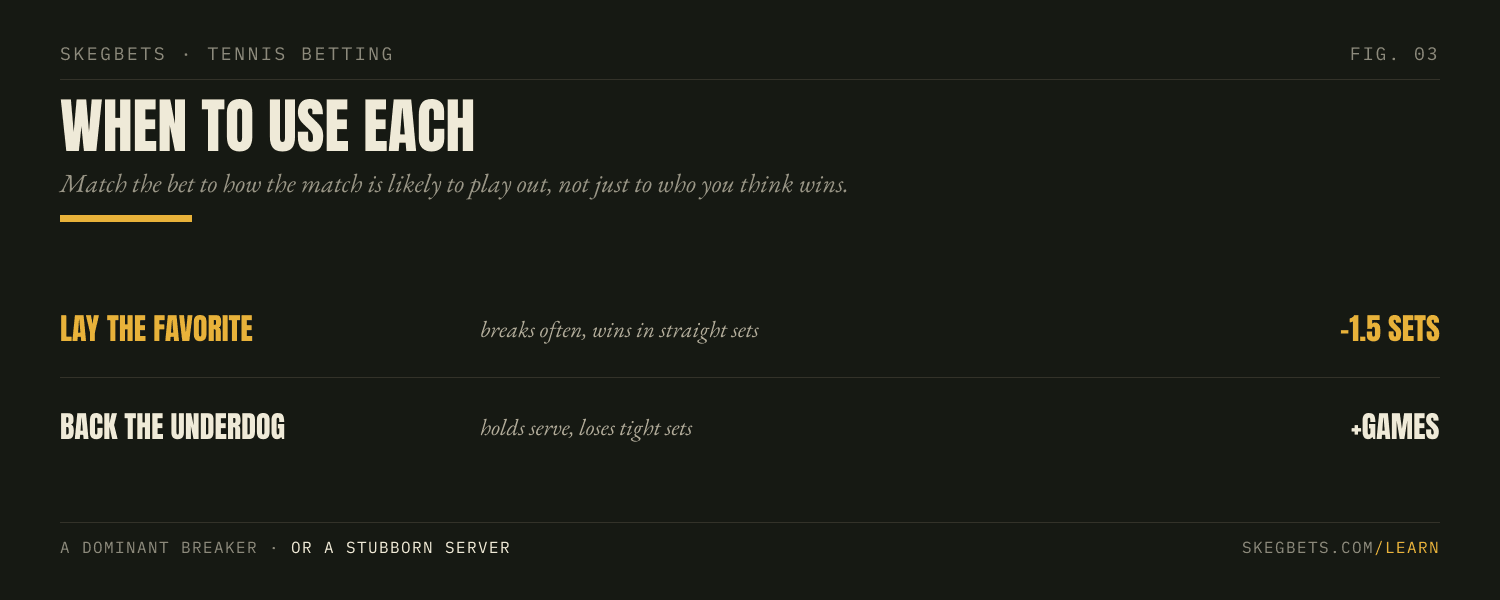
Take the underdog plus games the opposite way: when they hold serve well and lose tight rather than getting blown out. A player who goes down 4-6 6-7 lost by three games and still beats a plus 6.5 line. Big servers and tiebreak grinders are the classic plus-games dogs, because their holds keep the score close even on a night they lose. Surface and fatigue sharpen the call, the subject of situational angles, and the serve and return splits that say who holds and who breaks live on our tennis stats pages.
Convert any handicap price to a percentage with the odds converter before you bet, and only back a line when the number beats your read of how the margin lands. The full market map sits in how to bet on tennis, stake sizing comes from a real edge in when to place sports bets, and the handicaps we are actually playing show up in our live feed.
| Bet | What it needs | Best for |
|---|---|---|
| Set betting | Exact set score (2-0, 2-1, ...) | Reading how the win lands |
| Set handicap −1.5 | Favorite wins in straight sets | Dominant favorite, weak server |
| Set handicap +1.5 | Dog wins a set or the match | Live underdog, cushioned |
| Game handicap −4.5 | Favorite wins by 5+ clear games | Lopsided, break-heavy matchups |
| Game handicap +4.5 | Dog stays within 4 games | Big server losing tight |
Frequently asked questions
What is set betting in tennis?+
Set betting is a correct-score bet on how the sets land. In a best-of-three you pick one of four results: 2-0 or 2-1 for either player. Backing a favorite at 2-0 pays more than the match winner because you also need them to win in straight sets, not just to win.
What does minus 1.5 sets mean?+
It is the set handicap on the favorite. Minus 1.5 sets means they must win the match in straight sets, since a 2-1 win leaves them only one set clear and does not cover the 1.5. The other side, plus 1.5 sets, cashes if the underdog wins a single set or wins the match outright.
How does a games handicap work in tennis?+
A games handicap is tennis's spread, set in games rather than sets. A favorite at minus 4.5 games must win by five clear games across the match. A 6-3 6-4 win is a plus 5 margin and covers; a 6-4 7-6 win is only plus 3 and does not. The underdog at plus 4.5 covers if they stay within four games, even in a loss.
When should I take the underdog on the handicap?+
Take the underdog plus games when they hold serve well and tend to lose tight sets rather than get blown out. A player who loses 4-6 6-7 still beats a plus 6.5 line. Big servers and players who push sets to tiebreaks are the classic plus-games candidates, even when you expect them to lose the match.
Go deeper on the markets: how to bet on tennis, match betting, totals, and situational angles.
Free tools