Move a match from Roland Garros to Wimbledon, a few weeks apart on the calendar, and the favorite can flip to the underdog with no change in ranking. Tennis is three sports wearing one name: a slow clay game, a fast grass game, and a medium hard-court game in between. The surface under the players decides who is good that week, and the market does not always reprice the swing in full.
Three surfaces, three games
Hard, clay, and grass differ in two things that change everything: how fast the ball travels and how high it bounces. Those two dials sort players into winners and losers more sharply than almost any other factor in the sport.
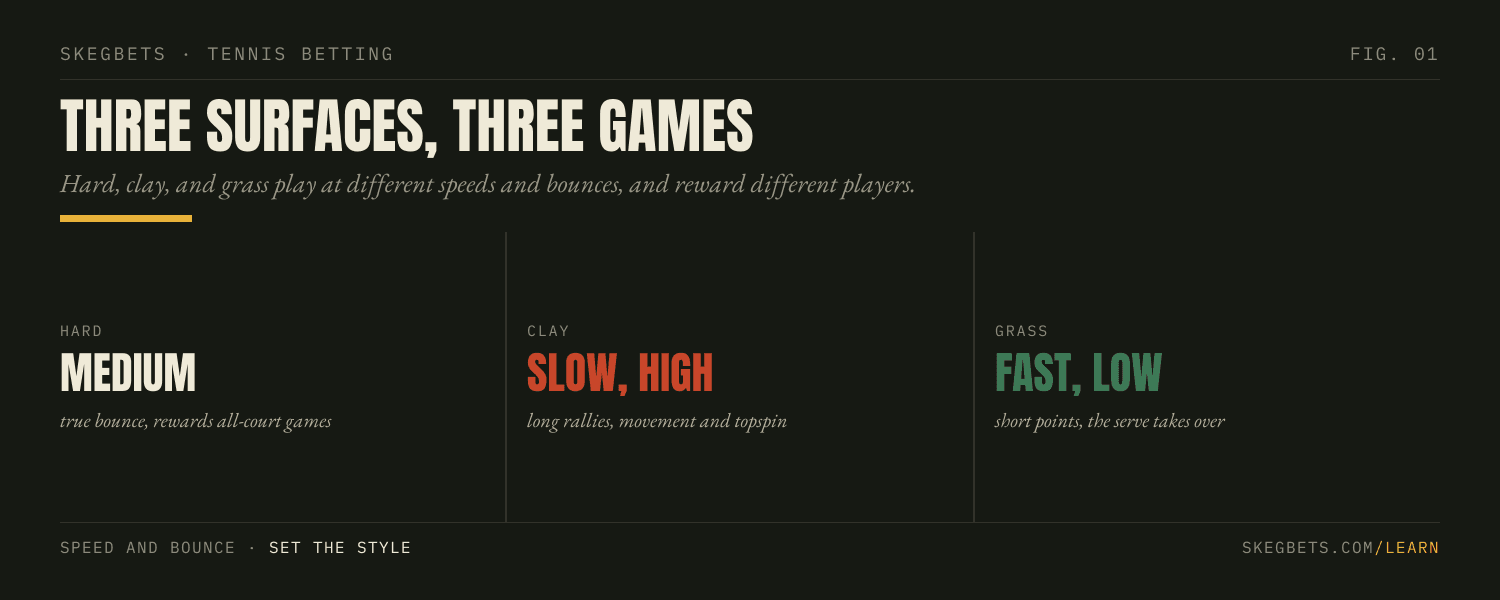
Hard courts play at medium speed with a true, predictable bounce, which is why they reward complete, all-court games and why most of the tour is contested on them. Clay is slow and bounces high, so it drags out rallies, blunts the serve, and rewards movement, topspin, and stamina. Grass is the opposite: fast, with a low skidding bounce that shortens points and hands the edge back to the server and to the returner who can chip and block. The grass season is also short and intense, a few weeks bridging the spring clay and the summer hard courts, so form there is harder to read and easier to misprice.
Surface specialists
Because each surface rewards a different skill, some players post results on one court that look nothing like their overall record. A clay grinder who slides, defends, and out-lasts opponents can beat higher-ranked all-court players in Madrid and Rome, then lose early once the tour reaches grass. A flat-hitting big server runs the opposite arc: a live threat at Wimbledon, a fade in Paris.
The market knows the famous names, but it routinely underprices the second-tier specialist, the player ranked 40th overall whose clay form belongs in the top 15. Reading the serve and return battle is how you spot the why, covered in how to read tennis stats, and the surface-specific split is the number that flags the spike. You can see every player’s surface splits on our tennis stats pages.
Surface Elo
A world ranking is one number for all three surfaces. A surface Elo is three: a strength rating computed only from a player’s matches on that court, kept separately for hard, clay, and grass. It is the sharpest single tool in surface betting because it puts a specialist’s edge in numbers.
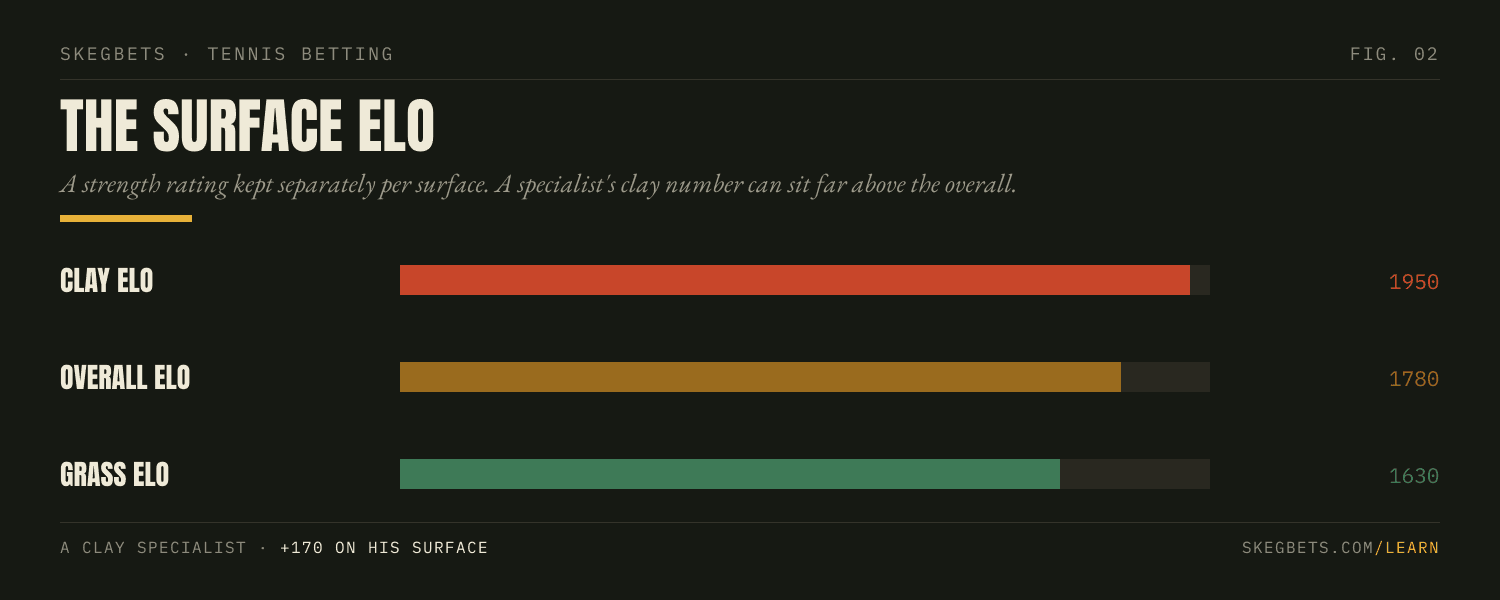
A clay specialist’s clay Elo can sit a full tier above their overall rating, and a big server’s grass Elo can sit above their clay number. When two players are close on the world ranking but a tier apart on the surface Elo, the surface number is the one that forecasts tonight’s match. Our player pages carry a per-surface Elo and surface splits on every pro, so you can check a clay number against an overall one before you bet, the same way the tennis betting guide leans on serve and return form.
How the price swings
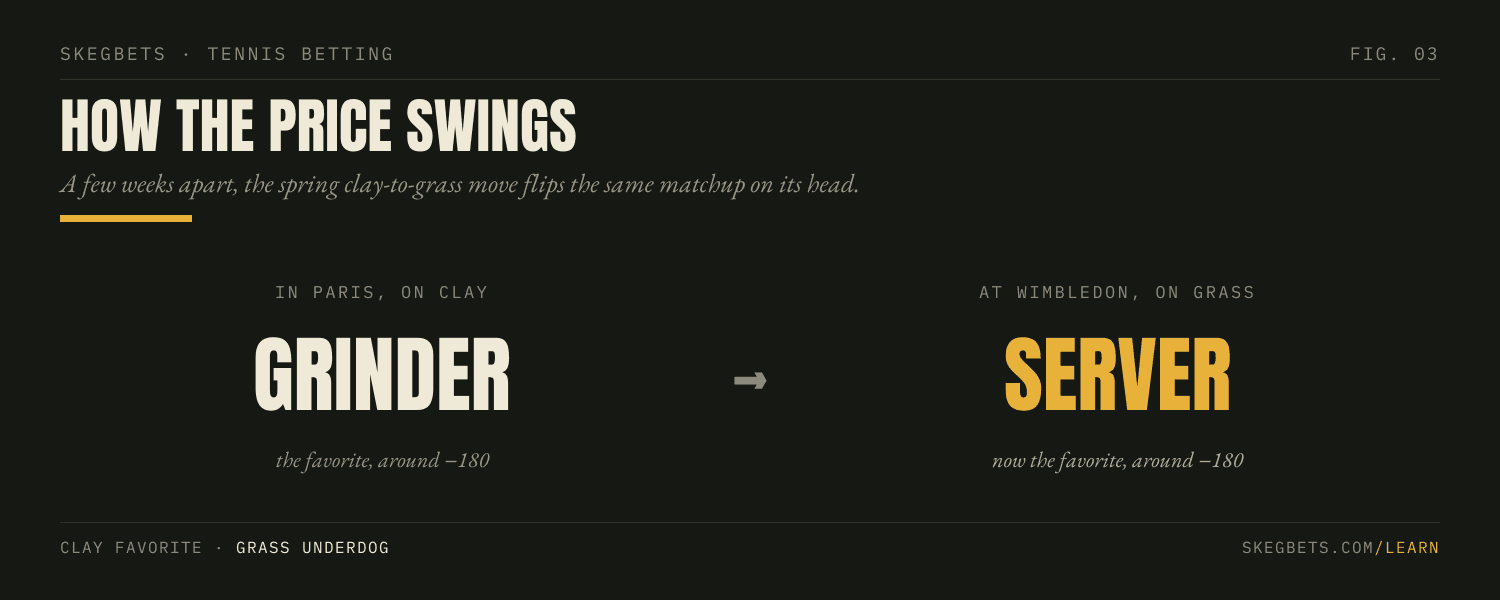
The same matchup prices differently by surface, and the cleanest example is the spring transition. The clay season ends at Roland Garros and the grass season opens a couple of weeks later, so a player who was a clay favorite can be a grass underdog against the very same opponent, with no result in between to explain it on a ranking screen.
Surface drives the total games too. Clay produces more breaks of serve, so sets run long and the game count climbs. Grass produces routine holds and leans on tiebreaks, which compresses the count, and hard sits between the two. That is the surface lever behind every tennis totals read. It feeds ace props as well: grass and fast hard courts lift ace counts, slow clay suppresses them, a split worth weighing in tennis player props. Schedule and the short grass swing bend the picture further, the subject of situational angles. To size a surface edge into a stake, turn the price into a percentage with the odds converter, and see the surface spots we play, with the price and the read, in our live feed.
| Surface | Speed & bounce | Rewards |
|---|---|---|
| Hard | Medium speed, true bounce | All-court games |
| Clay | Slow, high bounce, long rallies | Grinders, topspin, movement |
| Grass | Fast, low bounce, short points | Big servers, chip-and-block returners |
Frequently asked questions
Why does the surface matter so much in tennis betting?+
Hard, clay, and grass play at different speeds and bounce heights, so each rewards a different skill. Clay slows the ball and neutralizes the serve, grass speeds it up and hands the server the edge, and hard sits in between. The same two players can therefore swap favorite and underdog from one surface to another, even with identical rankings.
What is a clay-court specialist?+
A player whose results spike on clay relative to their other surfaces. The profile is usually heavy topspin, strong movement and sliding, and the stamina for long rallies. Their clay record and clay Elo sit well above their overall number, so they are often underpriced on clay against a higher-ranked all-court player and overpriced once the tour moves to grass.
What is a surface Elo?+
A strength rating computed only from a player's matches on one surface, kept separately for hard, clay, and grass. A specialist's clay Elo can sit far above their overall rating, and a big server's grass Elo can sit above their clay number. It forecasts the next match on that surface far better than a single all-surface ranking, which is why our tennis stats pages carry a per-surface Elo on every pro.
Does grass favor big servers?+
Yes. Grass is fast and the bounce stays low, so serves skid through and points end quickly. That hands the edge to the server and to returners who can chip and block rather than swing big. Hold percentages climb, breaks get rare, and matches lean on tiebreaks, which is why a flat-hitting server can be a live underdog on grass against a clay grinder.
For the full picture, start with how to bet on tennis, see how the surface sets the total, learn to read the surface splits and Elo, and find the surface spots we play in our live feed.
Free tools