The short version
The three-way match-result market: home, draw, or away. How the vig spreads across three outcomes and how to strip it out to read the true price.
A soccer match-result bet carries three prices, not two, because roughly one game in four ends level. Home win, draw, away win: that is 1X2, the default market on every league fixture. Learn how the book spreads its margin across those three numbers and you can read the true price behind any of them.
What 1X2 means
The name is the shorthand. 1 is the home team, X is the draw, and 2 is the away team, each a separate bet on how the match finishes. It settles on 90 minutes plus stoppage time, so a cup tie that goes to extra time or penalties still grades as a draw here if the score was level at the whistle. This is the soccer version of a moneyline, with one extra outcome bolted on, and it is why the general how to bet on soccer guide starts here before moving to the spread and totals.
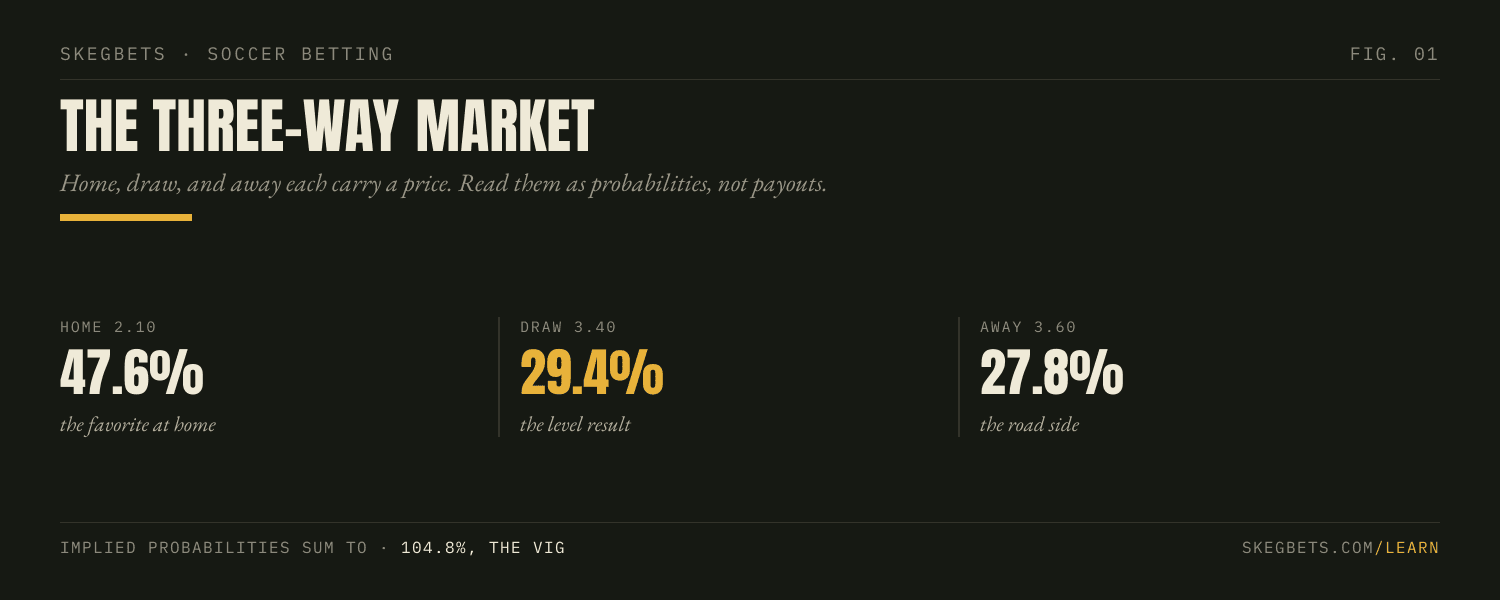
Take a common line: home 2.10, draw 3.40, away 3.60 in decimal odds. Each price is a claim about how likely that result is. The favorite carries the shortest number, the away side the longest, and the draw sits in the middle of almost every evenly matched fixture. Turn each into a probability and the market shows its hand.
Why the draw changes everything
In the NFL or NBA, a tie is a near-impossible edge case, so the moneyline is a clean two-way bet: one side wins, the other loses. Soccer does not work that way. Across the five big European leagues the draw lands in roughly 24 to 28 percent of matches, a fatter probability than most bettors carry in their heads, and in an evenly matched fixture it can run close to 30.
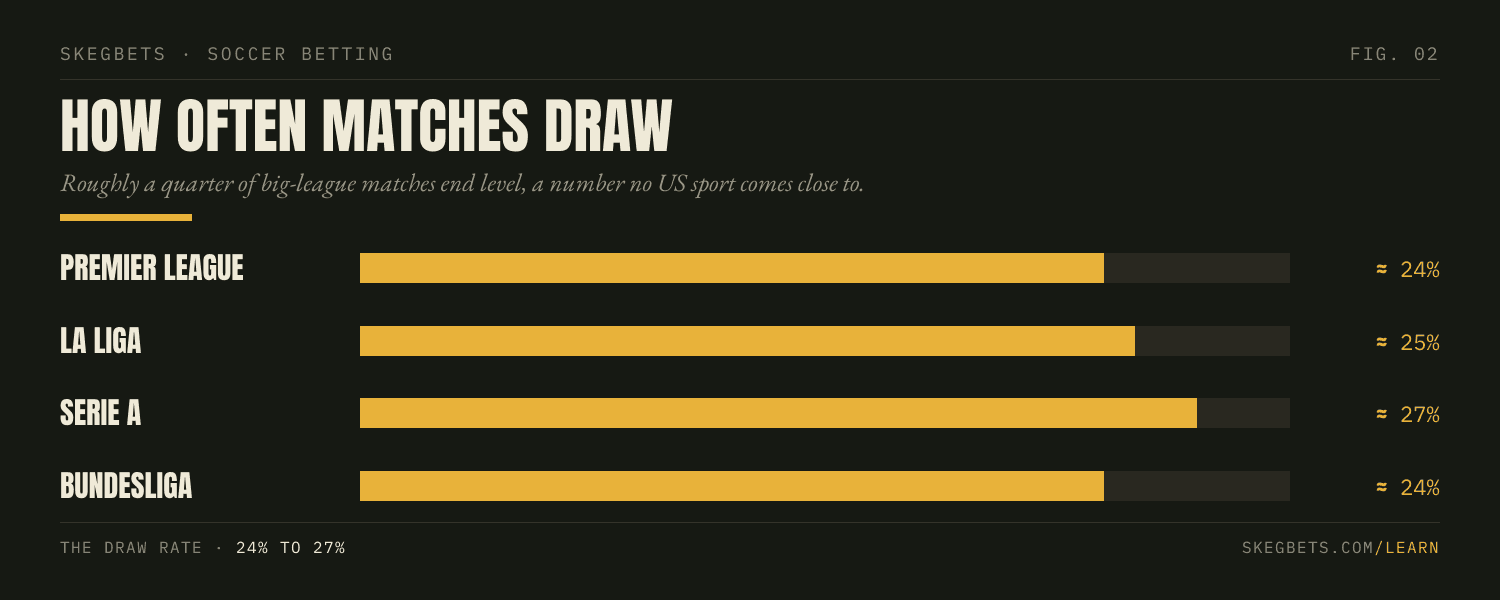
That frequency is why the book prices the draw as a full outcome instead of refunding a level game. It also drags on the other two prices: because a quarter of the market's probability is parked on X, the home and away sides can never be as short as a two-way moneyline would make them. A team you think should be a heavy favorite still trades near even money when the draw is siphoning off a real slice of the outcomes.
| League | Approx. draw rate |
|---|---|
| Premier League | ~24% |
| La Liga | ~25% |
| Serie A | ~27% |
| Bundesliga | ~24% |
The vig across three prices
Every posted market has the book's margin baked in, and 1X2 spreads that margin across three numbers rather than two. Convert each decimal price to a probability by dividing 1 by the odds: 1 / 2.10 is 47.6 percent, 1 / 3.40 is 29.4 percent, 1 / 3.60 is 27.8 percent. Add them up and you get 104.8 percent, not 100.
The 4.8 points over 100 are the vig, sometimes called the overround or the hold. On a two-way US moneyline the same idea shows up as, say, a 105 percent sum split over two sides. Soccer just slices it three ways, and the draw price is where a lot of it hides, which is exactly why the same math from implied probability matters more here than on a two-outcome bet.
Stripping the vig out
The posted probabilities are inflated by the hold, so they overstate every result. To find what the book actually thinks, divide each raw figure by the 104.8 percent total. The 47.6 percent home number becomes 45.4 percent, the 29.4 percent draw becomes 28.1 percent, and the 27.8 percent away becomes 26.5 percent. Those three now sum to 100, which is your no-vig, or fair, read of the game.
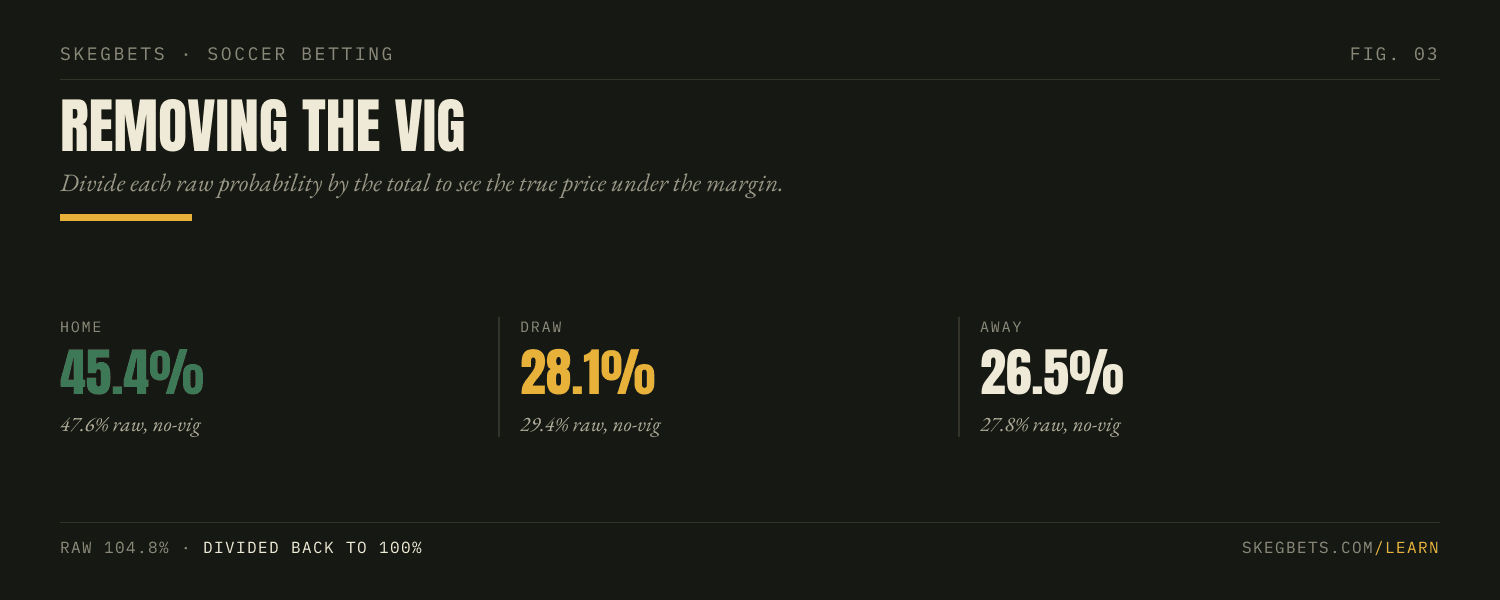
| Outcome | Decimal odds | Implied → no-vig |
|---|---|---|
| Home (1) | 2.10 | 47.6% → 45.4% |
| Draw (X) | 3.40 | 29.4% → 28.1% |
| Away (2) | 3.60 | 27.8% → 26.5% |
The no-vig line is the number worth carrying around. It tells you the book's honest estimate, so you can compare it against your own read or against a sharper book's price. Our betting tools do this conversion for you: drop in the three decimal prices to get the implied percentages and the vig-free split without doing the arithmetic by hand.
Reading the number, and where to look next
Once you can strip the vig, a 1X2 board stops being three prices and becomes one probability picture. A home side at a fair 45 percent that you rate closer to 52 percent is a bet. A draw priced at 28 percent in a fixture where both teams are content with a point can be the sharpest number on the card. The market gives you its estimate; your job is to find where yours differs.
If the draw is what makes 1X2 awkward for you, two sibling markets remove it from the equation. Draw no bet voids your stake when the game ends level, turning the three-way market back into a two-way one, and the Asian handicap erases the draw by giving one side a goal head start. Both trade the longer 1X2 price for a safer shape. When you are ready to see live three-way prices with a read attached, our soccer picks show the bet, the book, and the number.
Frequently asked questions
What does 1X2 mean in betting?+
1X2 is the three-way match-result market in soccer. 1 is the home team to win, X is the draw, and 2 is the away team to win. All three cover 90 minutes plus stoppage time only, so extra time and penalties in a knockout do not count toward the result.
Why is soccer a three-way market when most US sports are two-way?+
Because soccer games end level often, roughly one in four across the big European leagues. A tie is a real, common result, so the book prices it as its own outcome rather than pushing or refunding. That third price is what separates a soccer moneyline from a two-way NFL or NBA moneyline.
How do I convert 1X2 odds to a probability?+
Divide 1 by the decimal odds. Decimal 2.10 implies 1 / 2.10 = 47.6 percent. Do it for all three prices and the results sum to more than 100 percent. The amount over 100 is the vig, and dividing each raw figure by that total gives the no-vig probability.
What is the vig on a 1X2 market?+
The vig is the book's built-in margin, and on a three-way market it is spread across three prices instead of two. A typical league 1X2 holds 4 to 6 percent. You see it as an implied-probability sum above 100 percent, and it is the reason the fair price is always a little longer than the posted one.
Does the 1X2 result include extra time and penalties?+
No. 1X2 settles on the 90-minute result plus stoppage time. In a cup tie that goes to extra time or a shootout, a game level after 90 minutes is graded as a draw for 1X2 purposes, even though one team advances. Bet a to-advance or to-qualify market if you want the full tie broken.
Keep going: how to bet on soccer, draw no bet, and the Asian handicap.
Free tools