Minutes are the master variable in basketball. Points, boards, and dimes all accumulate at some per-minute rate, so the number that matters most before tip-off is how long a player will actually be on the floor and how much offense runs through him while he’s out there. Pin those two down and a prop line turns into arithmetic you can check.
The basketball prop markets
You’ll spend most of your action on four markets. Each one counts a different slice of the box score, and the labels are not always literal.
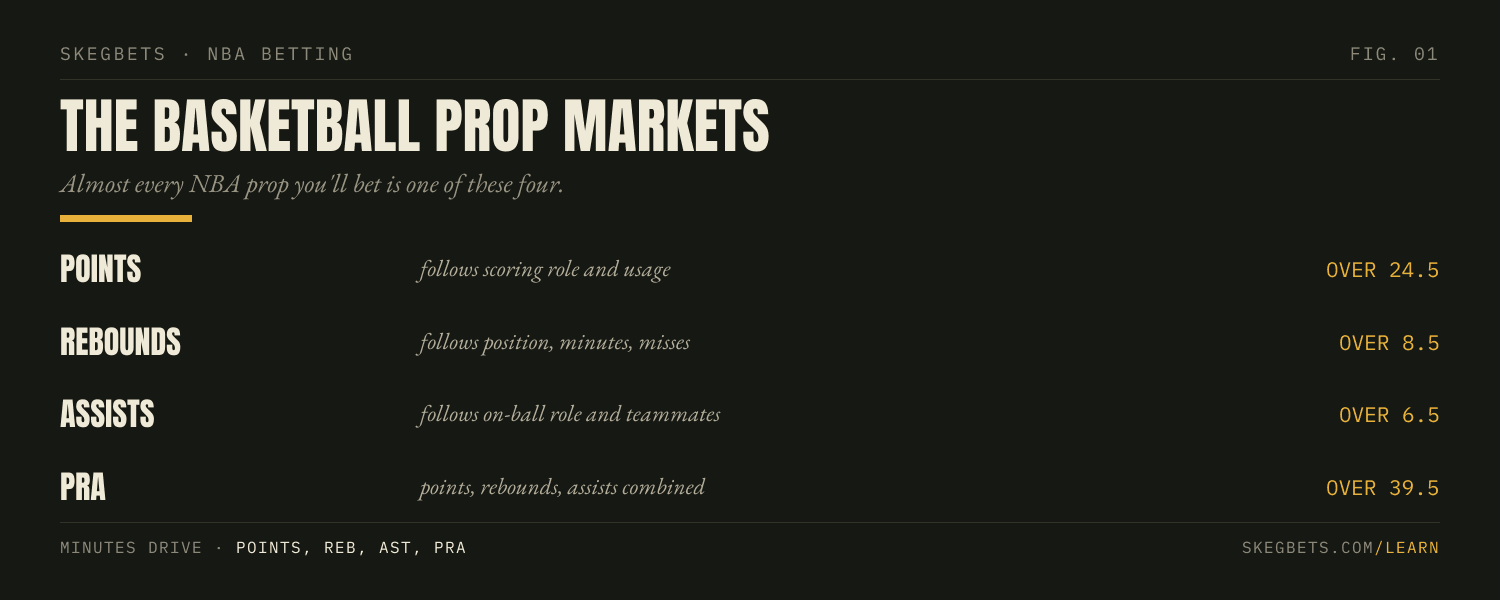
Points follow scoring role and usage. Rebounds follow position, minutes, and how many misses a game produces. Assists follow on-ball role and the teammates around a creator. And PRA, points plus rebounds plus assists, bundles all three into a steadier line. The general method for all four is in player prop betting strategy.
Minutes and usage
Opportunity comes first, and in basketball opportunity is measured in minutes and touches.
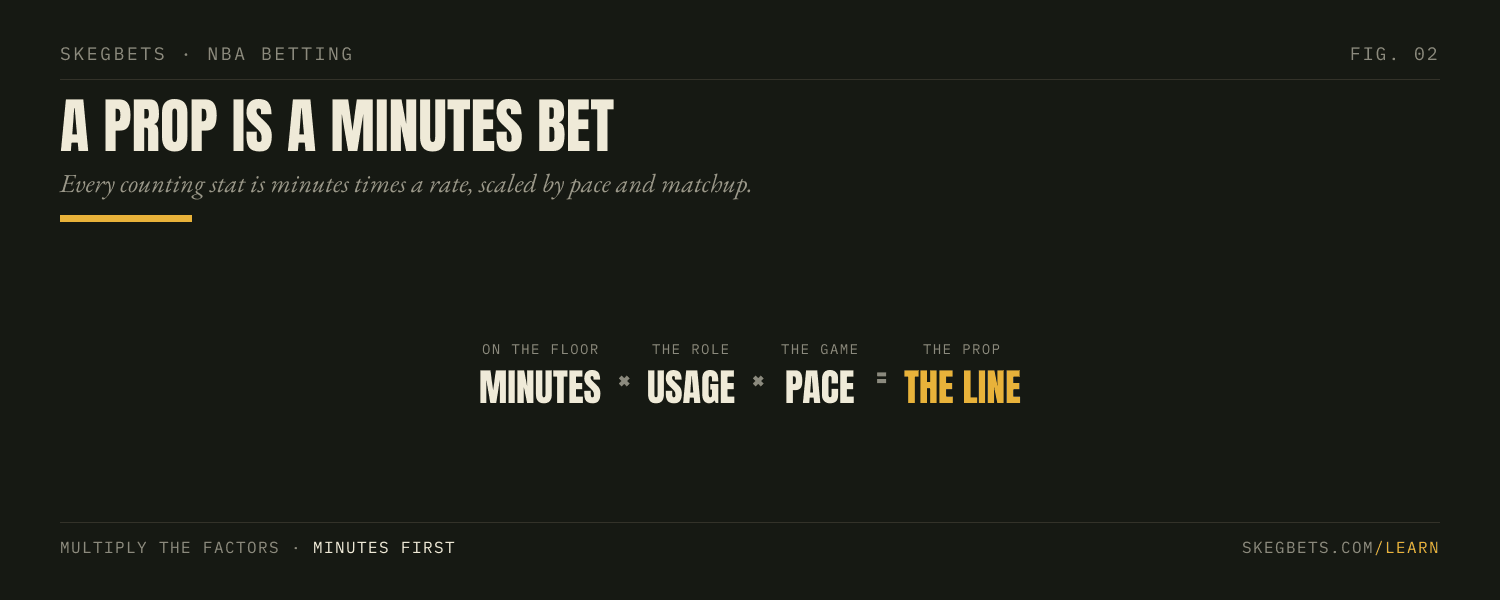
Take a player’s minutes, scale by his usage, the share of plays he finishes, then by the pace of the game and the matchup he faces. The biggest single edge appears when a teammate is ruled out and the minutes and usage both jump, which is why props and the injury report are read together. A high-usage starter in a fast game against a weak defender is the cleanest over there is.
Read the hit-rate board
You do not have to project every prop by hand. The history does a lot of the work, if you read it the right way.
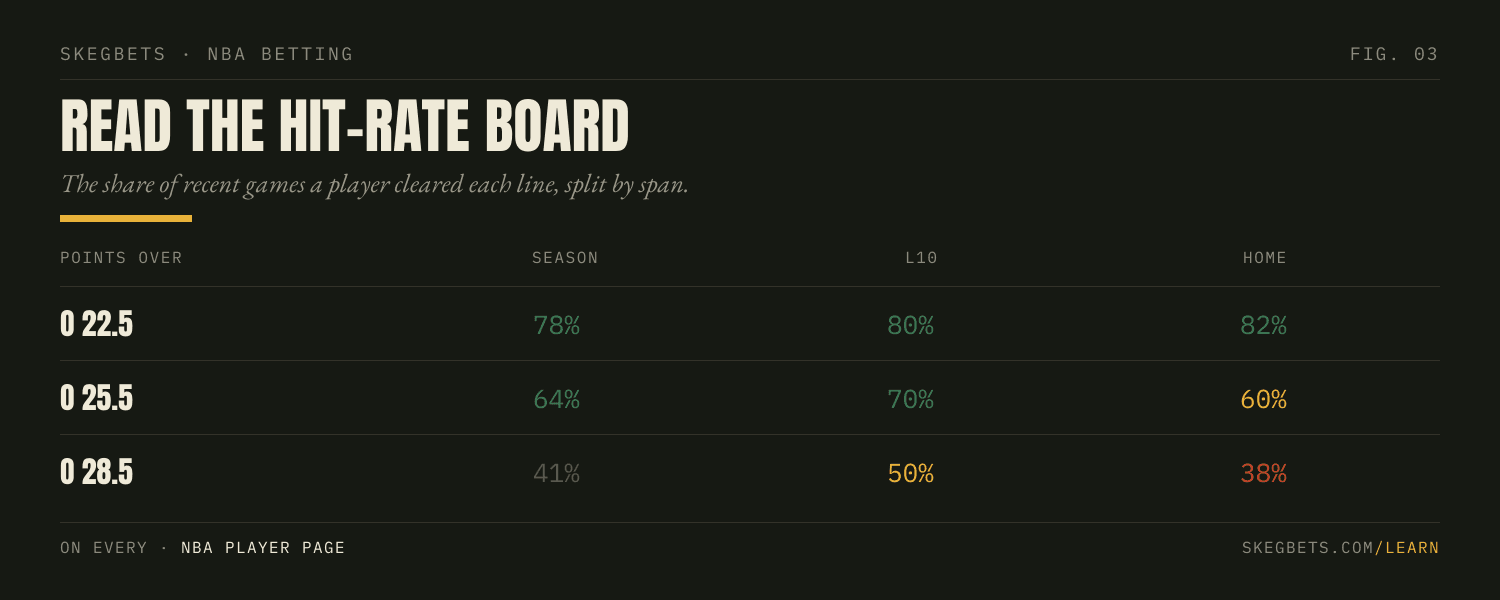
A hit-rate board shows how often a player cleared each line over the season, his last 10, and at home or on the road. A points line he beats 70% of the time is a very different bet from one he hits half the time, and the splits flag whether a recent trend is real. Every NBA player page carries one of these boards for points, rebounds, assists, and PRA.
Reading a prop
Confirm projected minutes first, weigh usage and the matchup, then check the hit-rate board to ground your number in how often the player actually clears it. Convert the prop price with the implied probability tool and bet only when your read beats it. That gap is expected value.
| Prop | What it really measures | The over wants |
|---|---|---|
| Points | Minutes x usage x matchup | High-usage scorer, fast game |
| Rebounds | Minutes + position + misses | Big minutes, low-efficiency game |
| Assists | On-ball role + teammates | Primary creator, hot shooters |
| PRA | All three combined | Steady box-score star |
Frequently asked questions
What is the most popular NBA prop?+
Points, and the combined points-rebounds-assists, or PRA. Points is the cleanest single-stat bet; PRA bundles a player's whole box-score impact into one line, which smooths out a quiet shooting night with rebounds and assists. Both scale directly with minutes.
What is a PRA prop?+
A bet on a player's points plus rebounds plus assists combined, over or under a line. Because it pools three categories, a star who scores less but fills the box score can still clear it, which makes PRA less volatile than a pure points prop.
Why do minutes matter most for NBA props?+
Because every counting stat is minutes times a per-minute rate. A player who jumps from 30 to 36 minutes, often when a teammate sits, sees his points, rebounds, and assists all rise together. Confirming projected minutes is the first and most important step in any basketball prop.
How do I read an NBA hit-rate board?+
It shows the share of recent games a player went over each line, split by season, last 10, and home or away. A line a player clears 70% of the time is a different bet than one he hits 50% of the time. Our NBA player pages carry these boards for points, rebounds, assists, and PRA.
For the full picture, start with how to bet on basketball, learn the metrics in how to read basketball stats, and see the props we take in our live feed.
Free tools