The short version
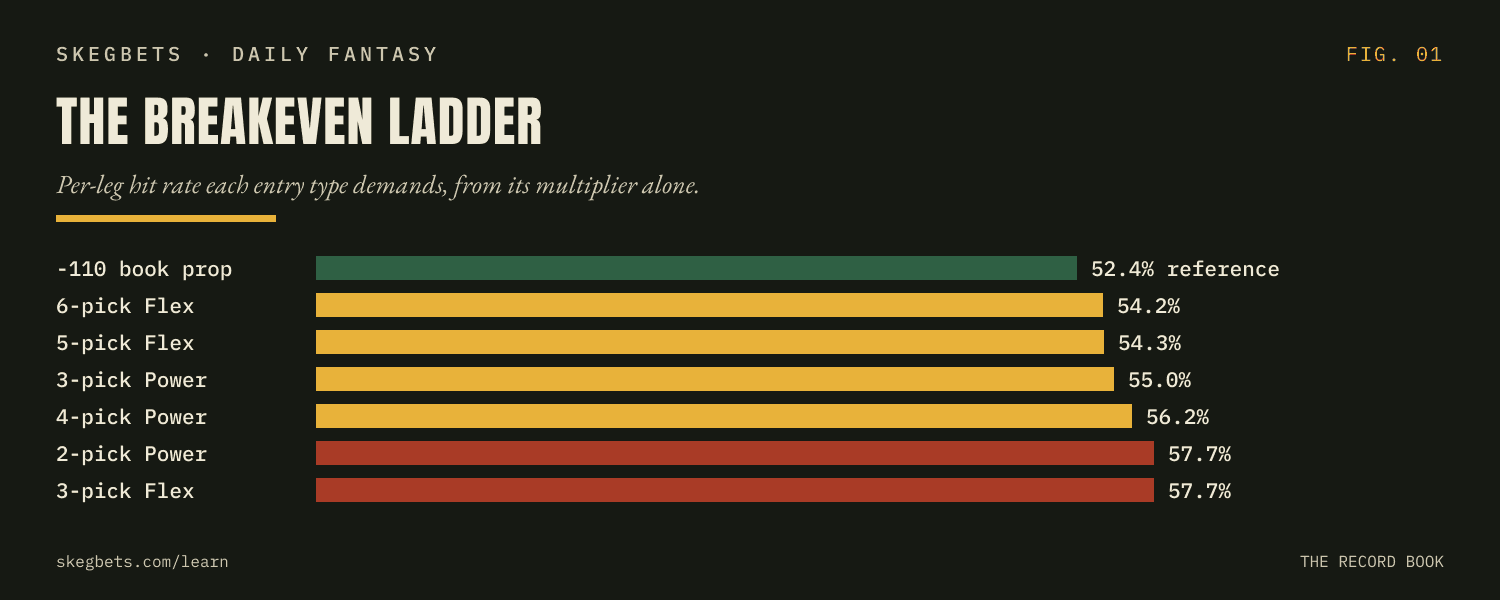
Every pick'em multiplier implies a breakeven hit rate you can compute. On the current schedule the bar runs from 54.2 to 57.7 percent per leg, and the smallest entries charge the most.
A 3-pick Power play pays 6x. Three independent coin flips come in at 12.5 percent, which prices fairly at 8x. That gap between 6 and 8 is the house margin, and translating it into the hit rate you need is a one-line calculation that most pick'em players never run. This piece runs it for every common entry type.
The price hidden in a multiplier
Sportsbook prices wear their demands openly: -110 means risk 110 to win 100, and the implied probability is a lookup away in our implied probability tool. A multiplier hides the same demand behind a rounder number. Paying 10x on four picks sounds generous until you invert it: you need all four, so your per-leg rate must satisfy p⁴ = 1/10, which solves to 56.2 percent.
That inversion is the whole trick, and it works on any entry an app can post. The rest of this piece is that formula applied to the standard schedule, plus the slightly messier version for entries with consolation payouts.
Power plays: all or nothing
Power-style entries pay only on a perfect card. The current schedule: 2 picks pay 3x, 3 picks pay 6x, 4 picks pay 10x, 5 picks pay 20x, and 6 picks pay 37.5x. Inverting each gives the breakeven per-leg rate: 57.7, 55.0, 56.2, 54.9, and 54.7 percent.
Notice the shape of those numbers. The ladder generally gets cheaper as it grows (the 4-pick at 10x is the one overpriced rung), and the worst deal on the board is the smallest: the 2-pick at 3x. Fair value on two 52.4-percent legs would be about 3.64x. Getting 3x means the app keeps roughly a sixth of the fair payout on the most popular entry size in the format.
Flex plays: the consolation tiers
Flex-style entries trade a smaller jackpot for partial payouts. The current 5-pick Flex pays 10x for 5-of-5, 2x for 4-of-5, and 0.4x for 3-of-5. Because several outcomes pay, the breakeven calculation is a weighted sum across the binomial distribution rather than a single root, and the answer lands at about 54.3 percent per leg. The 6-pick version (25x, 2x, 0.4x) prices a shade lower still, at 54.2.
Those two big Flex entries are the cheapest tickets in the pick'em shop, three and a half points per leg cheaper than the smallest entries. The consolation tiers do real work: going 4-of-5 returns double the entry, which softens the variance that makes all-or-nothing cards so streaky. The small Flex entries are another story. The 3-pick Flex pays 3x perfect and refunds the entry on 2-of-3, which sounds gentle but works out to the same 57.7 percent bar as the 2-pick Power, the joint-steepest demand on the board.
Breakeven rates, every entry type
| Entry type | Payout structure | Breakeven per leg |
|---|---|---|
| 6-pick Flex | 25x / 2x / 0.4x | 54.2% |
| 5-pick Flex | 10x / 2x / 0.4x | 54.3% |
| 6-pick Power | 37.5x, perfect only | 54.7% |
| 5-pick Power | 20x, perfect only | 54.9% |
| 3-pick Power | 6x, perfect only | 55.0% |
| 4-pick Flex | 6x / 1.5x | 55.0% |
| 4-pick Power | 10x, perfect only | 56.2% |
| 2-pick Power | 3x, perfect only | 57.7% |
| 3-pick Flex | 3x / 1x | 57.7% |
Read the column on the right as a difficulty setting. Nothing on the list is easy: the friendliest entry still demands nearly 2 points per leg more than a -110 prop, and the small entries most casual players start with demand more than 5. The formula generalizes, so when an app changes its schedule, and they do, rerun the numbers rather than trusting last season's table. Our pick'em EV calculator does the work for any structure, including custom tiers and legs with different probabilities.
What realistic skill is worth
Plugging skill levels into the same math shows how steep the curve is. At a 52.4 percent per-leg rate, the standard of a competent sportsbook bettor, a 5-pick Flex returns about 88 cents per dollar entered, an 11.6 percent loss. At 55 percent it turns positive at roughly +5 percent, and the 6-pick Flex reaches +7.5. At 58 percent the big entries pay 27 to 43 percent, while the 2-pick Power at that same skill level ekes out less than 1.
Two lessons fall out. First, entry selection matters as much as pick selection: an identical set of projections can be profitable in one format and losing in another. Second, the difference between losing and winning at pick'em is concentrated in a band of about 3 percentage points of per-leg skill, which is why line quality is everything. Comparing an app's posted line against the sportsbook consensus for the same stat, covered in pick'em vs sportsbook props, is the fastest way to find the legs where your true probability clears the bar. Correlation between legs bends this math further, in both directions; that gets its own treatment in correlated pick'em entries.
Sizing entries without wrecking a bankroll
Multiplier products are high variance by construction. Even a genuinely skilled 56-percent player collects nothing on about 39 of every 100 five-pick Flex entries, finishes at the losing 0.4x tier or worse about 73 times in 100, and hits the 10x jackpot on just 5 or 6. Flat-staking small fractions of a dedicated bankroll, 1 to 2 percent per entry, keeps those stretches survivable, and the case for fractional sizing in general is laid out in bankroll management and unit sizing. The Kelly calculator makes the same point quantitatively: at these edges and this variance, full Kelly stakes are far smaller than most players' habits.
The honest summary of the schedule: pick'em multipliers price the product like a parlay with extra margin, one entry type gives a meaningful discount, and the format only pays players who can beat specific lines by several points, not players who are merely decent on average. Compute the bar before you pay the entry. And if the format itself is new to you, how pick'em sits inside the wider DFS landscape is mapped in our daily fantasy explainer.
Frequently asked questions
What win rate do you need to profit on pick'em entries?+
It depends on the entry type. The 6-pick Flex breaks even at about 54.2 percent per leg and the 5-pick Flex at 54.3, the lowest demands on the current schedule. The 3-pick Power needs 55.0 percent, the 4-pick Power 56.2, and the 2-pick Power and 3-pick Flex sit highest at 57.7. For comparison, a standard -110 sportsbook bet breaks even at 52.4 percent.
Is a Flex play better than a Power play?+
At five and six picks, yes: the consolation payouts lower the required hit rate to about 54.3 and 54.2 percent per leg, the cheapest entries in the format. At three picks the order flips, and the 3-pick Flex ties the 2-pick Power as the most expensive common entry at 57.7 percent. The label matters less than the specific multiplier schedule.
How is the pick'em operator's edge built in?+
Through the gap between fair and posted multipliers. Two coin flips have a 25 percent chance of both hitting, so the fair payout is 4x; a 2-pick entry pays 3x. Three coin flips are fair at 8x; a 3-pick Power pays 6x. That gap plays the same role as vig at a sportsbook, and it is generally wider.
Can you actually hit 55 to 59 percent on player props?+
Sustained rates in that range are professional-grade. Sportsbook prop markets settle near prices that imply 52 to 58 percent for favorites, and the best-documented sharp bettors live in the mid-50s over large samples. It is achievable on selected spots where you have real information, and unrealistic as an average across every line an app posts.
Do these numbers apply to Underdog as well as PrizePicks?+
The method applies everywhere: raise 1 over the multiplier to the power of 1 over the number of legs and you have the breakeven per-leg rate for any all-or-nothing entry. The specific multipliers in this piece follow the common PrizePicks schedule. Underdog's standard and flex payouts differ in places, so run its numbers through the same formula before assuming they match.
Free tools