The short version
Multiplier schedules price every entry as if its legs were independent. Legs that move together break that assumption, and the break can favor either side of the counter.
A 4-pick Power pays 10x whether your legs are four strangers or four teammates riding the same game script. The multiplier assumes independence; the field does not cooperate. That mismatch between how entries are priced and how stats actually behave is the one seam in pick'em pricing that consistently favors a thoughtful player.
The independence assumption
Pick'em entries, the multiplier-paid format explained in our daily fantasy overview, are priced as if every leg were its own universe. Every breakeven number in pick'em payout math treats legs like separate coin flips: multiply the per-leg probabilities and compare against the multiplier. Operators price their schedules on the same assumption, and sportsbooks learned long ago that bettors exploit it, which is why same-game parlay engines reprice related legs downward, a mechanic covered in our parlay explainer.
Pick'em apps inherited the parlay's structure without inheriting the repricing engine. Outside of blocked combinations, a card of related legs pays the same multiplier as a card of strangers. Whenever reality correlates what the price sheet treats as independent, somebody gets an edge, and which side of the counter gets it depends on the entry type.
How correlation bends the math
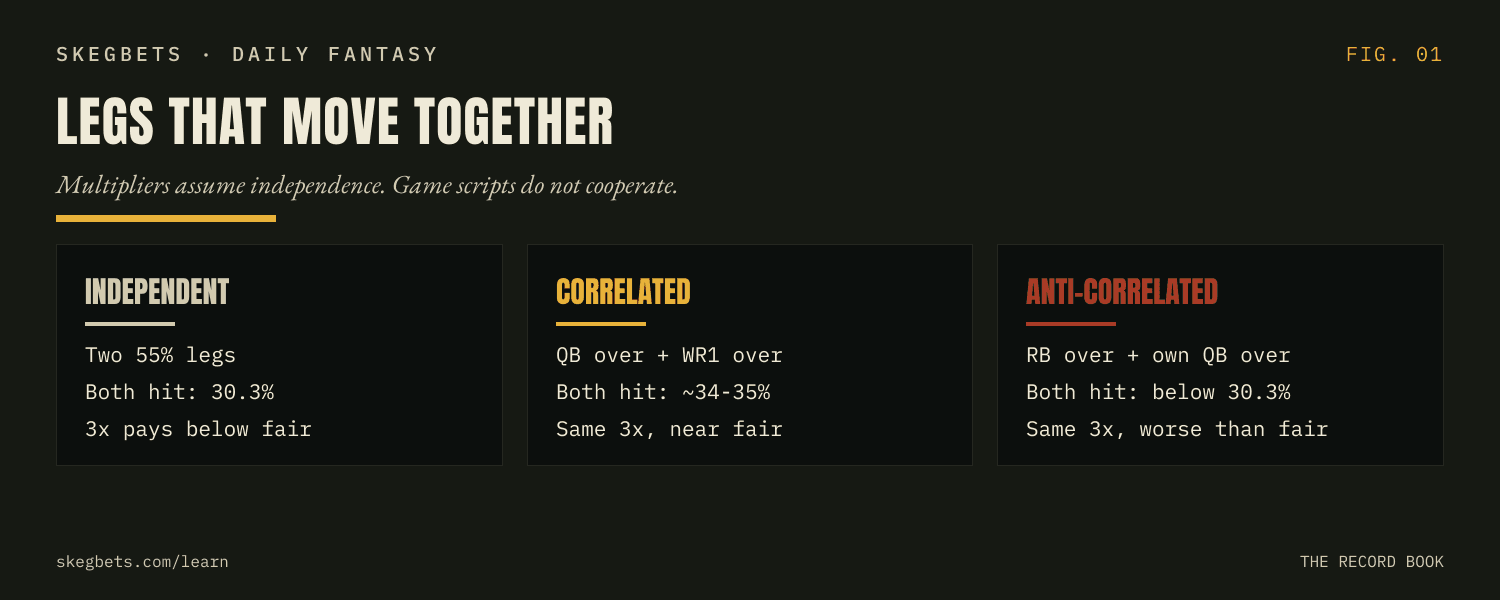
Positive correlation concentrates outcomes at the extremes: more all-hit cards, more all-miss cards, fewer splits. For an all-or-nothing entry only the all-hit column pays, so concentration at the extremes is pure gain, provided each leg still clears its own bar. The example above, 30.3 percent lifting toward 35, turns a 3x payout from below fair to near fair by itself, before any per-leg edge is counted.
The mirror image is just as real. Negatively correlated legs, a rusher's over stacked with his own quarterback's passing over, hit together less often than independence suggests, so the same 3x becomes quietly more expensive than the schedule implies. Most accidental correlation in casual cards is this kind: legs that feel thematically linked but compete for the same finite plays, snaps, or possessions.
Common pairs and their direction
| Pair | Direction | Why |
|---|---|---|
| QB pass yds over + WR1 rec yds over | Positive | Same drives produce both stats |
| Two overs in a projected shootout | Positive | Shared game environment lifts both |
| Two unders in a projected slog | Positive | Slow pace suppresses both |
| RB rush yds over + own QB pass yds over | Negative | Run and pass compete for plays |
| Pitcher Ks over + opposing hitter's hits over | Negative | One's success is the other's failure |
| Stars from unrelated games | None | Independent by construction |
The table is a compass, not a guarantee. Correlations are tendencies with wide error bars, and a blowout or an injury can decouple any pair. The strategic point survives the noise: direction of correlation should be a deliberate choice, never an accident of picking players you happen to like.
Why Flex entries punish correlation
Flex-style entries invert the logic. Their consolation tiers pay the near-miss outcomes, 4-of-5 or 3-of-5, and those middle outcomes are exactly what positive correlation drains away. A correlated 5-pick Flex behaves like a disguised all-or-nothing card: you land 5-of-5 more often and 4-of-5 less often, trading away the safety you paid for in the lower jackpot.
The pairing rule follows directly: put correlated combinations in all-or-nothing entries, where the extra all-hit frequency is pure upside, and keep Flex cards to independent legs, where the binomial middle stays fat and the consolation tiers do their job. Mixing the two styles on one card pays for both formats and captures the benefit of neither.
Building a deliberately correlated card
Start where all prop discipline starts, with legs that stand on their own, using the projection habits from prop betting strategy and line checks against the sportsbook market as described in pick'em vs sportsbook props. Correlation multiplies an edge; it cannot create one from legs you would not take individually.
Then choose one story per card and cast it consistently: a game environment thesis expressed through two or three same-direction legs, at all-or-nothing pricing, sized small. Correlated cards swing harder in both directions than their independent cousins, which is a variance cost the sizing rules in bankroll management exist to absorb. One thesis, a few clean legs, modest stakes, repeated across many slates: that is what exploiting the format's one friendly seam actually looks like.
Frequently asked questions
What is a correlated pick in pick'em?+
Two legs whose outcomes tend to move together. A quarterback going over his passing yards line makes his top receiver's yardage over more likely, because the same drives produce both stats. Legs can also be negatively correlated: a running back's rushing over and his own quarterback's passing over compete for the same plays.
Does correlation help or hurt a pick'em entry?+
Positive correlation helps all-or-nothing entries: if each leg is worth taking on its own, legs that hit together raise the chance of a perfect card above the independent estimate, while the multiplier stays fixed. It hurts Flex-style entries in one specific way: correlated legs also miss together, which drains the middle outcomes that the consolation tiers pay.
Do pick'em apps allow correlated legs?+
Within limits. Apps block the most extreme combinations, such as the same player's strongly linked stats, and they remove or cap lines that attract one-sided stacking. But the routine correlations, teammates in the same offense, opposing players in a projected shootout, generally price at the standard multiplier as if independent.
How is this different from a same-game parlay?+
A sportsbook same-game parlay reprices correlated legs: the book's engine shrinks the combined payout below the product of the individual odds, charging you for the correlation. Pick'em multiplier schedules mostly do not reprice, which is precisely why correlation is a live strategy in one format and largely paid for in the other.
What is the best correlation strategy for a beginner?+
Only combine legs you would take individually, then prefer combinations from the same game environment pointing the same direction: a projected high-scoring game supporting two overs, or a projected slog supporting two unders. Avoid stuffing a card with legs that depend on one fragile assumption, and size entries small because correlated cards swing harder in both directions.
Free tools