The short version
DFS reaches far more states than sports betting, but the map has four tiers, and the pick'em format is being redrawn by regulators in real time.
Online sportsbooks reach about 30 states. Daily fantasy apps reach at least as many, and they reach the ones that matter most: Texas and California, first and second in population, allow no online sportsbooks at all, and Florida's lone sportsbook is a single operator's monopoly. That gap is the commercial logic of the DFS industry, and the legal machinery that created it is also what makes the map shift under the pick'em format today.
A wider map than sports betting
The two products are licensed under different laws. Sports betting expanded state by state after 2018, with each legislature writing its own licensing regime, and the biggest states have mostly declined or restricted it. DFS rode a different vehicle: skill-game carve-outs and fantasy sports statutes passed mostly between 2016 and 2019, before pick'em existed in its current form. An operator running under a fantasy statute reaches players a sportsbook license never could.
For players, the asymmetry decides venue before any question of price does. The pricing comparison between the two venues, covered in pick'em vs sportsbook props, only matters where both are on the menu.
Why DFS is legal where betting is not
The legal theory is that fantasy contests are games of skill whose outcomes depend on entrants' knowledge, not on chance or on a single game's result. That framing fits salary cap DFS naturally: you beat other people through roster construction, as described in our daily fantasy explainer.
Pick'em strained the theory. An over/under call on one player's stat line, paid by the house at fixed multipliers, looks to many regulators like a proposition bet with a fantasy label, and since 2023 that resemblance has driven enforcement. The result is a format living in two bodies of law at once, which is why the map now needs four tiers instead of two.
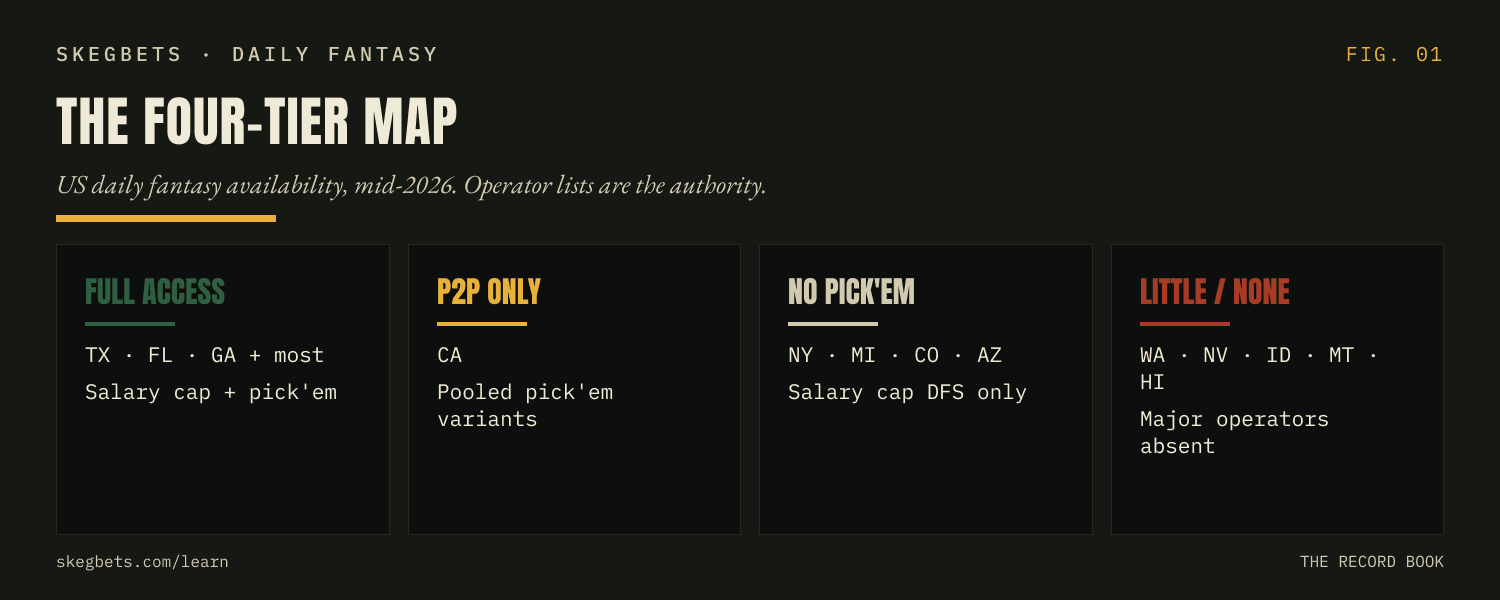
The four tiers of availability
| Tier | Representative states | What's available |
|---|---|---|
| Full access | TX, FL, GA, and most others | Salary cap and house-banked pick'em |
| Peer-to-peer only | CA | Pick'em variants pooled against players |
| Pick'em prohibited | NY, MI, CO, AZ | Salary cap DFS only |
| Little or no DFS | WA, NV, ID, MT, HI | Major operators absent |
Two cautions on reading the table. Membership in the middle tiers has changed several times since 2023 and will change again; and operators respond to the same rule differently, so one app's state list is not another's. The tiers are stable; the rosters are not.
The fight over pick'em
The regulatory wave since late 2023 has a consistent shape: a state gaming authority concludes that house-banked pick'em mimics prop betting, the operators withdraw the standard product from that state, and, where the market is big enough, they return with a peer-to-peer variant built to fit the fantasy statute. California is the template: the standard products left, and pooled formats like PrizePicks Arena and Underdog's peer-to-peer contests took their place.
For players the practical effect is product drift: the app in your pocket may quietly swap its underlying format depending on where you open it. The entry mechanics and payout schedules can differ between the variants, so the multiplier math in pick'em payout math is worth rerunning if your app switches you to a pooled format. The operator comparison in PrizePicks vs Underdog covers how each has adapted.
How to check your state today
Skip the aggregator lists, which lag. The authoritative sources are the operators' own availability pages, updated as their lawyers react: PrizePicks publishes a where-can-I-play list and Underdog maintains the equivalent, and both apps enforce eligibility by geolocation at deposit, so the app itself is the final word. If a format matters to you, check whether your state gets the house-banked product or a pooled variant, not just whether the app installs.
Wherever the map puts you, the fundamentals travel: entries are priced with a margin, edges live in specific mispriced lines, and stakes belong inside the limits laid out in responsible gambling. A legal product is not automatically a cheap one.
Frequently asked questions
Is daily fantasy sports legal in Texas, California, and Florida?+
Yes, DFS operates in all three. Texas and California have no legal online sportsbooks, and Florida's sports betting is limited to a single operator, so DFS apps are the open market in each. Texas and Florida players currently get the standard pick'em products. In California, regulatory pressure pushed operators to peer-to-peer formats, so apps offer variants where entries pool against other players rather than against the house.
Why is pick'em banned in New York?+
New York finalized regulations in 2023 prohibiting fantasy contests that mimic proposition betting, which is what house-banked pick'em does: over/under calls on player stats, paid by the operator. Salary cap DFS remains legal there under the state's fantasy sports law. Michigan, Colorado, and Arizona have taken similar positions against house-banked pick'em.
In which states is DFS not available at all?+
The consistently restrictive group is small. Washington treats online DFS as illegal gambling, Nevada requires a gaming license that DFS operators have declined to pursue, and a few others, historically Idaho, Montana, and Hawaii, have laws or attorney general opinions that keep major operators out. Exact availability varies by operator, so check the app's own state list.
Is peer-to-peer pick'em different from regular pick'em?+
The player experience is similar, over/under calls on stat lines, but the counterparty changes: your entry pools against other players' entries instead of being banked by the operator, and payouts derive from the pool. Operators built these variants, such as PrizePicks Arena, specifically to satisfy states that objected to the house-banked model.
Could my state's DFS rules change?+
Yes, and in this format they change quickly. Since 2023 several states have restricted house-banked pick'em, operators have pivoted products in response, and courts and regulators continue to apply old gambling statutes to new formats. Treat any state map, including this one, as a snapshot, and confirm against the operator's availability page before depositing.
Free tools