The short version
A pick'em line and a sportsbook prop are the same prediction sold at different prices. Comparing them tells you where the value is, and sometimes that a leg is a trap.
A hitter's line sits at 0.5 hits on a pick'em app while a sportsbook prices the same over at -137. Those two numbers are the same prediction sold in different stores, and one store is charging more. A bettor who can read both price tags gets to choose, and choosing well is worth several points of win rate over a season.
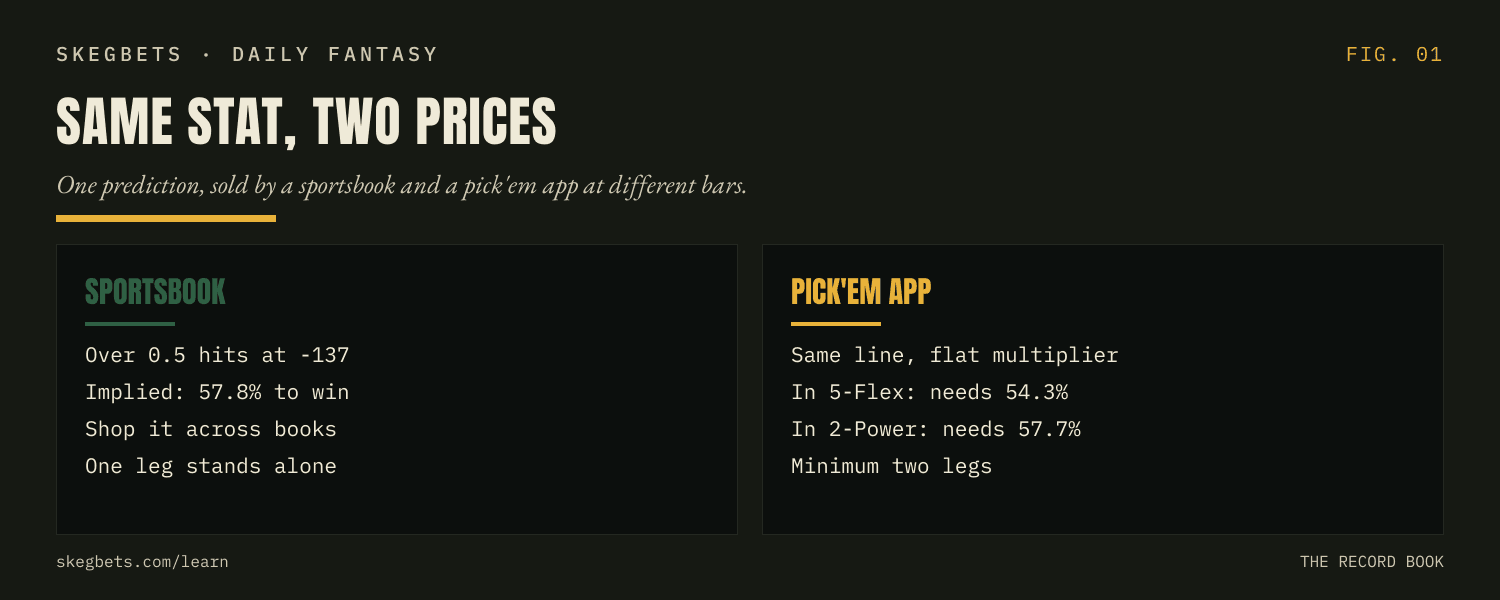
One prediction, two storefronts
Sportsbook props and pick'em entries answer the same question: will this player go over or under this number. The venues differ in licensing, which decides where each can operate, and in pricing mechanics, which decide what your opinion costs. Our prop betting strategy guide covers how to form the opinion; this piece is about where to sell it.
The licensing half is simple geography. Online sportsbooks reach about 30 states; pick'em apps reach at least as many, and they reach the biggest holdouts: Texas and California have no online sportsbooks at all, and Florida's is a single-operator market. For a large share of US players the comparison is settled by their address, a map drawn in where daily fantasy is legal.
How each venue expresses price
A sportsbook prices every leg individually. The odds carry the information: -110 implies 52.4 percent, -137 implies 57.8, and juice varies leg by leg, so a sharp line and a soft line announce themselves. You can also shop the same prop across books for the best number, the habit our line shopping piece treats as the cheapest edge in betting.
A pick'em app prices the whole card. Legs carry no individual odds; the multiplier schedule sets one blended price for the combination, and that price only becomes visible when you invert it into a breakeven rate, the arithmetic worked through in pick'em payout math. The practical consequence: a sportsbook lets you avoid one overpriced leg; a pick'em card makes every leg pay the same toll, so a single bad leg quietly taxes the good ones next to it.
Venue vs venue
| Dimension | Sportsbook props | Pick'em entries |
|---|---|---|
| Price visibility | Per-leg odds, explicit | Hidden in the multiplier schedule |
| Typical breakeven | 52.4% at -110; worse with juice | 54.3% to 59.1% by entry type |
| Line shopping | Across many books | Across 2-3 apps at most |
| Single-leg bets | Yes | No; minimum two picks |
| Availability | ~30 states online; none in TX or CA | 30+ states incl. TX, CA, FL |
| Winner treatment | Limits and bans | Stake caps on sharp lines |
Using the books to scout pick'em lines
The sportsbook market is the sharper of the two venues: more money, more makers, faster reaction to news. That makes it a free scouting report. When a book consensus sits at 24.5 on a points prop and an app still posts 23.5, the app is effectively selling the over at a discount the books already refused to offer. When the app's number matches consensus but the books juice the over to -145, the market is telling you which side the sharp money took, and an app leg on that side at flat multiplier pricing is comparatively cheap.
The reverse signal matters just as much. An app line sitting well off consensus with no news behind it is often deliberate shading on a popular player, priced to sell the side the public wants. Treat offers that look too generous with the same suspicion you would a too-good sportsbook line: someone on the other side of the counter has seen the action. Our implied probability explainer and the calculator behind it turn any book price into the percentage you need for these comparisons.
When each venue is the better sale
Sell your opinion at a sportsbook when you have access, when the bet stands alone, or when book juice on your side is lighter than the pick'em toll. A single -110 prop needing 52.4 percent is a structurally better sale than any pick'em entry can offer for one opinion, since the format's minimum card is two legs.
Sell it in a pick'em entry when geography decides for you, when an app lags a market move and hands you a stale number, or when you genuinely hold several simultaneous edges and the entry structure prices the combination better than a parlay at your book, a comparison the parlay calculator makes concrete. Related legs change this calculus again, because correlation is priced by sportsbooks and mostly ignored by multiplier schedules; that seam is the subject of correlated pick'em entries.
Frequently asked questions
Are pick'em lines the same as sportsbook lines?+
Usually close, not identical. Pick'em apps set projections with the sportsbook market as an anchor, but they update more slowly and round to halves, so gaps of a half point or more appear on most slates. Those gaps are the main opportunity in the format: a pick'em line that lags a sportsbook move is mispriced until it catches up.
Is it better to bet props at a sportsbook or play pick'em?+
For a single opinion, a sportsbook prop is usually the cleaner sale: you pick your price, shop it across books, and a standard -110 needs a 52.4 percent hit rate versus the 54-to-58 percent that pick'em multipliers demand. Pick'em wins when you live in a state without legal sportsbooks, when an app posts a stale line the books have moved off, or when a favorable entry structure prices your combined opinions better than a same-book parlay would.
Why are pick'em lines sometimes different from every sportsbook?+
Apps balance two goals: track fair value and manage their own exposure on lines the public piles onto. When one side of a projection attracts heavy action, an app may hold or shade the number rather than follow the market, and it may cap stakes instead of moving the line. The result is occasional numbers that sit off consensus, in either direction.
Can you arbitrage between pick'em apps and sportsbooks?+
True risk-free arbitrage is rare because multiplier pricing does not offer per-leg odds to lock against, and staking limits are tight. What exists is soft arbitrage: taking the side of a pick'em line that a sportsbook move has made favorable. That is a value play, not a hedge, and it still needs the per-leg edge to clear the entry's breakeven rate.
Do sportsbook prop skills transfer to pick'em?+
Almost entirely. Projecting a player's stat distribution, respecting sample sizes, and reacting to lineup and injury news are identical in both venues. The two additions pick'em requires are multiplier math, since the price is hidden in the payout structure, and entry construction, since every card is a combination rather than a single bet.
Free tools