The short version
Daily fantasy splits into two formats that share a name and little else: salary cap contests against other people, and pick'em entries priced against the house.
Around 60 million North Americans play fantasy sports, and the fastest growing corner of that market is a format that barely resembles the season-long leagues the name comes from. Daily fantasy sports compresses a fantasy season into one slate of games, and it now splits into two products so different that lumping them together mostly causes confusion: salary cap contests and pick'em entries.
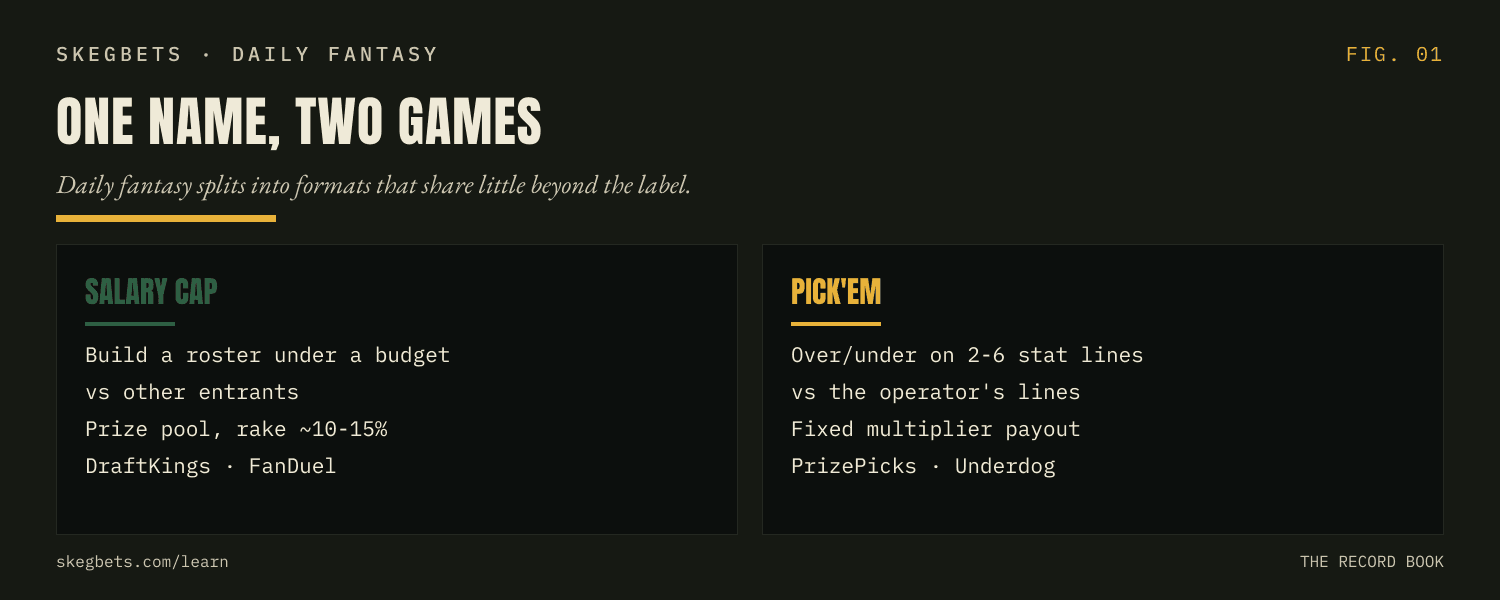
One name, two games
Daily fantasy grew out of season-long fantasy leagues in the late 2000s, when DraftKings and FanDuel realized the draft, the roster, and the sweat could be compressed into a single night. That original format, salary cap DFS, is still what most regulation and most news coverage means by “DFS.”
The newer branch took over growth. Pick'em apps such as PrizePicks and Underdog grew their monthly active users by 82 percent and 35 percent respectively through 2025, while the two legacy operators grew in the low single digits. The pick'em product is simpler, mobile-first, and available in big states where sportsbooks are not legal, and each of those three facts feeds the other two.
Salary cap: the original DFS
A salary cap contest hands every entrant the same budget, commonly 50,000 fictional dollars, and a slate of real games. Each player on that slate carries a price. You assemble a legal roster under the cap, your players score fantasy points from their real box scores, and the highest-scoring rosters split the prize pool.
Two things define the format. First, you are playing other people, not the operator. The site takes a rake from entry fees, typically 10 to 15 percent, and pays the rest back out, so your opponents’ skill sets your difficulty. Second, roster construction is the whole game: finding underpriced players, deciding when to stack teammates whose production moves together, and choosing between cash games (flat payouts, safer builds) and tournaments (top-heavy payouts, contrarian builds).
Pick'em: props by another name
A pick'em entry asks a much smaller question. The app posts a projection for a player stat, say 22.5 points or 0.5 hits, and you call more or less. Combine two to six of those calls in one entry and the app pays a fixed multiplier if enough of them hit. There is no prize pool and no other entrant to beat in the standard format: the operator sets the lines and banks the entries.
Anyone who has read our piece on player prop betting will recognize the shape. A pick'em entry is functionally a props parlay with the odds expressed as one multiplier instead of per-leg prices. That framing matters because it makes the format analyzable: every entry has a breakeven hit rate you can compute, which we do line by line in the pick'em payout math. How those app lines compare with sportsbook prices for the same stat is its own topic, covered in pick'em vs sportsbook props.
One regulatory wrinkle is reshaping the format: several states have pushed back on entries banked by the house, so operators now run peer-to-peer variants in some places, where your entry is pooled against other players’ entries rather than against the operator. The details by state live in where daily fantasy is legal.
The formats at a glance
| Dimension | Salary cap | Pick'em |
|---|---|---|
| You play against | Other entrants | The operator's lines (P2P in some states) |
| Core decision | Roster under a budget | Over/under on 2 to 6 stat lines |
| Payout | Share of a prize pool | Fixed multiplier |
| Operator take | Rake on entries (~10-15%) | Margin built into multipliers |
| Main platforms | DraftKings, FanDuel | PrizePicks, Underdog |
| Skill expression | Pricing, stacking, game theory | Projecting player stats vs a line |
| Time per entry | Minutes to hours | Under a minute |
How DFS differs from sports betting
Legally, the gap is wide. Most states treat DFS as a skill game under carve-outs written after 2015, which is why DFS apps operate openly in Texas and California, where online sportsbooks cannot, and in Florida, where the sportsbook market is closed to all but one operator. Mechanically, the gap is narrower than the licensing suggests. Calling over on a player's hits line in a pick'em app and betting the over on the same prop at a sportsbook are the same prediction with different pricing and different counterparties.
The practical differences worth knowing: sportsbooks price each leg individually and let you shop lines across books, while pick'em apps post one line and one multiplier schedule. Sportsbooks ban or limit winning players; pick'em apps restrict sharp action too, often by capping stakes on specific lines. And the tax treatment of winnings is the same headache either way. The skills transfer almost entirely: reading a line, estimating a fair probability, and only paying prices that clear your estimate, the discipline at the heart of expected value betting, is exactly what separates winning DFS players from the rest.
Which format fits you
Choose salary cap if you enjoy the craft of roster building and want upside against beatable fields: soft opponents exist, especially in small local contests, and one great tournament build can pay thousands of times the entry. Accept that the rake is steep and the best fields are full of professionals running optimization software.
Choose pick'em if your edge is player projection. The format rewards exactly one skill, knowing when a posted line is wrong, and it punishes everything else with multiplier math that demands a mid-50s hit rate per leg. Start with the two platform leaders, compared in PrizePicks vs Underdog, and treat entry sizing with the same care as unit sizing in bankroll management. Whichever format you pick, the money you put in should be money you can lose without consequence.
Frequently asked questions
What is daily fantasy sports in simple terms?+
You pay an entry fee and build a roster or a set of player predictions for that day's real games. Your result depends on how those players actually perform. Salary cap contests score your roster against other entrants for a share of a prize pool. Pick'em entries pay a fixed multiplier when your over/under calls on player stats all hit.
Is daily fantasy sports gambling?+
Legally, most US states classify DFS as a game of skill and regulate it separately from sports betting, which is why apps like PrizePicks operate in states with no legal sportsbooks. Practically, you are risking money on uncertain sports outcomes either way, so the bankroll discipline that applies to betting applies here too.
What is the difference between pick'em and salary cap DFS?+
Salary cap DFS has you assemble a full roster under a budget and compete against other people. Pick'em strips that down to over/under calls on individual player stat lines, usually two to six of them, paid at a fixed multiplier by the operator. Salary cap is roster construction and tournament strategy; pick'em is closer to pricing individual player props.
Can you make money playing daily fantasy sports?+
A small share of players profit consistently, and the math differs by format. In salary cap tournaments you need to beat other entrants after the operator's rake, roughly 10 to 15 percent of entry fees. In pick'em you need your per-leg hit rate to clear the multiplier's breakeven, which runs from about 54 to 58 percent depending on the entry type.
Which sports does DFS cover?+
Every major US sport plus a long tail: NFL, NBA, MLB, NHL, college football and basketball, soccer, golf, MMA, tennis, esports, and more. NFL dominates volume in the fall. Pick'em apps in particular add niche categories quickly because any player stat with a projectable line can become an entry.
Free tools