The short version
The two pick'em leaders run the same core product with different payout schedules, different extra formats, and different footprints. The differences are worth money.
PrizePicks and Underdog run the two largest pick'em products in daily fantasy, and through 2025 they grew monthly users at 82 and 35 percent while the salary-cap incumbents barely moved. Pick either one and you get the same core mechanic: over/under calls on player stat lines, paid at a multiplier. The money is in the places they differ.
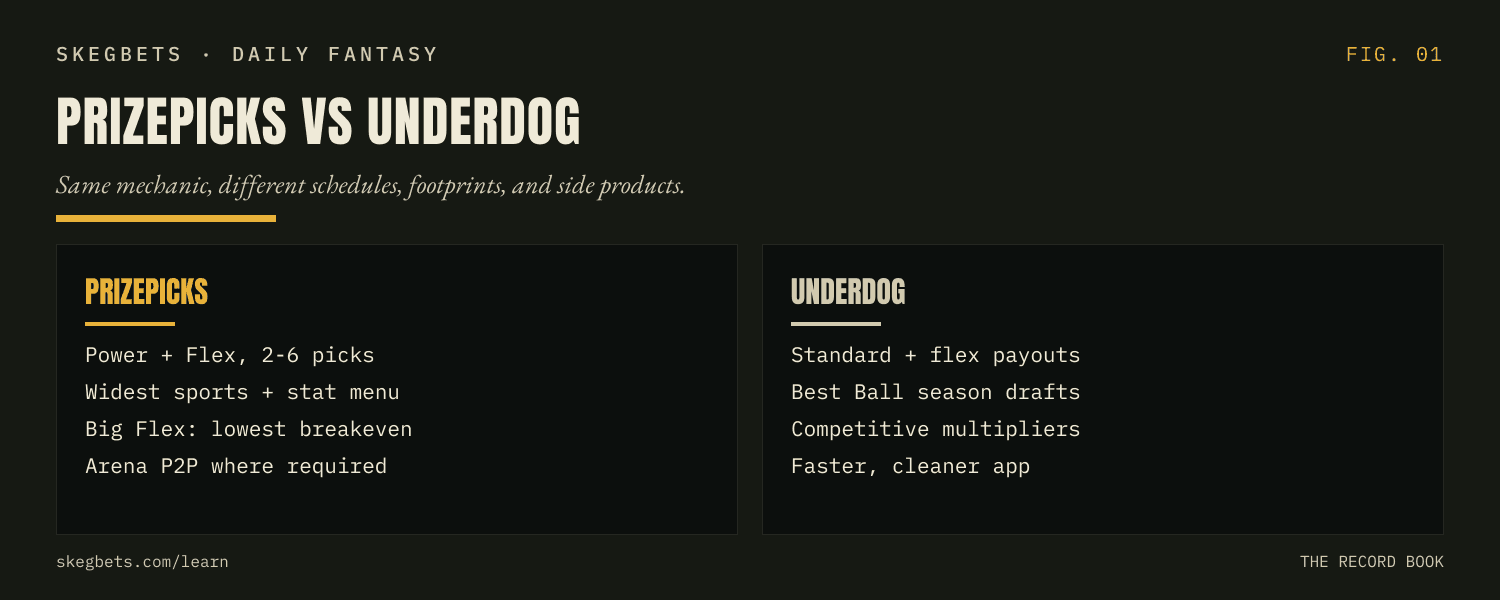
Same product, different schedules
Strip the branding and both apps sell the same thing described in our daily fantasy explainer: a menu of player stat projections, an entry slip of two to six calls, and a multiplier that pays when enough calls hit. Both are DFS operators legally, not sportsbooks, which is why they reach 30-plus states, including Texas and California, which the online books cannot touch at all.
Because the mechanic is identical, the comparison reduces to four practical questions: how each schedule pays, what else each app offers, how each treats winning players, and where each operates.
At a glance
| Dimension | PrizePicks | Underdog |
|---|---|---|
| Core formats | Power (all-or-nothing), Flex (consolation tiers) | Standard entries plus flex-style payouts |
| Entry sizes | 2 to 6 picks | 2 to 5 picks on most slates |
| Best-priced entry | 5- and 6-pick Flex (~54.2-54.3% breakeven) | Varies; several sizes competitive |
| Beyond pick'em | Arena (peer-to-peer), Predict markets | Best Ball drafts, season-long fantasy |
| Sports breadth | Widest, incl. niche categories | Major sports, deep on NFL drafts |
| Scale | Largest pick'em user base | Second, growing fast |
Payouts: where the money differs
A headline multiplier tells you less than the hit rate it implies. The honest comparison converts every schedule into the per-leg rate it demands, and the arithmetic for doing that lives in pick'em payout math. On the current PrizePicks schedule the answers range from 54.2 percent per leg on the 6-pick Flex to 57.7 on the 2-pick Power and 3-pick Flex, with everything else clustered between 54.7 and 56.2.
Underdog's schedules move on a similar band but not in lockstep, and both operators adjust payouts over time, occasionally by sport or by promotional period. The durable advice is a habit, not a table: before any entry, invert the multiplier, and when the two apps offer different structures for the same size, give the entry to whichever demands the lower rate. Over hundreds of entries those single points of breakeven compound into the difference between a winning and a losing year.
Beyond pick'em: the other formats
Underdog's clearest differentiator is not in pick'em at all. Its Best Ball product, draft a roster once, no weekly management, scores seasons rather than slates, and it owns that niche the way PrizePicks owns quick entries. If your fantasy habit spans both time horizons, Underdog consolidates them in one app.
PrizePicks has pushed in the other direction: regulatory pressure in several states produced Arena, a peer-to-peer version of pick'em where entries pool against other players instead of the house, and a prediction-markets product in the mold of the venues covered in our prediction markets explainer. In states like California those variants are the only way either operator can offer the product at all, a story told state by state in where daily fantasy is legal.
Lines, limits, and sharp treatment
Both apps post their own projections, and both move them when money or news arrives, just slower than sportsbook consensus moves. That lag is the format's main exploitable seam, and it cuts both ways across the two apps: on any given slate a few players are priced a half point apart between PrizePicks and Underdog. Checking an app line against the sportsbook market for the same stat, the workflow in pick'em vs sportsbook props, works identically on either platform.
On limits, neither operator bans winners the way sportsbooks do, but both manage exposure: stake caps on specific lines, reduced maximums for accounts that consistently beat closing numbers, and occasional removal of a line that attracted one-sided sharp action. Expect the friction to scale with your success on either app.
Which app to open first
Open PrizePicks first if you want maximum surface area: the most sports, the most stat types, the most states, and the single best-priced entry in the format. Open Underdog first if Best Ball is part of your season or its current payout schedule prices your preferred entry size better. Keep both if you are treating pick'em as an investment rather than entertainment, because the app-to-app line differences are an edge available to anyone who compares.
Whichever you choose, fund it like a bankroll and not like a wallet, sized by the principles in bankroll management, and hold every entry to the breakeven bar its multiplier implies. The discipline is the same on either app.
Frequently asked questions
Is PrizePicks or Underdog better?+
Neither dominates. PrizePicks has the larger player base, the broadest sport and stat coverage, and a Flex schedule whose 5- and 6-pick entries are the cheapest common entries in the format. Underdog counters with payouts that are stronger on some entry sizes, a cleaner app, and season-long products like Best Ball that PrizePicks lacks. Serious players keep both installed and route each entry to whichever app prices it better.
Do PrizePicks and Underdog post the same lines?+
Often close but not identical. Both set projections off the same underlying markets, but they move at different speeds and disagree on specific players most slates. Those half-point and full-point gaps are the main reason to hold both accounts: the same opinion can clear the breakeven bar on one app and miss it on the other.
Which app pays out more?+
It depends on the entry size and how many legs hit. The way to compare is the breakeven per-leg hit rate implied by each multiplier schedule rather than the headline multiplier. A 5-pick PrizePicks Flex breaks even around 54.3 percent per leg and the 6-pick a shade lower, while the smallest entries on the same schedule demand 57.7 percent.
Are PrizePicks and Underdog legal in my state?+
Both operate in most US states, including Texas and California, where online sportsbooks are not legal, and Florida, where the sportsbook market is limited to a single operator. A handful of states prohibit house-banked pick'em specifically, and in California both apps run peer-to-peer variants instead. Availability changes as regulators act, so check the operator's own state list before depositing.
Can you use both apps at once?+
Yes, and it is the closest thing pick'em has to line shopping. Holding accounts on both lets you take the better line when the apps disagree and the better multiplier schedule for the entry size you want. The same discipline sportsbook bettors apply across books applies across pick'em apps.
Free tools